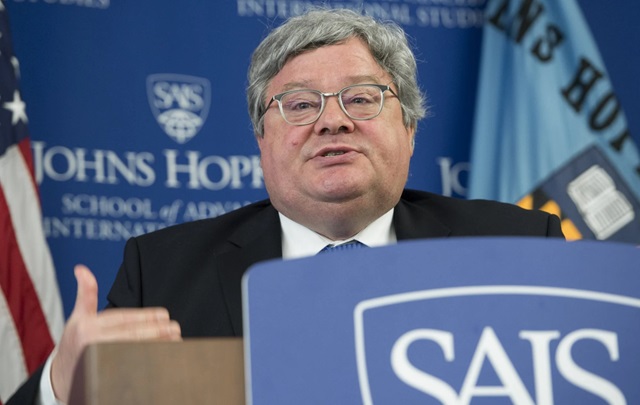
China has officially lifted sanctions on former European Parliament member Reinhard Buetikofer, a move that could help restore long-frozen relations between the European Parliament and China’s National People’s Congress (NPC), according to a report from the South China Morning Post.
Buetikofer, a prominent critic of Beijing and former chair of the European Parliament’s China delegation, had been sanctioned by China in 2021 along with other EU lawmakers and institutions. At the time, the sanctions were a retaliatory measure following EU sanctions on Chinese officials over alleged human rights violations in Xinjiang—allegations China has consistently denied.
The South China Morning Post reports that Beijing’s decision to remove what it termed “restrictions” on Buetikofer was conveyed in a letter to European Parliament President Roberta Metsola, dated July 4. The letter, reviewed by SCMP, was sent by China’s mission to the EU and confirmed that the lifting of sanctions now includes both sitting and former lawmakers—of which Buetikofer was the only one.
The development is expected to pave the way for the first official meeting between the European Parliament and China’s legislature since 2018, with a session tentatively scheduled for October in Brussels. According to sources familiar with the planning, this would involve a formal exchange between the NPC and the European Parliament’s China delegation.
The letter also mentioned a “preliminary consensus” to resume regular political meetings between the two legislatures, an effort driven by both diplomatic calculation and recent high-level engagements. Notably, the sanctions lift comes just ahead of an EU-China summit in Beijing on July 24, where European leaders are scheduled to meet Chinese President Xi Jinping and Premier Li Qiang.
The sanctions issue has been a major sticking point for the European Parliament. Delegation chair Engin Eroglu confirmed a recent meeting with NPC vice-chairman Fu Ziying and described the lifting of sanctions as “a step toward resuming regular EP-NPC meetings.”
“I am pleased that the Chinese side was able to correct mistakes and look forward to an open, honest, and results-oriented exchange with our Chinese counterparts,” Eroglu said.
However, while Buetikofer’s restrictions have been lifted, many others remain in place. Chinese sanctions still target researchers from the Mercator Institute for China Studies, German scholar Adrian Zenz, Swedish researcher Björn Jerdén, and the Denmark-based Alliance of Democracies Foundation. Several European national lawmakers, along with the EU’s Political and Security Committee, are also still sanctioned by Beijing.
China has extended another invitation for President Metsola to visit Beijing, this time through NPC Standing Committee Chair Zhao Leiji. However, according to SCMP, Metsola—who has taken a firm stance on human rights issues—currently has no plans to accept the offer.
Meanwhile, EU sanctions imposed in 2021 on Chinese officials and one entity over alleged abuses in Xinjiang remain firmly in place. “The EU has not observed changes in the human rights situation in China/Xinjiang. Therefore, the Council maintains the China/Xinjiang-related designations,” said EU foreign affairs spokesperson Anitta Hipper in April.
The looming EU-China leaders’ summit is unlikely to produce breakthroughs, European officials suggest. Brussels remains vocal in its criticism of China’s economic policies, particularly its subsidized industrial overcapacity, which European manufacturers argue distorts fair competition. The EU also continues to pressure China over its position on Russia’s war in Ukraine, accusing Beijing of tacitly aiding Moscow—an allegation Beijing denies, claiming neutrality.
Beijing, for its part, insists that surging Chinese exports to Europe and declining imports from the EU are due to market dynamics rather than deliberate policy manipulation.