


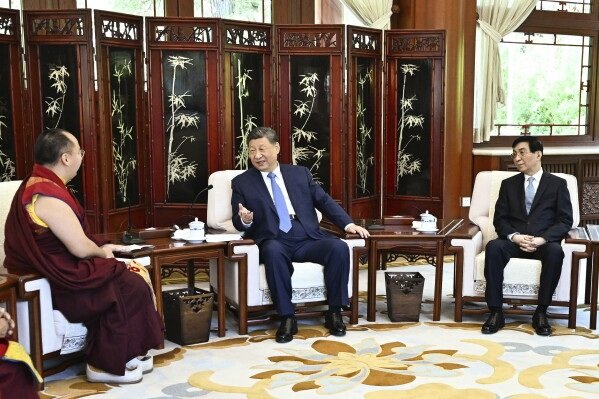
The Chinese government-installed “11th Panchen Lama”, Gyaltsen Norbu, met Tibet Autonomous Region (TAR) Party Secretary Wang Junzheng on August 3, with the meeting focusing on political loyalty, national unity, religious policy and the integration of Tibetan Buddhism with China’s socialist system.
Wang, representing the Party Committee of the TAR, welcomed Gyaltsen Norbu for official duties, inspection and religious activities and wished him a happy birthday and good health, according to China’s online Tibet news service eng.tibet.cn, which reported on the meeting on August 6.
During the meeting, Wang referred to a June 2025 meeting between Gyaltsen Norbu and Chinese Communist Party General Secretary Xi Jinping. Wang said Xi had encouraged him to become a learned and respected Tibetan Buddhist incarnation, like the 10th Panchen Lama, and to make greater contributions to national unity, religious harmony, stability and development in Tibet.
Wang praised Gyaltsen Norbu for remembering Xi’s instructions and for promoting what was described as the Party’s new-era Tibet work policy over the preceding year. He also credited him with supporting the Chinese Buddhist Association’s efforts to promote the Sinicization and healthy development of Tibetan Buddhism, while uniting religious figures and presenting what officials described as a positive image of a Tibetan Buddhist incarnation.
The meeting placed particular emphasis on political education. Wang urged Gyaltsen Norbu, in his capacity as the “11th Panchen Lama”, to thoroughly understand and implement Xi’s instructions, fulfil his duties conscientiously and make every effort to become what he described as a great person.
Wang also called for stronger political awareness and leadership among monks, nuns and religious believers. He urged them to understand the significance of the “Two Determinations” and to study the Communist Party’s innovative theoretical system. The term refers to the political formulation establishing Xi as China’s “core” leader and his ideas as the foundation of the country’s official doctrine.
The TAR Party secretary further called on Gyaltsen Norbu to promote national and ethnic unity and continue what he described as the patriotic, religious and nation-serving tradition of successive Panchen Lamas. He urged deeper commitment to the Party, the country and socialism, together with greater emphasis on ethnic unity and education concerning laws relating to its promotion.
Wang said the objective was to guide monks, nuns and religious believers to establish awareness of a united Chinese nation and deepen their commitment to the “Five Loves”, an ideological and moral slogan promoted by the Communist Party during the Maoist era.
Religious policy was another central theme of the meeting. Wang instructed Gyaltsen Norbu to uphold the direction of the Sinicization of religion in China and implement the Party’s basic policy on religious affairs. He also called for the interpretation of Tibetan Buddhist teachings and discipline through reasoning, as well as wider publicity concerning laws and regulations including the Regulations on Religious Affairs in the Tibet Autonomous Region.
Gyaltsen Norbu was also asked to connect Tibetan Buddhism with what Chinese officials described as the country’s future, the fate of the nation and the aspirations of its people. Wang called on him to encourage monks, nuns and believers to participate in the construction of a new socialist modern Tibet and adhere to the “Four Standards”, which require religious figures to demonstrate proficiency in Buddhist teachings, political reliability, willingness to serve the public and dependability during critical moments.
For his part, Gyaltsen Norbu praised what he described as the tremendous changes in Tibet. He said he had kept Xi’s instructions in mind and had worked to improve his political quality and understanding of the Party’s ethnic and religious theories and policies.
He pledged to deepen his Buddhist practice and improve the academic level of Buddhism through preaching, teaching and interpretation. He also said he would help Tibetans recognise what he described as the care and love of the Party and government, unite religious figures with the Party and government, and contribute to building a new modern socialist Tibet.
Gyaltsen Norbu further pledged to guide monks and believers in protecting national unity, ethnic unity and religious harmony while contributing to what officials described as the long-term stability and high-quality development of Tibet.
The meeting took place shortly after Gyaltsen Norbu arrived in Lhasa on July 30 to begin official duties. According to the supplied account, he lives in Beijing under the supervision of the United Front Work Department of the Communist Party and tours Tibet for around six months each year. His activities currently focus on promoting the assimilation of Tibet and the Sinicization of Tibetan Buddhism.
The political significance of the meeting is heightened by the contested status of Gyaltsen Norbu as the “11th Panchen Lama”. Nevertheless, the official account of his meeting with Wang makes clear the role Beijing expects him to play: promoting national unity, supporting the Party’s religious policies and helping align Tibetan Buddhism with the political and social objectives of the Chinese state.










