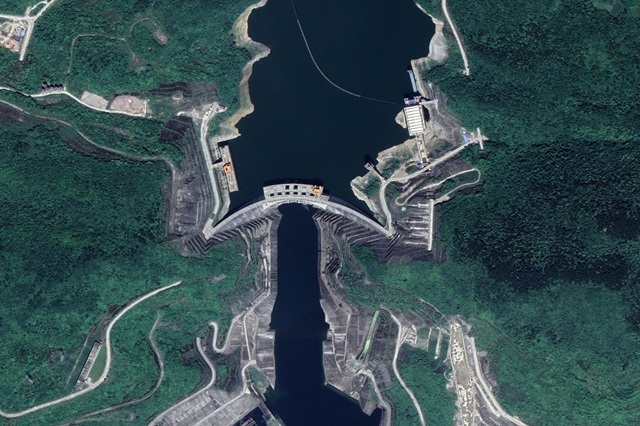
China’s Xiluodu Dam, one of the world’s largest hydropower stations, has completed a full transition from Western-made industrial control chips to domestically developed systems, in a move aimed at bolstering national security and supply chain resilience.
The replacement was announced by Loongson Technology, a leading Chinese chipmaker, which confirmed that the facility has phased out German Siemens and French Schneider Electric programmable logic controllers (PLCs) in favor of a home-grown system powered by Loongson’s latest 3C6000 processors.
Located on the Jinsha River at the border of Yunnan and Sichuan provinces, Xiluodu is China’s third-largest hydropower project—after the Three Gorges and Baihetan dams—and the fourth-largest globally. It boasts a total installed capacity of 13.86 gigawatts, with nine 770-megawatt turbine generators on each bank.
The new control system, the NJ400 series PLC developed by Atekon Technology, was officially deployed on August 4. Atekon, founded in 2008, specializes in industrial remote control systems and has been increasingly involved in replacing foreign equipment in critical Chinese infrastructure.
Loongson stated that the move “marks the complete localisation of the core control equipment of the tubular valve control system,” providing a solid technological foundation for long-term safe and stable operations.
The transition comes amid heightened awareness of cybersecurity threats to industrial control systems. Attacks such as the Stuxnet worm, which allegedly sabotaged Iran’s nuclear facilities via Siemens PLCs in 2010, have fueled concerns about foreign-sourced components in strategic sectors.
PLCs are vital to industrial control systems across China’s economy, including in energy, petrochemicals, rail, shipping, and metallurgy. Yet the domestic market for medium to large PLCs has long been dominated by international players—Siemens held over 50% market share in 2023, compared to under 6% for local manufacturers, according to MIR Databank.
Loongson, spun off from the Chinese Academy of Sciences in 2011, has been central to Beijing’s push to reduce dependence on foreign technology. Its latest 3C6000 processor, built entirely on the in-house LoongArch instruction set, removes the need for overseas technology licenses. The company has been on the U.S. Commerce Department’s trade blacklist since March 2023, restricting its access to American technology.
According to Loongson, similar domestic PLC replacements have been deployed at the Three Gorges and Xiangjiaba dams. Atekon has also expanded its reach into high-speed rail, coal mining, thermal power, and petrochemical industries—becoming a Class A supplier to Japan’s Toshiba Power for Southeast Asian projects.