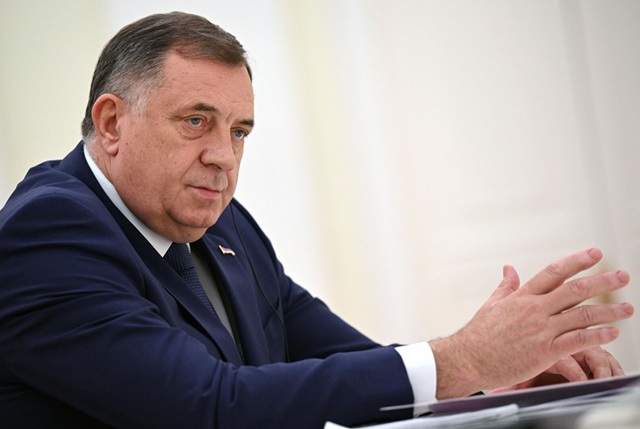
The Court of Bosnia and Herzegovina has sentenced Republika Srpska President Milorad Dodik in absentia to one year in prison and imposed a six-year ban on holding the presidential office. This first-instance verdict can still be appealed by Dodik, who has dismissed the trial as a politically motivated move orchestrated by international actors.
Dodik was convicted for enacting laws that contravened decisions made by High Representative Christian Schmidt, the international envoy overseeing the Dayton Peace Accords. He challenged Schmidt’s authority, declaring his decisions illegal within Republika Srpska and rejecting the 2023 amendment to the Bosnian criminal code that criminalized non-compliance with the High Representative’s mandates. Furthermore, Dodik argued that Schmidt’s appointment lacked legitimacy, as it was not validated by a UN Security Council resolution—a position backed by Russia and China.
In response to the ruling, Dodik described the trial as a “purely political process” and likened his situation to that of former U.S. President Donald Trump, suggesting that both were victims of a “pressure matrix” targeting leaders who oppose globalist agendas. He warned that the Republika Srpska parliament might consider secession from Bosnia and Herzegovina, potentially holding a referendum on independence.
Dodik has received regional support, with Serbian President Aleksandar Vucić expressing hope for his acquittal and reaffirming Serbia’s unwavering backing. Hungarian Prime Minister Viktor Orbán also defended Dodik, stating that Hungary has consistently advocated for stability in the Balkans, which he credited Dodik with maintaining in recent years.
The case has reignited political tensions in Bosnia and Herzegovina, with the verdict likely to deepen divisions between Republika Srpska and the central government in Sarajevo. As Dodik prepares his appeal, the decision could have significant ramifications for the future of the region and its geopolitical alignments.