Nearly four decades ago, the funeral of Iran’s revolutionary founder descended into scenes so chaotic that even seasoned observers struggled to comprehend them. Now, as Iran prepares to bury its second supreme leader amid war and political uncertainty, those memories have returned with renewed urgency. The killing of Ayatollah Ali Khamenei in Israeli-American airstrikes has left the Islamic Republic grappling with how to stage a state funeral while missiles streak across the skies above Tehran and the question of succession remains dangerously unresolved.
The last time Iran buried a supreme leader, the spectacle stunned the world. On June 6, 1989, millions flooded Tehran for the funeral of Ayatollah Ruhollah Khomeini, the architect of the 1979 Islamic Revolution. What was meant to be a solemn farewell quickly spiraled into chaos as grief and devotion erupted into uncontrollable frenzy.
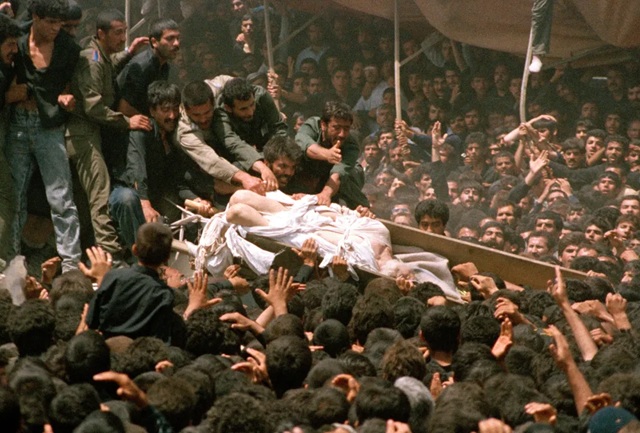
As Khomeini’s coffin was lifted from a helicopter to begin the burial rites, the enormous crowd surged forward. Pallbearers from the Revolutionary Guard struggled to maintain order as mourners overwhelmed them, wrenching the flimsy coffin from their grasp. The coffin was carried into the sea of people, hoisted above heads as desperate followers tried to touch the body of the man they regarded as both political leader and spiritual guide.
Among the few witnesses to capture the moment was French photojournalist Eric Bouvet, who at the time was the only foreign photographer at the cemetery. Recalling the moment years later, he described a scene of mass hysteria. The coffin slipped from the crowd’s grip and fell, exposing Khomeini’s body wrapped in a white shroud. Devotees lunged toward it, tearing pieces of the cloth away as sacred relics.
Security forces fired shots and blasted water cannons in an attempt to restore control. Khomeini’s son, Ahmad, reportedly collapsed in horror as guards fought to retrieve the coffin and return it to the helicopter. Some mourners clung to the aircraft’s landing skids as it lifted off again. Others ran to the grave that had been prepared for the ayatollah and leapt inside it, declaring they wished to be buried alongside him.
The images shocked international audiences. A correspondent writing at the time described an emotional outpouring that many in the West found bewildering and frightening. Yet for millions of Iranians, it was an expression of devotion to a figure they believed had transformed their country and defied global powers.
Much has changed since that extraordinary day. The Iran that now prepares to bury Khomeini’s successor is a country deeply divided and under intense military pressure. The death of Ayatollah Ali Khamenei, reportedly killed during Israeli-American airstrikes targeting strategic sites, triggered both mourning and celebration across the country.
State supporters have poured into the streets to grieve the man who ruled Iran for more than three decades. But many others, particularly those scarred by the government’s violent crackdown on anti-regime protests earlier this year, have quietly celebrated the end of his rule. The conflicting reactions illustrate a nation whose relationship with its leadership has grown far more complicated than it was in 1989.
The war raging across Iran has further complicated the plans for Khamenei’s funeral. The government initially scheduled a three-stage state ceremony, but relentless aerial bombardment forced officials to delay the event and rethink the logistics of gathering massive crowds in a capital under threat.
Authorities now plan to place Khamenei’s body on public display for three days at Tehran’s Mosalla prayer complex, echoing the arrangements made for Khomeini’s funeral. State television recently showed workers constructing a vast platform and a glass display case intended to hold the coffin while mourners file past.
Even these preparations carry significant risk. Tehran has endured one of the heaviest aerial bombardments in modern military history, raising fears that large public gatherings could become targets or descend into panic if air raid sirens sound. Security officials are also concerned about the danger of assassination attempts against any figure named as Khamenei’s successor.
That successor remains unknown. Unlike in 1989, when Khamenei himself quickly emerged as the new supreme leader following Khomeini’s death, Iran’s ruling establishment has so far avoided announcing a replacement. Analysts say the delay reflects both internal power struggles and fears that a newly named leader could immediately become a target.
The uncertainty surrounding the funeral has revived memories of Bouvet’s dramatic experience at Khomeini’s burial. On that blisteringly hot day in 1989, he recalled standing among more than a million people packed into the cemetery. Many wore black shirts in mourning, fainting in the heat as the crowd swelled through the night.
When plans to drive Khomeini’s body through the packed streets were abandoned, officials summoned a helicopter instead. Bouvet and other foreign journalists rushed toward the cemetery to capture the moment. By chance, he arrived just as the aircraft landed and found himself alone among the throng.
When the coffin fell and the crowd surged, Bouvet managed to take a single photograph before the mob turned on him. He was beaten and knocked to the ground, convinced he would not survive. Revolutionary Guards eventually forced their way through and pulled him to safety, escorting him away as he clutched his camera.
Authorities quickly cut the live television feed and launched sweeps to confiscate or destroy photographs that captured the chaos. Bouvet hid his film in his underwear before racing to the airport, determined to smuggle the images out of the country.
Some of the photographs did make it to international newsrooms. One striking image distributed by the Associated Press showed the pale body of Khomeini surrounded by black-clad mourners, resembling a Renaissance pietà. The picture appeared on front pages around the world, though the identity of the Iranian photographer who captured it has never been revealed.
Bouvet’s own photographs eventually appeared in international publications, including The Sunday Times magazine. The story of that day has since become a defining memory of Iran’s revolutionary era.
Today, as the country prepares for another funeral under dramatically different circumstances, the contrast is stark. Khomeini died of natural causes after the devastating Iran-Iraq war. Khamenei, by contrast, was killed in the midst of a regional conflict and leaves behind a political system facing perhaps its most uncertain moment since the revolution.
The Times UK has reported that Iranian authorities are still weighing how to stage a funeral that balances security concerns, wartime realities, and the regime’s desire to project unity and strength. Whether the ceremony will echo the overwhelming crowds of 1989—or unfold under the shadow of sirens and airstrikes—remains unclear.
What is certain is that Iran is preparing to bury not just a leader, but the end of an era.