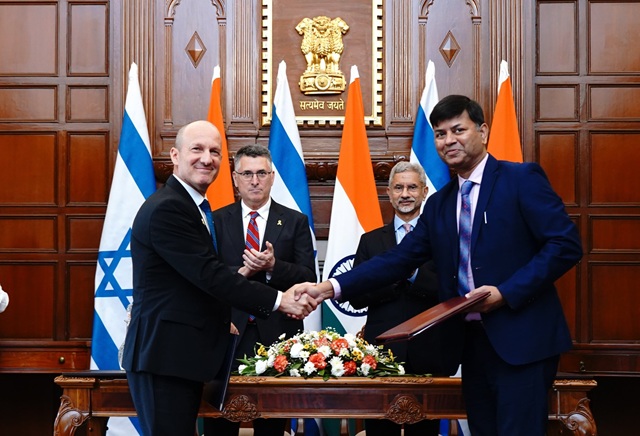
India and Israel have signed a sweeping defense cooperation agreement aimed at strengthening their long-standing military and technological ties, India’s Defense Ministry announced on Tuesday. The agreement was finalized in Tel Aviv during a joint working group meeting co-chaired by Indian Defense Secretary Rajesh Kumar Singh and Israeli Defense Ministry Director General Maj. Gen. (Res) Amir Baram.
According to the ministry, the pact will enable the sharing of advanced defense technologies and promote joint research, co-development, and co-production of military systems. While the official statement did not disclose the value or nature of specific deals, Israeli media reports indicate that the agreement includes several major acquisitions by New Delhi. The Jerusalem Post reported that India is set to purchase rockets for its ground forces and medium-range surface-to-air missile systems developed by Israel Aerospace Industries (IAI), worth approximately $3.75 billion. Additionally, IAI will reportedly convert six commercial aircraft into aerial refueling planes for the Indian Air Force under a $900 million contract.
The signing coincided with the visit of Israeli Foreign Minister Gideon Sa’ar to New Delhi, where he met with Indian External Affairs Minister S. Jaishankar. Sa’ar described India as a “global superpower” and said that relations between the two countries had reached an unprecedented level, driven by shared interests in security and technology.
Jaishankar echoed these sentiments, emphasizing the trust and reliability that define the partnership. “India and Israel have a strategic partnership, and particularly in our case, that term has a real meaning. We have stood together in testing times and created a relationship built on mutual confidence,” he said.
Israel has long been among India’s top arms suppliers, with both nations collaborating on the development of advanced weapons systems such as the Barak-8 air and missile defense system. According to 2025 data from the Stockholm International Peace Research Institute (SIPRI), India accounted for 34% of Israel’s total arms exports—valued at around $2.9 billion—including radars, drones, and missile systems. Despite this growing defense relationship, Russia remains India’s largest overall supplier, providing 36% of its total arms imports.
In addition to defense issues, the talks also touched on regional stability. Jaishankar reiterated India’s support for a peace plan proposed by U.S. President Donald Trump in Sharm el-Sheikh last month, expressing hope that it could pave the way for a lasting resolution to the Gaza conflict.
The new agreement underscores the deepening convergence between India and Israel on defense, innovation, and geopolitical strategy, marking another milestone in a partnership that continues to expand beyond traditional military cooperation.