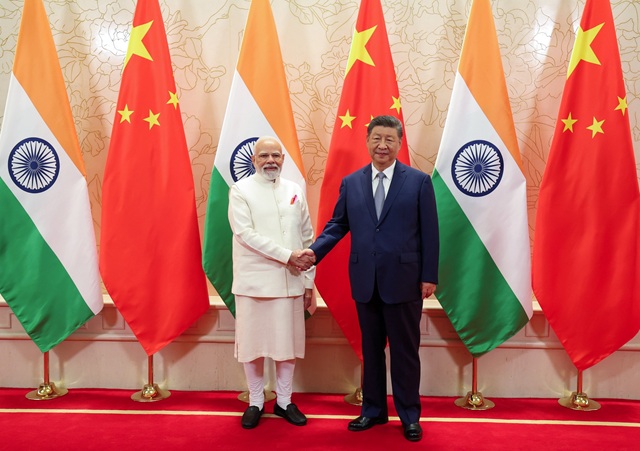
Many opinion makers argue that in international relations, there are no permanent enemies and no permanent friends. In support of this view, they point to the current strain in India–US relations, while only a few years ago Prime Minister Modi and US President Trump embraced each other warmly in friendship. Similarly, in the case of the present bonhomie between India and China, during a meeting before the SCO event, Prime Minister Modi and President Xi Jinping stressed that both countries should work together for mutual benefit, whereas in the past there were bitter conflicts in which soldiers on both sides lost their lives.
However, contrary to the view of such opinion makers, the fact remains that a prerequisite for lasting friendship between two countries is the absence of a conflict of interest. Even if there are occasional setbacks, they can usually be resolved quickly provided no such fundamental conflict exists.
India–US Relations
In the case of India–US relations, the present friction is bound to be short-lived, as there is no real conflict of interest between the two countries.
Both nations are committed to democracy and to respect for personal freedom and liberty. Millions of Indians admire the United States for its prosperity, technological strength, individual freedoms, and above all, the willingness of native Americans to welcome people from across the world, enabling them to live in the US as permanent residents or citizens after meeting certain conditions.
In turn, well-informed Americans appreciate India’s culture, traditions, and philosophical outlook, which have evolved over centuries.
The present discord has arisen largely due to the whimsical decision of President Trump to impose heavy and unacceptable tariffs on Indian exports to the US. The reasoning behind this decision is unclear, and political observers, legislators, and informed citizens in the United States have questioned and criticised this tariff assault, calling it short-sighted.
Many believe this tension will dissipate sooner rather than later, as there is no fundamental conflict of interest between the two countries. Recognising this, Prime Minister Modi and his government have wisely avoided overreacting to hostile statements from the White House, choosing instead to ignore them.
India–China Relations
While Prime Minister Modi and President Xi lauded each other during Modi’s visit to China, the reality is that there are deep conflicts of interest between the two countries.
China continues to occupy thousands of kilometres of Indian territory seized during the 1962 war, and still claims that Arunachal Pradesh should be part of China. In addition, Beijing’s proposal to construct a massive dam in Tibet, potentially blocking water flow into India, is viewed with extreme suspicion in New Delhi.
Furthermore, millions of Indians sympathise with the plight of Tibetans, as China has forcefully occupied Tibet, driven thousands into exile, and caused many deaths through its aggression. His Holiness the Dalai Lama, now living in India, commands deep respect among Indians, while Beijing spares no effort in vilifying him. Many Indians believe their government should press China to restore Tibet’s liberty.
Indians still recall the misplaced trust reposed in China by Jawaharlal Nehru, independent India’s first Prime Minister, and how that trust was betrayed when China launched the 1962 war.
It is well known that China harbours vast territorial ambitions and seeks to emerge as the dominant global superpower. In pursuit of this, it strives for supremacy in Asia, viewing India as a stumbling block. In recent years, Beijing has frequently criticised India in global forums.
This underlying lack of trust towards China is deeply felt among Indians and cannot be ignored.
Many in India are now urging Prime Minister Modi to be extremely cautious in dealing with China, given the chequered history of bilateral relations. They believe that China’s current cordiality may not last, and that hostility could resurface, with Beijing continuing to press its claims over Arunachal Pradesh and other areas. Meanwhile, India’s relationship with the US is expected to return to normal as China recalibrates its diplomatic strategy.
Preconditions for Relationships
Historical experience repeatedly shows that the fundamental precondition for smooth relations between nations is the absence of conflicting interests. This remains the essential guiding factor for fostering stable and lasting international partnerships.