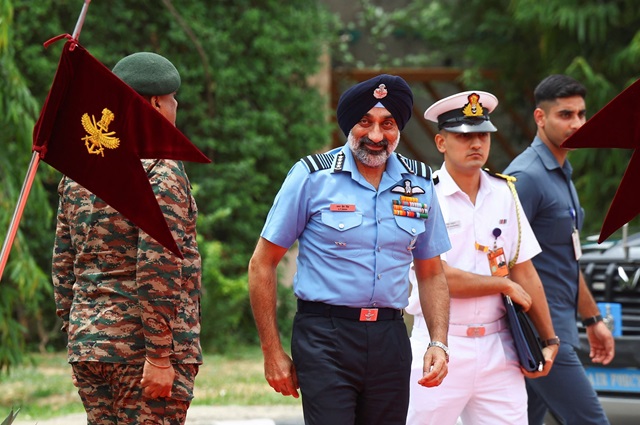
India’s Chief of Air Staff A.P. Singh has urged caution over Prime Minister Narendra Modi’s ambitious plan to restructure the armed forces into theater commands, warning that such a drastic overhaul may not be the best approach at this stage.
Speaking Tuesday at a seminar on new technologies and warfare in Mhow, Madhya Pradesh, Singh expressed skepticism about adopting theater command structures modeled on other nations. “We don’t really actually need another structure at the lower level,” he said, stressing that India should not “pick up theater commands from any other country.”
The proposed reorganization—described as the largest military overhaul in seven decades—would combine warships, patrol craft, soldiers, and fighter jets under unified theater commands. According to earlier reporting by Bloomberg News, at least four commands are envisioned: one focused on Pakistan, another on China, a maritime command for the Indian Ocean, and an air defense command.
Currently, the Army, Navy, and Air Force largely operate independently in planning, training, and procurement. Singh suggested that rather than restructuring at multiple levels, India should strengthen joint planning and coordination at the apex level. “Disrupting everything and making one structure now at this time may not be the best way forward,” he said.
Officials have indicated that the sensitive northern regions of Jammu and Kashmir, long prone to unrest, would remain outside the scope of the proposed reforms for now. The broader aim is to enable seamless operations across land, sea, and air to counter threats from both China and Pakistan.
India has debated military transformation since the 1990s, and countries like the US, China, and Australia have already adopted versions of theater command structures. But Singh cautioned that India must chart its own course: “Every country has its own requirements. We need to evaluate our needs, otherwise we will go wrong.”