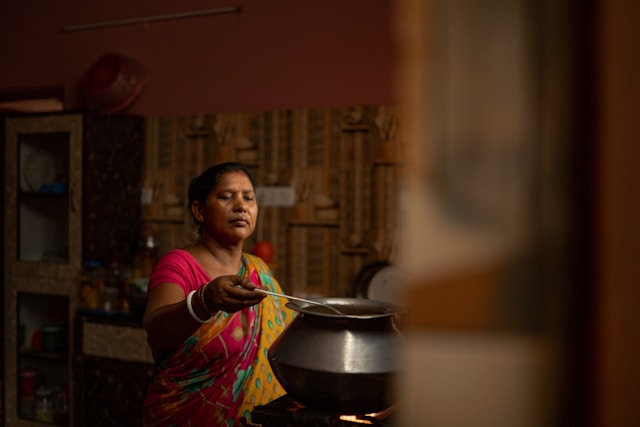
In India’s rapidly growing economy, where convenience and instant service have become the norm, a new innovation is making waves: the “Insta Maid” service, offered by Mumbai-based company Urban Company. Similar to the “quick commerce” model that promises groceries delivered to your door within minutes, Insta Maids promises an all-in-one help at your doorstep in just 15 minutes. For a low fee of 59 rupees (approximately 50 pence) per hour, users can hire a maid to change the sheets, clean the house, or even cook lunch—services that are often the cornerstone of daily life in many Indian households.
The concept of on-demand domestic help comes at a time when an increasing number of Indians—particularly in affluent households—rely on maids, whether part-time or live-in, to manage household chores. It’s a dependence deeply embedded in the fabric of society, as many upper-class families rely on a full staff of helpers ranging from cleaners and cooks to drivers and nannies to maintain their lifestyle.
For many, the instant availability of domestic help is seen as a solution to a common household dilemma: when the regular maid is absent due to illness, leave, or other reasons, the household almost grinds to a halt. Akansha Basra from Delhi, who is eagerly awaiting the service’s arrival in the capital, sees no issue with the concept. “If we can hire drivers and plumbers, why is a maid any different?” she says. “It’s a service like any other. If my regular maid doesn’t show up, I would be happy to call an Insta Maid for basic chores like watering the plants or ironing clothes.”
However, while many consumers are excited about the convenience of on-demand domestic workers, the service has provoked mixed reactions. The very use of the word “maid” has sparked anger among some, with critics arguing that it perpetuates outdated hierarchies and stigmatizes domestic workers. The term “servant,” which is still used by some, adds to the controversy surrounding the social implications of hiring help in modern India. For others, the term “maid” is considered more respectful than “servant,” and they argue that the service simply caters to a practical need, much like other on-demand services available in the country.
Despite the mixed reactions, the service is likely to be successful due to India’s deep-rooted dependence on domestic workers. The rich and upper middle class, in particular, are often more reliant on large staffs to manage their daily lives, creating a strong market for services like Insta Maid. However, there are concerns about the wages and working conditions of these temporary workers. Ramendra Kumar, head of the Delhi Domestic Workers’ Union Shramik Sangathan, has raised alarms over the low pay of 59 rupees per hour, which he considers far below what domestic workers deserve. His union demands wages closer to 100 rupees per hour.
While Urban Company has assured that their maids are provided with health insurance and a guaranteed income of 20,000 rupees a month for 132 hours of work, critics argue that the pay is still insufficient. Kumar acknowledges that some domestic workers may appreciate the flexibility that comes with short-term work, but insists that fair compensation is essential. “Some domestic workers may prefer this kind of work because it allows them more freedom compared to full-time roles. But they need to be paid better,” he states.
As India’s economy grows and its dependence on on-demand services increases, the Insta Maid service highlights a broader societal issue: the treatment and fair compensation of domestic workers, who remain an integral part of many Indian homes. While the service may offer convenience to affluent households, it also raises important questions about labor rights and the need for fair wages in a rapidly modernizing economy.