Editor’s Note: The following article is based on excerpts adapted from the 196-page testimony given by Abdul Cader Fathima Hadiya, the widow of National Thowheed Jama’ath (NTJ) leader and mastermind Mohamed Hashim Zahran, before the Presidential Commission of Inquiry (PCoI) investigating the 2019 Easter Sunday attacks in October 2020.
by Our Correspondent in Colombo
The first confirmation came not in a courtroom but inside the Judicial Medical Officer’s office, where Abdul Cader Fathima Hadiya said she identified the remains of her husband, Mohamed Hashim Zahran, following the Shangri-La Hotel suicide bombing on Easter Sunday in 2019.
“It was confirmed that his body, including his head, was found at the site,” she testified before the Presidential Commission of Inquiry investigating the coordinated attacks that killed hundreds and reshaped Sri Lanka’s security landscape.
Her testimony, spanning 196 pages, provides a detailed personal account of life alongside the man identified as the leader of the National Thowheed Jama’ath and the mastermind behind the Easter Sunday bombings. Beginning with their marriage in 2009 and ending with her survival of the explosion at the Saindamarudu safe house days after the attacks, the statement offers a chronology of family life, ideological change, clandestine movements, communications with associates and the development of a network that investigators later linked to one of the deadliest terrorist attacks in Sri Lanka’s history.
Hadiya described growing up in Kekunagolla in Kurunegala District before marrying Zahran in Kaththankudi on October 16, 2009. She said Zahran was already a qualified Maulavi who conducted religious lectures and earned his income through mosque activities. According to her testimony, the couple initially lived with his family before moving between rented homes in Kaththankudi and Ganethenna in Mawanalla as his religious activities expanded.
She recalled that supporters from several parts of the country contributed funds to acquire land and build a mosque associated with the movement. Financial assistance also arrived from overseas, including donations from individuals in Singapore, which she said were used to develop mosque infrastructure. She testified that Zahran taught subjects including Sharia law and Aqeeda while gradually attracting followers from multiple districts.
The testimony portrays what appeared to be an outwardly ordinary family life during the early years of their marriage. The couple had two children, and Hadiya described Zahran supplementing his income by driving a three-wheeler to transport schoolchildren while also purchasing land in Kaththankudi. She said he financially supported his parents and remained active in religious work.
According to Hadiya, a significant turning point emerged in 2016 after Zahran reconciled with her relative Naufer Maulavi following years of estrangement. She testified that Naufer later handed Zahran a pen drive containing violent videos.
“I saw him watching the videos from the pen drive on his laptop. These were extremely violent videos,” she told the Commission. Concerned that their young son might see the material, she questioned him about it. “He then took the laptop to the Mosque and assured me he wouldn’t watch such videos at home again.”
Less than a year later, another incident altered the family’s trajectory. Hadiya said Zahran delivered a sermon at Aliyar Junction in Kaththankudi on March 10, 2017, after obtaining police permission. A confrontation followed between supporters of different religious groups, leaving several people hospitalized. After the clash, she testified, Zahran disappeared instead of returning home.
“I called him, and he said he would call back,” she said. When he eventually contacted her, he informed her that he was leaving Kaththankudi without revealing his destination. Hadiya returned with her children to her parents’ home in Kekunagolla, where she would remain for almost two years while Zahran lived underground.
During that period, she said he visited only a handful of times, never revealing where he had been staying. Instead, she later learned he had begun communicating through social media platforms including Facebook and Telegram, where he delivered sermons promoting the Islamic State. She testified that she herself communicated with him via Telegram and had been added to a Telegram group called “Anasar Cilafat,” which she said had around 200 members because “Telegram was considered safer than WhatsApp.”
The testimony describes how Zahran’s ideological beliefs hardened during this period. Hadiya said he believed Sri Lanka should become an Islamic nation and advocated compulsory conversion under his interpretation of Sharia law.
“Despite my efforts to reason with him, Zahran insisted on these beliefs, rejecting the idea of harmonious coexistence,” she testified, adding that she personally preferred a society where Buddhists, Muslims and Hindus could live peacefully together.
She also described the emergence of an increasingly organised network around him. According to her testimony, individuals joining the group were required to swear an oath to the Islamic State and adopt the prefix “Abu” as part of new identities. She alleged that Zahran referred to himself as the Islamic State’s leader in Sri Lanka while maintaining contacts with people identified as Abu Hind and Abu Bara through encrypted messaging platforms.
The testimony further describes how she became aware of communications relating to Syria. She stated that she occasionally observed members of the group sending money to Syria and recalled discussions involving Abu Bara about transferring substantial sums using sea routes. She also described Abu Hind, whom Zahran identified as being from India, as regularly exchanging voice messages and requesting updates, translations and information concerning the group’s activities.
As law enforcement intensified efforts to locate Zahran, Hadiya said officers from the Terrorism Investigation Division visited her family home searching for him. Following his instructions, she admitted misleading investigators by denying that he had contacted or visited her after March 2017. She said officers showed her his Facebook videos and requested that she inform them if he returned.
The pace of events accelerated in February 2019 after Criminal Investigation Department officers again questioned her family. According to her testimony, Zahran demanded that she immediately leave home with their children and join him. Although she initially resisted, continued pressure eventually led her to leave under the guidance of associates including Sara and Hasthun.
She described a carefully orchestrated journey involving multiple tuk-tuks, hospitals, changing vehicles and repeated telephone instructions before arriving at a safe house in Katuwapitiya. Upon arrival, she said their mobile phones were confiscated, their IMEI numbers removed and the devices destroyed.
From that point onward, the testimony traces a succession of safe houses across western Sri Lanka, including locations in Katuwapitiya, Panadura, Enderamulla and an apartment in Colombo’s Lucky Plaza. Hadiya testified that CCTV cameras were routinely installed inside the residences and that the occupants frequently relocated whenever security concerns arose.
She also described conversations concerning bomb-making materials and preparations. According to her evidence, Zahran accumulated items including urea while associates searched different districts to obtain additional supplies. Messages discussed buckets, tapes, safety jackets and other materials before they were transferred between safe houses when landlords unexpectedly appeared.
The testimony also recounts injuries suffered by Zahran’s brother Rilwan, whom she said was wounded during what family members described as bomb testing. She detailed his extensive injuries and described arrangements to secure medical treatment while funds were allegedly raised by associates to cover expenses.
In the days immediately before Easter Sunday, Hadiya said Zahran spoke cryptically about “Hijra” and instructed her to prepare for separation. He gave her Rs. 35,000 to purchase white clothing.
“If we heard that we are no longer, then you need these white clothes for the mourning period,” she quoted him as saying, adding that he never directly informed her that suicide attacks were imminent.
She testified that CCTV footage later shown before the Commission confirmed a stop at Jayasundara Textiles in Giriulla, where she, Sara and Ferosa purchased clothing intended for the Islamic mourning period known as Idda.
The group subsequently travelled to several houses in the Eastern Province before arriving at properties in Nindavur and Sainthamaruthu. Hadiya described families being separated between different locations while movements outside the houses became increasingly restricted.
On the morning of April 21, 2019, she said relatives informed them that Zahran and his team had carried out the suicide bombings.
“It was Nafna, Rilwan’s wife, who informed us to wear the white clothes, as they had done the blast,” she testified.
Hadiya said she later learned from Rilwan that additional attacks had allegedly been planned. According to her testimony, he claimed that “around 20” individuals had been expected to participate in a broader campaign and that another younger group remained prepared for future operations before heightened security measures disrupted those plans.
She also testified that communications continued immediately after the Easter bombings. According to her account, Abu Hind requested videos for transmission to Islamic State figures in Syria. She said laptops, hard drives and pen drives were collected before oath-taking videos were edited and forwarded through Telegram.
The final chapter of her testimony describes the siege at the Saindamarudu safe house on April 26, 2019. As police surrounded the property, she said members of the group concluded there was no alternative but to detonate explosives rather than surrender.
“I saw Sara and Rilwan wearing suicide bombs,” Hadiya testified. “Sara asked me to join them and not to go to the room.”
Instead, she took her daughter into a separate room.
“Immediately after that, there was a blast,” she recalled.
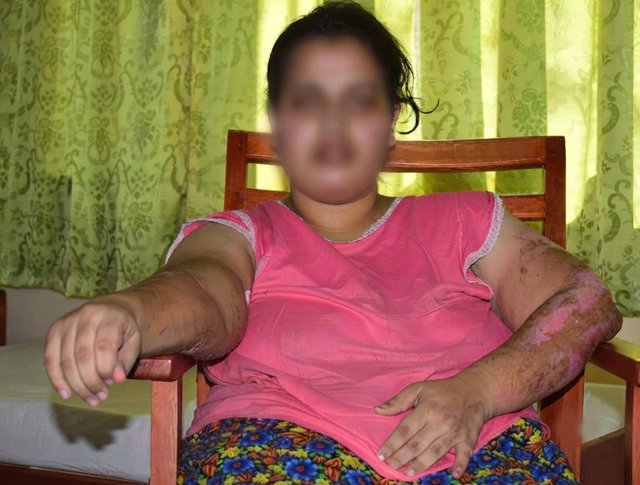
When she regained consciousness, she heard her daughter asking for water. She later heard gunfire outside and voices from within the damaged building as security forces moved in. Unable to identify everyone around her because of the devastation caused by the explosion, Hadiya’s testimony ends with her account of surviving the final destruction of the network’s last known safe house, closing a personal narrative that spans the rise, operation and violent collapse of the cell linked to the Easter Sunday attacks.