Israel’s approaching parliamentary elections are emerging as a defining moment not only for Prime Minister Benjamin Netanyahu’s political future but also for the ideological direction of the country. As explored in an extensive investigation by the German news magazine The Spiegel, the contest has become a referendum on the growing influence of the settler movement within the ruling Likud party and on competing visions of Israel’s identity, governance and territorial future.
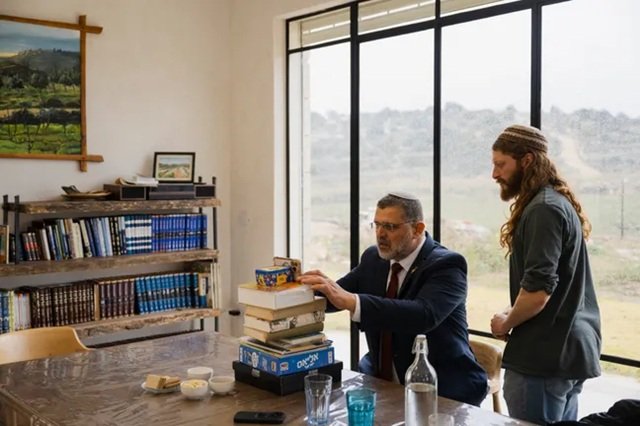
At the centre of that transformation stands Avichay Boaron, a 53-year-old Likud member of parliament whose political career reflects the increasingly close relationship between Israel’s governing party and the settlement movement. Speaking from Amihai, the settlement he founded north of Ramallah in the occupied West Bank, Boaron presents the expanding community as a model for Israel’s future.
Standing outside his Jerusalem-stone home, Boaron points towards a nearby hillside where a new neighbourhood for 50 families is under construction. Once completed, the settlement’s population will nearly double from its current 400 residents. For Boaron, the area is not the occupied West Bank but “Judea and Samaria”, which he describes as the historic homeland of the Jewish people. Facilities including schools, sports grounds, a synagogue and a library reinforce what he portrays as a permanent community rather than a temporary outpost.
“This is the future of Israel,” he says.
Boaron’s political ambitions extend well beyond settlement expansion. “There will never be a Palestinian state,” he states unequivocally. Asked about the future of Palestinians living in the territory, he responds: “We’ll sort out those details later,” before suggesting that “Arabs can apply for Jordanian citizenship.”
According to The Spiegel, Boaron represents a broader ideological shift that has transformed Likud during Netanyahu’s years in power. After joining the party eight years ago, Boaron concluded that “Only Likud can change the policies of the State of Israel.” In his view, that transformation is already well underway.
Since Netanyahu returned to office at the end of 2022, the government has established more than 100 new Israeli settlements, nearly matching the total created during the previous five decades of occupation. An additional 185 outposts—illegal even under Israeli law—have also been established while receiving government support and military protection. According to the report, these outposts alone give settlers control over approximately one-fifth of the West Bank, while more than 100 Palestinian villages have been partially or completely depopulated during the same period.
Against that backdrop, October’s election carries implications extending far beyond party politics. If Netanyahu secures another term, The Spiegel reports that his current coalition is expected to continue pursuing the annexation of large parts of the West Bank, potentially establish Jewish settlements in Gaza, tighten government influence over the judiciary, education system and media, and continue military campaigns in Gaza, Lebanon and Iran.
Opinion polls, however, suggest the outcome remains uncertain. Likud is running neck and neck with the more moderate Yashar party led by former army chief Gadi Eisenkot. Even so, Netanyahu could once again emerge as the only politician capable of assembling a governing coalition, or remain in office if prolonged coalition negotiations prevent an alternative government from taking shape.
The investigation argues that one of Netanyahu’s most consequential political decisions came when he formed a coalition in late 2022 with Itamar Ben-Gvir and Bezalel Smotrich, bringing figures long associated with Israel’s far right into senior government positions. What was once viewed as a political taboo has, according to several interviewees, gradually become normalised.
Likud minister May Golan reflects that shift, telling a recent television interview that “there aren’t many ideological differences between Otzma Yehudit and Likud.” Boaron similarly describes any distinctions as largely “a matter of style.”
Political scientist Gayil Talshir of the Hebrew University in Jerusalem argues that Likud has undergone a profound ideological transformation. She describes the party as seeking “Jewish supremacy”, in which Judaism increasingly takes precedence over liberal democratic principles. Rather than originating on the political fringe, she says, the movement towards a more authoritarian political model is now being driven by what was once Israel’s principal conservative party.
“The settlers set the agenda, and Netanyahu gives them free rein,” Talshir says.
The report traces Boaron’s own political awakening to the dismantling of the settlement of Amona, where he previously lived. After Israel’s Supreme Court ordered the illegal settlement demolished, Netanyahu’s government simultaneously approved thousands of new housing units elsewhere in the West Bank and authorised the establishment of Amihai as a replacement settlement. For Boaron, that episode demonstrated the importance of influencing policy from within Likud itself.
The Spiegel also profiles Nissim Vaturi, Deputy Speaker of the Knesset, whose public statements during the Gaza war have attracted international attention. Following the Hamas attack of 7 October 2023, Vaturi posted that Israel’s objective should be “to wipe the Gaza Strip off the face of the earth.” He later defended those remarks by saying he had referred only to buildings, adding: “We destroyed their homes.”
Vaturi has also praised the late far-right politician Meir Kahane, stating that “Kahane was right about some things” and suggesting he would deserve Israel’s highest national honour today. His rhetoric has featured in South Africa’s genocide case before the International Court of Justice, according to the report.
Among legislation promoted by Vaturi is a law providing that Palestinians convicted of terrorist-motivated murders of Israelis would receive death sentences imposed by military courts and carried out within 90 days. Vaturi describes it proudly as “This is my law,” arguing that capital punishment is intended “to stop the killing.”
Alongside territorial issues, judicial reform has become another central battleground. Likud lawmaker Moshe Saada has emerged as one of the leading advocates of restructuring Israel’s legal system after previously working within the country’s police oversight apparatus. Saada says his experiences investigating alleged police misconduct convinced him that the justice system required fundamental reform.
After joining Likud at Netanyahu’s invitation in 2022, Saada became closely involved in legislation limiting the authority of the Supreme Court, reducing the powers of the Attorney General’s Office and increasing political influence over judicial appointments. Mass protests erupted when the government’s judicial reform programme was unveiled in early 2023, although momentum slowed following the Hamas attacks later that year.
“The legal revolution is on the right track,” Saada says. “I am very satisfied.”
For Israeli extremism researcher Mateo Cohen of Leiden University, the developments represent the culmination of a much longer process. Netanyahu, he argues, has gradually reshaped Likud while presenting different messages to domestic and international audiences. According to Cohen, support for a Greater Israel stretching from the Jordan River to the Mediterranean has effectively become a prerequisite for party membership, following a unanimous 2017 resolution by the Likud Central Committee calling for the annexation of “all liberated settlement areas in Judea and Samaria”.
“The settlers are in no hurry; they know that time is on their side,” Cohen says. “They are waiting for the right moment.”
According to The Spiegel, that strategy extends beyond settlement construction itself. It encompasses efforts to normalise the idea of Greater Israel within Israeli society while reshaping state institutions that could obstruct those ambitions. Cohen argues that judicial reform and territorial expansion are inseparable because any future annexation would inevitably require legal changes affecting the rights of Palestinians living in annexed territory.
As Israelis prepare to vote, the investigation concludes that the election is no longer solely about who governs the country. It has become a contest over whether the ideological transformation unfolding within Likud over the past decade will continue to redefine the relationship between democracy, state institutions, territorial policy and national identity in Israel for years to come.