The brief but intense India–Pakistan confrontation of May 2025 will likely be remembered not only for military exchanges or cross-border strikes, but for something equally significant: the contest over narrative, credibility and strategic perception in South Asia. Modern conflicts are no longer shaped solely by battlefield outcomes. Information management, diplomatic positioning and international legitimacy now play a decisive role alongside conventional military capabilities. In this evolving environment, Pakistan appeared to narrow-and in some areas challenge- India’s long-standing narrative advantage during moments of regional crisis.
The confrontation began after the April 2025 Pahalgam attack, which India used to justify Operation Sindoor on the night of May 6-7. Indian strikes targeted areas inside Pakistan, resulting in civilian casualties including women, children and the elderly. Pakistan described the attacks as an unprovoked violation of sovereignty and accused New Delhi of attempting to establish escalation dominance under the assumption that Pakistan would either absorb the strikes quietly or respond in a limited manner.
Pakistan’s response under Operation Bunyan-un-Marsoos altered the trajectory of the confrontation. Rather than reacting immediately, Pakistan calibrated its response carefully, striking at a time and place of its own choosing. According to Pakistani military briefings delivered by DG ISPR Lieutenant General Ahmed Sharif Chaudhry, Pakistani forces targeted installations linked to Indian military operations against Pakistani territory. Domestically, the operation was framed not as escalation for escalation’s sake, but as an attempt to restore deterrence and reaffirm sovereign red lines.
The Shift in Narrative Dynamics
For years, India held a considerable advantage in shaping international narratives during crises with Pakistan. Its diplomatic reach, global partnerships and expansive media ecosystem often enabled New Delhi to frame events quickly and decisively before alternative interpretations gained momentum. Pakistan, by contrast, frequently struggled to counter this informational asymmetry.
The events of May 2025, however, revealed a more contested narrative environment.
Both sides attempted to shape international perceptions aggressively during the confrontation, though Pakistan’s messaging appeared comparatively more centralized and coordinated throughout the crisis. Pakistani officials consistently framed the confrontation around deterrence, proportionality and sovereignty rather than conquest or escalation. State messaging remained coordinated across military, diplomatic and political channels, allowing Pakistan to present a more coherent position internationally during a rapidly unfolding conflict.
Equally important was the role of digital media and real-time information flows. In earlier decades, governments often controlled the pace and direction of wartime narratives. In 2025, however, satellite imagery, open-source intelligence, social media analysis and independent international reporting narrowed the space for information monopolies. Competing claims were scrutinized almost instantly, while exaggerated narratives faced immediate digital verification and challenge.
In this environment, India faced growing scrutiny as competing claims and independent reporting complicated official narratives surrounding the conflict.
Reports and open-source assessments concerning damaged military assets, aerial losses and the vulnerability of expensive defence systems complicated official narratives surrounding the confrontation. The conflict therefore became not only a military confrontation, but also a test of strategic credibility.
Deterrence, Balance and Regional Perceptions
The broader significance of Marka-e-Haq lies in what it revealed about deterrence and the balance of power in South Asia.
For nearly a decade, India appeared increasingly confident in its ability to impose calibrated military pressure on Pakistan without triggering a meaningful response capable of imposing comparable costs. Marka-e-Haq challenged that assumption directly. Pakistan demonstrated not only military readiness, but also the ability to contest India’s informational and diplomatic positioning simultaneously.
This mattered because regional stability in a nuclearized environment depends less on absolute superiority and more on the absence of unilateral dominance. Once one side begins believing it can act militarily without facing proportional consequences, instability increases dramatically. The events of May 2025 signaled that such assumptions carried far greater risks than previously believed.
Pakistan’s internal cohesion during the crisis also strengthened its external positioning. Political institutions, military leadership and public messaging appeared unusually synchronized. Officials repeatedly emphasized that the conflict was not merely about retaliation, but about defending sovereignty, restoring deterrence and countering disinformation. This coherence projected institutional confidence rather than strategic panic.
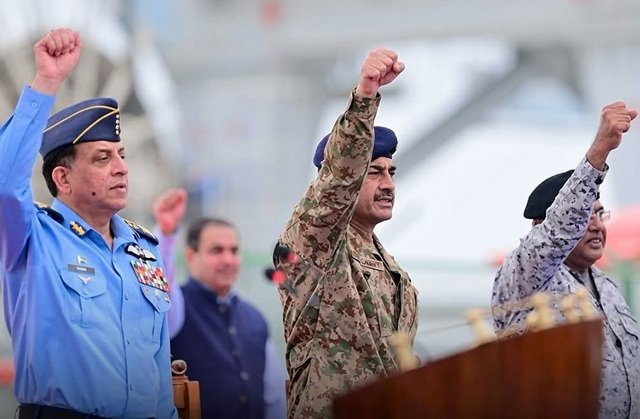
Leadership became central to that perception. Field Marshal Syed Asim Munir emerged domestically as the principal architect of Pakistan’s strategic response. Supporters viewed his approach as calculated, restrained and deterrence-oriented rather than emotionally escalatory. Prime Minister Shehbaz Sharif simultaneously maintained diplomatic engagement, helping Pakistan project a combination of military resolve and political restraint.
India, meanwhile, encountered growing debate over whether domestic political considerations had shaped strategic decision-making during the crisis. Nationalist rhetoric and media hyperbole generated public expectations that became more difficult to manage once the confrontation evolved unpredictably and international reporting presented a more complex picture of events.
Warfare Beyond the Battlefield
Marka-e-Haq also demonstrated how profoundly warfare itself has changed in the digital era.
Modern conflicts are no longer fought solely through missiles, aircraft and artillery. They are increasingly shaped by perception management, cyber capabilities, strategic communication and information credibility. States must now sustain legitimacy not only militarily, but narratively. Battlefield success alone no longer guarantees strategic advantage if official claims lose credibility internationally.
This may be the most important lesson of the 2025 confrontation: credibility matters as much as capability.
States may possess advanced military platforms, enormous defence budgets and technological superiority, but strategic influence ultimately depends on whether their narratives remain believable under pressure. During Marka-e-Haq, Pakistan appeared comparatively more effective in presenting its position as centered on deterrence, proportionality and strategic restraint, while India faced greater international scrutiny amid competing claims and rapidly evolving battlefield realities.
One year later, the significance of Marka-e-Haq lies less in triumphalism and more in transformation. The confrontation demonstrated that military power alone no longer guarantees uncontested strategic dominance in South Asia. Information credibility, institutional coordination and public trust now shape outcomes as decisively as conventional force.
Future crises in South Asia are likely to be shaped not only by military capability, but also by the ability of states to maintain narrative credibility under conditions of real-time global scrutiny. Marka-e-Haq demonstrated that in the digital era, strategic legitimacy itself has become a central domain of deterrence.