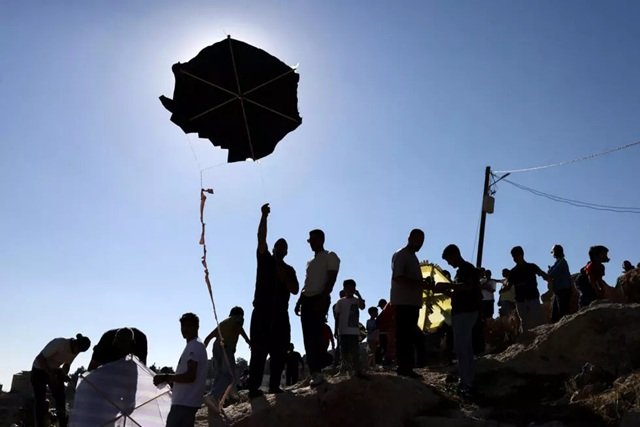
On a summer afternoon in the northern West Bank village of Burin, the sky above a sun-baked hillside fills with bright colours. Children run across the open ground, pulling strings attached to handmade kites as families gather beneath the breeze. For a few hours, the scene resembles a traditional village celebration.
But behind the kites flying above Burin are the red-roofed homes of Har Bracha, an Israeli settlement overlooking the Palestinian village below. For residents, the annual kite festival is not only a children’s event. It is also a reminder of the land they say they have gradually lost and a statement of their continued connection to the area.
The festival has been held every summer since 2009 on a hillside that residents say has been partly inaccessible after land was confiscated following the establishment of the settlement in 1983. Organisers say the event allows children to play while also carrying a broader message about belonging and presence.
“We want to tell the settlers that this is our land, this is our sky. If we can’t reach those lands anymore, our kites can,” said Ghassan Najjar, one of the festival organisers.
Burin, a village of several thousand people, is surrounded by Israeli settlements and has long experienced tensions linked to land disputes and settler activity. Residents say discussions in the community often return to concerns over attacks, restrictions, and the expansion of settlements across the West Bank.
The United Nations Office for the Coordination of Humanitarian Affairs (OCHA) reported as early as 2008 that the area had experienced settler violence, including shootings targeting Burin residents and the uprooting of olive trees. Since the beginning of the war in Gaza in October 2023, the United Nations has reported an increase in violence attributed to Israeli settlers in the West Bank, while some Israeli ministers have continued to call for annexation of parts or all of the territory.
For residents of Burin, however, the festival creates a temporary space away from the pressures of daily life. The hillside transforms into a community gathering, with music, face painting, and families sitting together on picnic carpets spread across the grass.
The kites themselves carry their own symbolism. Many are painted in the colours of the Palestinian flag — black, white, green, and red. Another kite carries the colours of Egypt, flown as a tribute to the Egyptian national football team.
“Our children have the right to play and to have a real and a good life,” Najjar said.
Yet even this moment of celebration takes place with caution. Residents say they checked the area before gathering to ensure that groups of Israeli settlers were not nearby. The possibility of confrontation remains a concern for many families.
“Sometimes we are scared,” said 15-year-old Sanaa Bashar Najjar. She recalled that residents did not attend the festival the previous year after settler attacks on the village. “We stay only half an hour or an hour, just to get a bit of fresh air. With the war and the economic hardship, we’re simply trying to breathe.”
Other residents describe personal experiences that have shaped their fears. Dalia Zaban said her parents’ home was attacked, with windows smashed and cars vandalised. As the festival continued, she expressed hope that the gathering would pass without disruption.
“Today, we just hope they don’t come down here,” she said.
The event’s organisers say the festival is not intended only as a political statement but also as a way to provide children with a sense of normal life amid ongoing uncertainty. For young participants, the kites offer a rare opportunity for recreation in a landscape where movement, security concerns, and economic hardship influence everyday routines.
As the afternoon continues, the wind gradually weakens and the colourful kites begin descending toward the ground. Families slowly leave the hillside, but residents say the festival will return the following summer.
For Qusai Walid Eid, a Burin resident who attends the event each year, the gathering represents a connection between generations and the land surrounding them. Wearing sunglasses and dressed for the occasion, he said he returns to the festival to strengthen “our roots in this land.”
Above Burin, the kites eventually disappear from the sky, but residents say the message behind them remains: a small celebration on contested ground has become an annual expression of community, memory, and presence.