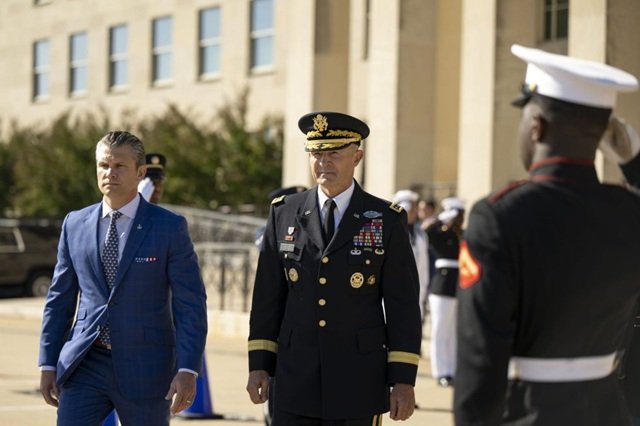
The United States has witnessed a dramatic shift in military leadership after Defense Secretary Pete Hegseth asked Army Chief of Staff General Randy George to step down, a decision that comes at a critical moment during the ongoing war against Iran. According to Reuters, the move underscores a broader effort to reshape the Pentagon’s top ranks as Washington ramps up its military posture in the region.
Pentagon officials confirmed that George will retire immediately from his role as the Army’s 41st chief of staff, ending his tenure earlier than expected. The Defense Department expressed appreciation for his decades of service but did not provide a detailed explanation for his sudden departure, fueling speculation about the reasons behind the decision.
The leadership change comes as the United States, alongside Israel, continues its military campaign against Iran. In recent weeks, thousands of American troops, including Marines and paratroopers, have been deployed to the region in preparation for a possible ground operation. Analysts note that removing a senior military leader during an active conflict is highly unusual and could signal deeper strategic or internal disagreements.
General George, a career infantry officer and West Point graduate, became Army chief in 2023 after serving in several high-level positions, including vice chief of staff and senior military assistant to former Defense Secretary Lloyd Austin. Despite his extensive experience, he remained largely out of the public spotlight during the current conflict and did not make major public statements regarding operations in Iran.
His removal is part of a wider shake-up led by Hegseth, who has taken an assertive approach to reorganizing senior military leadership. In recent months, other high-ranking officials have also been replaced or stepped down, reflecting a broader effort to align the armed forces with evolving strategic priorities.
The decision has drawn comparisons to past wartime leadership disputes, including the sidelining of senior generals during the Iraq War over disagreements on troop levels. Such moves often highlight tensions between civilian leadership and military commanders during periods of heightened conflict.
Before rising to the Army’s top position, George had a long operational career that included deployments in the Gulf War, Iraq and Afghanistan. Earlier in his career, he faced scrutiny after a remote outpost under his command in Afghanistan was overrun by Taliban fighters, resulting in casualties and a formal reprimand. He later rebuilt his reputation and went on to hold key leadership roles.
As chief of staff, George led efforts to modernize the Army, focusing on restructuring forces, reducing administrative overhead and accelerating the adoption of new technologies such as counter-drone systems. His sudden exit now raises uncertainty about the continuity of these reforms.