Editor’s Note: The following column is based on the presentation by Professor Wu Bihu,a leading Chinese scholar and professor at Peking University, specializing in tourism development, planning, and management, at the China-Sri Lanka-Maldives Tourism Forum held in Colombo, Sri Lanka, on 16 June 2025. It explores key themes of China Inbound Tourism, focusing on the Maritime Silk Road narratives, policy dynamics, and image creation.
To contemplate the evolution of China’s inbound tourism through the intersecting prisms of historical narrative, statecraft, and image-making is to witness an intricate choreography of memory, policy, and perception. Professor Wu Bihu’s recent exposition unearths the multidimensionality of this endeavour, situating it within the longue durée of the Maritime Silk Road, while deftly illuminating the hypermodern strategies of digital virality and policy innovation. In this evolving matrix, tourism becomes neither a mere economic transaction nor a banal cultural exchange, but an epistemic and ontological instrument by which China simultaneously retrieves, reframes, and reprojects itself onto the global imaginary.

At the conceptual nucleus of China’s inbound tourism narrative lies the invocation of the Maritime Silk Road—a civilisational metaphor freighted with both antiquarian gravitas and contemporary geopolitical utility. Far from being an inert historical artefact, this metaphor is resurrected as a narrative infrastructure that authorises and animates China’s positioning within transoceanic flows of culture, commerce, and cosmopolitanism. Figures such as Fa-Hsien, Marco Polo, and Zheng He are reconstituted as semiotic lodestars of intercultural engagement, whose peregrinations and textual afterlives are deployed not as static commemorations, but as living scripts upon which new tourism imaginaries are inscribed. The semiotics of ancient travel texts—Fei Xin’s Star Raft, Ma Huan’s Ocean’s Shores, and the Galle Trilingual Inscription—are not merely citations of historical facticity, but dramaturgical devices in a meta-narrative of peaceful connectivity, non-coercive exchange, and premodern globalisation avant la lettre.
Yet to relegate this to the realm of romantic historicism would be to miss the critical suppleness with which these narratives are interfaced with contemporary policy and infrastructural mechanisms. China’s inbound tourism strategy is, at its core, a techno-bureaucratic exercise in nation-branding, calibrated through an ever-expanding assemblage of institutional protocols, inter-ministerial coordination, and cross-sectoral experimentation. The taxonomy of world-class tourist destinations, as delineated by the Ministry of Culture and Tourism, signals a semiotic inflation of touristic categories—national parks, AAAAA attractions, and leisure cities—not as mere locational entities, but as performative classifications that produce their own reality through the rituals of designation and certification.
Underpinning this classificatory zeal is a sophisticated policy apparatus that mediates the interface between mobility and sovereignty. The liberalisation of visa regimes—comprising mutual exemptions, unilateral waivers, and region-specific relaxations—encapsulates a recalibrated modality of border governance. The stratification of access (30-day visa-free, 15-day exemptions, transit-specific leniencies) is a testament to the strategic granularity with which China orchestrates its inbound flows, simultaneously courting tourism receipts and reinforcing its image as an open, cosmopolitan actor in the global mobility regime. Moreover, the tax refund system—lowering the eligibility threshold, raising cash refund limits, and enabling instantaneous rebates—betrays a deeply instrumental logic: to convert transient visitors into economically productive bodies within the circuits of consumption.
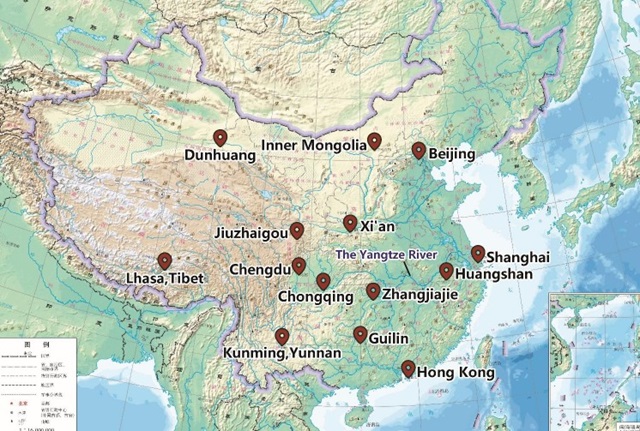
The geographical choreography of inbound tourism further reflects the spatial politics of visibility and valuation. Destinations such as Beijing, Xi’an, Chengdu, and Guilin function not only as repositories of cultural capital but also as meticulously curated theatres of national self-presentation. Zhangjiajie, in particular, emerges as a paradigmatic case of affective cartography: its elevation into the “spiritual hometown” of Korean visitors reveals how transnational sentimental geographies are forged through a dialectic of foreign gaze and domestic performance. In such spaces, tourism is not the innocent movement of people, but the scenographic engineering of affect, where memory, nostalgia, and aspiration coalesce into marketable experience.
Crucially, the social media ecology of the 2020s has intensified and destabilised traditional paradigms of image-making. No longer is the national image sculpted exclusively by ministries and media apparatchiks; it is increasingly refracted through the prism of digital influencers, livestreaming spectacles, and algorithmic virality. The IShowSpeed phenomenon exemplifies this ontological pivot: an American content creator whose peregrinations across China—from panda makeup sessions in Chengdu to kung fu interludes at Shaolin—have engendered a new vernacular of digital cosmopolitanism. His videos, punctuated by spontaneous exclamations and visceral encounters, eschew polished narration in favour of affective immediacy. In doing so, they disintermediate traditional channels of national branding and inaugurate a horizontal, participatory modality of transnational meaning-making.
Such episodes signify more than a cultural epiphenomenon. They constitute an epistemological recalibration of how national identities are constructed and disseminated in the hypermediated public sphere. The proliferation of keywords—”real”, “special”, “beautiful”—under the comment sections of IShowSpeed’s videos suggests not only a phenomenological appreciation, but a discursive reconstitution of China’s global image. This crowdsourced semiotics, grounded in polyglot authenticity and affective contagion, signals the waning of top-down narratives and the ascent of polyphonic, decentralised storytelling. The traveller becomes not merely a consumer of place but a co-author of its global representation.
Yet this democratisation of image-making is not devoid of contradictions. The rise of self-media and influencer tourism raises ethical quandaries about representation, spectacle, and commodification. What forms of cultural expression are privileged, sanitised, or exoticised in these performances? To what extent do viral encounters risk devolving into epistemological tourism, wherein cultural depth is sacrificed at the altar of clickability? These questions point to the ambivalent dialectic at the heart of digital-era tourism: between revelation and reduction, intimacy and intrusion, authenticity and algorithm.
Meanwhile, the infrastructural underpinning of this entire edifice—be it visa policies, transport logistics, or interdepartmental synergy—cannot be overemphasised. The performativity of tourism is always already scaffolded by the invisible labour of governance and the materiality of planning. The state’s role in scripting and choreographing tourism experience is neither passive nor peripheral; it is constitutive. From the calibration of tax incentives to the spatial zoning of tourism clusters, the apparatus of the state penetrates deeply into the seemingly spontaneous realm of travel and leisure. This is not an authoritarian imposition, but a technocratic sublimation—a Foucauldian regime of “governmentality” that manufactures desire, directs flows, and distributes visibility.
At the metanarrative level, China’s inbound tourism strategy reveals a double gesture. On the one hand, it projects a confident cosmopolitanism grounded in historical continuity and cultural self-assurance. On the other, it reveals an acute sensitivity to global perception, an ongoing anxiety about how China is seen, known, and felt in the world. This oscillation—between assertiveness and anxieties of representation—animates much of the current discourse around China’s soft power. The tourism sector thus becomes a crucible wherein these contradictory impulses are negotiated, enacted, and transmuted.
Therein lies the deeper significance of Wu Bihu’s argument: that tourism, far from being a derivative or ornamental domain, is central to the geocultural configuration of twenty-first-century modernity. It is through tourism that nations articulate their narratives, reframe their pasts, and negotiate their place in the global order. For China, the recalibration of inbound tourism is not merely about increasing visitor numbers or economic inflows—it is about narrative sovereignty, cultural confidence, and discursive parity in an international system still freighted with postcolonial asymmetries.
The strategic invocation of the Maritime Silk Road, the liberalisation of inbound policies, and the mobilisation of digital vernaculars together instantiate a new paradigm of tourism governance—one that is at once historico-cultural, technocratic, and affective. It fuses nostalgia with futurity, infrastructure with emotion, and bureaucracy with virality. This hybridity is not a weakness, but a source of generativity. It allows China to navigate the contested terrain of global perception with a repertoire that is both rooted and adaptive, deliberate and improvisational.
China’s inbound tourism strategy—is not merely an assemblage of policies, destinations, and media strategies. It is a performative rearticulation of China’s historical destiny, cultural plurality, and global ambition. It invites us to reconceptualise tourism not as escapism, but as geopolitics; not as recreation, but as representation. In this theatre of movement, every traveller is a witness, every city a stage, and every narrative a stake in the battle for the world’s imagination.