In the winter of 1937, the Chinese city of Nanjing became a stage for atrocities so profound that they would echo across generations. What unfolded over six weeks beginning in December was not only a humanitarian catastrophe but also a defining moment in the global understanding of wartime violence against civilians. Today, the voices of survivors, corroborated by foreign witnesses and preserved through legal and historical efforts, continue to challenge denial and demand remembrance.
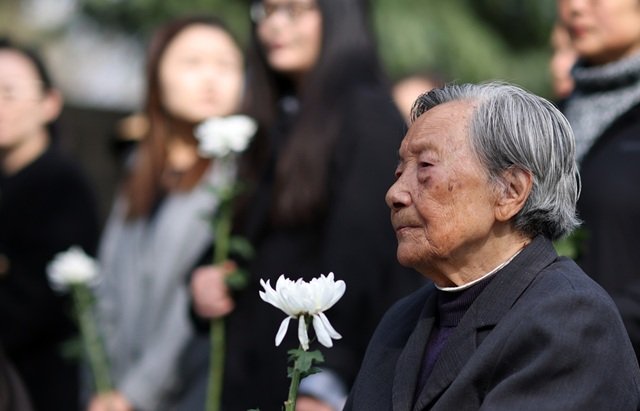
On December 13, 1937, violence entered the home of eight-year-old Xia Shuqin with devastating force. As her family prepared a midday meal, Japanese soldiers stormed into their residence. In a matter of moments, the household was reduced to a scene of unimaginable brutality. Her father was shot while pleading for mercy, her mother and sisters were subjected to sexual violence and killed, and even her infant sibling was not spared. Hidden briefly under a quilt, Xia herself was discovered and stabbed multiple times.
When she regained consciousness, she found herself surrounded by the bodies of her family. Only she and one younger sister had survived. For more than ten days, the two children remained in the house, living among the dead, surviving on scraps of food and collected rainwater. Of nine family members, seven had been killed. Their eventual rescue by elderly volunteers marked the beginning of a lifelong journey for Xia—not only as a survivor but as a witness.
Historians estimate that at least 300,000 civilians were killed during the Nanjing Massacre, as it came to be known. The scale of the violence, which included widespread killing, sexual assault, and looting, left an indelible scar on the city and the collective memory of humanity. Yet for decades, the truth of what happened in Nanjing has been contested, denied, and politicized.
In 1994, Xia took a bold step by traveling to Japan to recount her experiences. Speaking in cities such as Tokyo and Hiroshima, she was confronted not only with sympathy but also with ignorance. Many ordinary Japanese citizens, she discovered, were unaware of the events that had taken place in Nanjing. Her mission to share her story became not only a personal act of remembrance but a broader effort to bridge historical gaps.
That effort faced fierce resistance. In 1998, Japanese right-wing writers publicly labeled her testimony as fabricated. Refusing to remain silent, Xia initiated legal action. Her lawsuit in China concluded in 2006 with a victory affirming her credibility. She then pursued justice in Japan, where after years of litigation, she secured another decisive ruling in 2009. These legal victories were not only personal vindications but also milestones in the preservation of historical truth.
Central to her case was evidence provided by foreign witnesses who had documented the massacre firsthand. Among them was John Magee, an American missionary who filmed scenes of devastation in Nanjing. His footage captured bombed-out neighborhoods, wounded civilians, and the chaos that engulfed the city. Magee had risked his life to navigate through Japanese patrols and record what he saw, later using his material to testify at postwar trials.
Another key figure was German businessman John Rabe, who played a crucial role in establishing an international safety zone that sheltered approximately 200,000 Chinese civilians. Rabe’s meticulous diaries, spanning thousands of pages, described daily encounters with violence. He wrote of bodies lining the streets, of civilians shot while fleeing, and of widespread sexual violence carried out by soldiers. His records, along with Magee’s film, would later serve as critical evidence during the International Military Tribunal for the Far East.
These third-party accounts proved essential not only in documenting the massacre but also in countering later attempts at denial. In the 1990s, as skepticism about the Nanjing Massacre gained traction among some groups in Japan, efforts were made to locate original evidence. Thirteen reels of Magee’s film were eventually discovered in the United States and restored, providing visual confirmation of events long described in survivor testimony.
Beyond the courtroom and the archive, the emotional toll of the massacre extended even to those who had tried to help. Minnie Vautrin, an American missionary who managed a refugee shelter at Ginling Women’s College, documented her experiences in a diary that revealed the constant threat faced by women under her care. Her entries described soldiers attempting to assault refugees and her own desperate efforts to intervene.
The trauma she witnessed and endured left deep psychological scars. After returning to the United States, she struggled with severe depression and ultimately took her own life in 1941. Her death was later described as that of a casualty of war, underscoring the far-reaching impact of the violence in Nanjing.
The preservation of these testimonies—whether through diaries, film, or legal records—has become a cornerstone in the global understanding of the massacre. Institutions and historians continue to study these materials, emphasizing their importance not only for historical accuracy but also for moral accountability.
For Xia Shuqin, the journey from survivor to advocate has been marked by both pain and resilience. During her legal battles in Japan, she found unexpected support from Japanese citizens and lawyers who worked to uphold her testimony. In courtrooms, some attendees reportedly expressed remorse, acknowledging the suffering inflicted decades earlier.
These moments of recognition highlight a broader truth: that even in the aftermath of profound injustice, there remains the possibility of empathy and reconciliation. The convergence of survivor voices and international evidence has ensured that the events of Nanjing are neither forgotten nor easily dismissed.
As time passes and the number of living witnesses dwindles, the responsibility of remembrance increasingly shifts to historical records and collective conscience. The story of Nanjing is not only a chapter in Chinese history but a warning to the world—a reminder of the consequences of unchecked violence and the enduring need for truth.
In the words of those who have carried this history forward, the memories of Nanjing serve as both a burden and a safeguard. They compel humanity to confront its darkest moments while striving to ensure that such tragedies are never repeated.