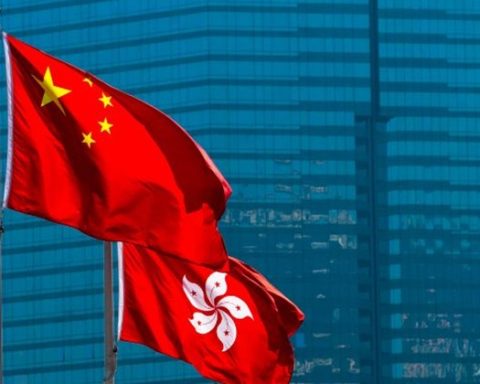
Reports that former U.S. President Donald Trump may visit Beijing in September have stirred cautious optimism among Chinese analysts, with some seeing the potential trip as an opportunity to defuse mounting tensions between the two global powers, particularly in trade and strategic relations.
According to a Kyodo News report on Sunday, China is considering inviting Trump to attend a military parade in Tiananmen Square on September 3 to mark the 80th anniversary of the end of World War II, referred to in China as the victory over Japanese aggression. The report, which cited unnamed sources, has yet to be confirmed by either side.
In response to media inquiries on Monday, Chinese foreign ministry spokeswoman Mao Ning said she had “no information to provide” regarding the possibility of a Trump visit.
Beijing announced last week that it would host a large-scale military parade to commemorate the wartime victory, a symbolic event that could serve as a platform for international diplomacy. Chinese President Xi Jinping and Russian President Vladimir Putin are both expected to attend.
Trump hinted at a possible trip to China earlier this month after holding his first phone conversation with Xi since reigniting trade tensions in February. In that June 5 call, both sides acknowledged the importance of maintaining communication, and Trump confirmed that Xi had extended an invitation for him and First Lady Melania Trump to visit China. Trump said he reciprocated the offer for a future Xi visit to the U.S.
Analysts Call for Diplomatic Momentum
Shen Dingli, an international affairs expert based in Shanghai, expressed “cautious optimism” over Trump’s potential attendance at the September event. “The more difficult the relationship, the more vital such visits become,” Shen said. “A visit isn’t about concession or surrender; it’s about creating conditions for dialogue.”
He added that despite recent strains, the U.S. and China were allies during World War II, making the invitation symbolically appropriate. Shen recalled Xi’s 2017 remarks during Trump’s visit to Mar-a-Lago: “There are a thousand reasons to make China-US relations a success, but not a single reason to break it.”
Trump has long touted his personal rapport with Xi, often describing their relationship as “great.” Some observers believe Trump is interested in reviving his high-profile diplomacy with North Korea, a goal that could benefit from Chinese support.
Strategic Considerations and Political Complexities
However, other analysts are skeptical about the likelihood of a Trump visit, particularly due to the potential optics of appearing alongside Vladimir Putin amid heightened Western criticism of Russia’s war in Ukraine.
Wang Yiwei, a former Chinese diplomat and director at Renmin University’s Institute of International Affairs, said Trump’s attendance at the Beijing parade was “very unlikely” given current geopolitical sensitivities. “Trump may not personally object to standing beside Putin, but considering the position of the U.S. and its allies, the optics would be difficult,” he said.
The Kremlin has confirmed that Putin will attend the event, reinforcing the close strategic alignment between China and Russia. Xi was seen beside Putin at the May 9 Victory Day celebrations in Moscow, a move that underscored Beijing’s growing partnership with Moscow.
Meanwhile, speculation also surrounds a possible visit by Xi to the United States in September, coinciding with the 80th session of the UN General Assembly in New York. However, Wang said this was unlikely, confirming that Premier Li Qiang is scheduled to attend in Xi’s place due to the lack of substantive diplomatic deliverables.
Focus on Broader Engagement
Other scenarios being floated include a Trump state visit ahead of the APEC summit in South Korea later this year, with a possible reciprocal visit by Xi in 2025. That year will see the United States host the G20 summit and celebrate its 250th anniversary of independence, which some analysts see as an ideal moment for a symbolic diplomatic gesture.
Diao Daming, a professor at Renmin University, emphasized that high-level diplomacy between U.S. and Chinese leaders has historically played a stabilizing role in the relationship. He noted that since diplomatic ties were established in 1979, there have been 136 interactions between Chinese and American presidents through visits, calls, or third-country meetings.
“As long as the bilateral relationship remains fundamentally stable and the conditions are suitable, there is room for meaningful engagement,” Diao said. “The earlier the leaders meet, the sooner relations can stabilize.”
As the world watches for signals of thaw or escalation between the two superpowers, the prospect of Trump visiting Beijing — even in a highly symbolic context — could mark a pivotal moment in the ongoing saga of U.S.-China relations.