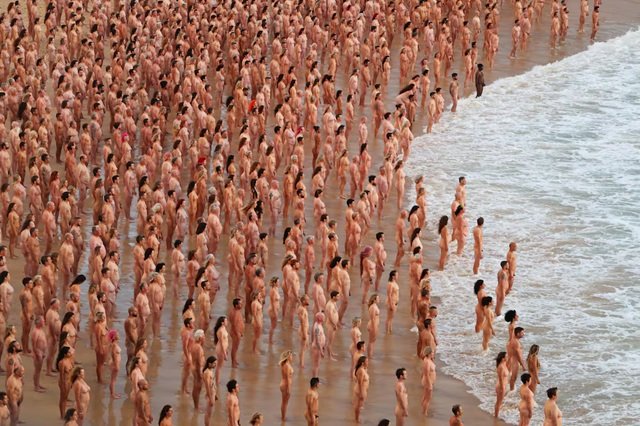
New York photographer Spencer Tunick, whose large-scale photographs of nude crowds have become some of the most recognisable works of contemporary public art, is preparing to stage a new collective installation in Gran Canaria later this month, returning to Spain with a project that links his signature artistic practice to support for LGTBIQA+ rights. According to El País, the work, titled Gran Spectrum, will take place on 26 July as part of Culture & Business Pride 2026, bringing together hundreds of volunteers in an intervention inspired by the colours of the Pride flag.
The project marks another chapter in a career that has taken Tunick across continents over the past three decades, photographing thousands of unclothed participants in public spaces while blurring the boundaries between photography, sculpture and performance art. Speaking from New York, where he continues to live and work with his family, Tunick reflected on how an artistic experiment that began with individual portraits in the early 1990s gradually evolved into the mass installations that have defined his career.
At the beginning of his professional journey, New York regulations permitted artistic nude photography in public spaces, allowing him to photograph individuals on city streets during the early hours of the morning before crowds emerged. As the number of volunteers steadily increased, he realised that photographing each participant separately would take years. Instead, he invited dozens of them to pose together in front of the United Nations headquarters. Twenty-eight people accepted the invitation, creating what became his first collective nude portrait.
Looking back on that moment, Tunick recalled recognising that the resulting image possessed a serious visual quality rather than appearing sensational or decorative. The experience convinced him that he had discovered a new artistic direction, setting in motion a career centred on assembling large groups of volunteers into carefully composed public installations.
Those early experiments soon expanded far beyond New York. Spain became one of the defining locations in Tunick’s international career when thousands of people gathered in Barcelona in 2003 to participate in one of his best-known works. According to the source, participation ranged between 4,500 and 7,000 people. Four years later, he staged what became his largest installation in Mexico City, attracting between 18,000 and 20,000 participants. Not every project reached completion. Tunick recalled unsuccessful attempts in South Korea, where government permission was denied, and Taiwan, where preparations had already been completed before the event was cancelled. He described those experiences as examples of working in places with restrictive governments.
His upcoming return to the Canary Islands follows an unsuccessful attempt to organise a project in Tenerife a decade ago, although he said he no longer remembers the exact reasons why that initiative failed. This time, he said, Gran Canaria presents an environment where he has encountered respect for artistic expression. The Gran Spectrum installation is being organised within the framework of Culture & Business Pride 2026 by the Cabildo de Gran Canaria and the Government of the Canary Islands. While Tunick declined to reveal the exact number of participants ahead of the event, he confirmed that hundreds of volunteers will once again take part.
Unlike many of his previous projects, Gran Spectrum has been conceived with a clearly defined social message. Tunick said using the colours associated with Pride allows him to explore abstraction while simultaneously giving each participant an individual place within the larger composition. Although he stressed that not every installation is connected to a specific cause, he said this project responds to what he described as widespread misinformation, hostility and falsehoods surrounding the LGTBIQA+ community in the United States. He said the installation offers an opportunity to promote community through a positive artistic experience.
Tunick describes his work less as conventional photography than as abstract compositions created with human bodies occupying public space. As hundreds or thousands of participants become part of a single visual arrangement, individual nudity gives way to a broader aesthetic experience that resembles a collective gathering rather than an accumulation of separate figures. He cites artists including Yayoi Kusama, Ellsworth Kelly and Carolee Schneemann among the influences that have shaped his thinking.
Although he does not regard every installation as an act of protest, Tunick said nudity inevitably carries political meaning, particularly when presented on such a large scale. The body, he explained, functions as both artistic material and public sculpture, creating works that exist simultaneously as photographs, performances and spatial compositions.
Central to every installation are the volunteers themselves, who participate without payment. For the Gran Canaria project, participants will receive a copy of the completed artwork. Tunick said the involvement of ordinary people remains the defining feature of his practice because audiences rarely become active components of an artwork. Through their participation, people from different backgrounds contribute to visual statements that engage with ideas of identity, freedom and social convention.
Before beginning his artistic career, Tunick said he was already aware that collective nudity had been used as a form of protest in countries including Mexico and South Africa. Following his Barcelona installation, however, he observed that demonstrations opposing political power began adopting visual approaches resembling his work, a development that later spread internationally.
Despite the global recognition of his images, Tunick described his professional operation as deliberately modest. Working without employees from his New York studio, he relies on the support of his wife and creative partner, Kristin, a painter and graphic designer whom he credits with helping shape artistic decisions. Together, he said, they maintain a small operation capable of producing projects on a monumental scale. Tunick added that while his photographs are widely recognised, he has never sought personal celebrity, telling his children that he considers himself a well-known artist rather than a famous one.
Reflecting on changes over the past three decades, Tunick said public representations of the nude body have shifted dramatically, with social media emerging as the principal arena where artistic expression now encounters restrictions. He argued that platforms such as Instagram apply strict moderation policies that force artists to censor their own work in order to remain visible online. That concern led him to co-found the platform Don’tDelete.Art, which campaigns against the removal of artists’ accounts from social media services. Speaking to El País, Tunick said he believes open-minded people increasingly face hostility from governments and corporations seeking greater control, adding that respectful artistic uses of the human body remain an important way of expanding the boundaries of public expression.