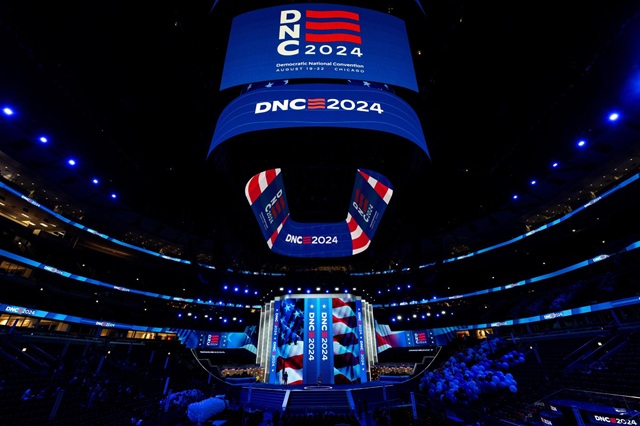
A covert surveillance device known as a cell-site simulator was likely deployed during the 2024 Democratic National Convention (DNC) in Chicago, according to findings reported by WIRED. The revelation, based on data collected by WIRED and analyzed in collaboration with the Electronic Frontier Foundation (EFF), raises significant privacy concerns and questions about the purpose and authorization of such a device.
Cell-site simulators, often referred to as “stingrays,” impersonate legitimate cell towers to intercept phone signals, indiscriminately gathering sensitive information such as call metadata, location data, and app traffic from all nearby phones. Their use has sparked widespread criticism from privacy advocates, who argue that the technology can be weaponized to monitor protesters and suppress dissent.
The DNC took place against the backdrop of protests over Israel’s assault on Gaza, drawing thousands of demonstrators alongside a heavy law enforcement presence. WIRED, concerned about potential surveillance, conducted a pioneering wireless survey during the convention. Using detection tools developed by the EFF, including the Rayhunter software, reporters monitored cellular activity at key protest and event locations across Chicago.
Initial analysis conducted during the event showed no conclusive evidence of cell-site simulator activity. However, EFF technologists revisited the raw data months later with enhanced detection methods. Their breakthrough came when they identified an unusual sequence of interactions between a device carried by WIRED reporters and a cell tower. On August 18, the device unexpectedly connected to a new tower that requested its IMSI (international mobile subscriber identity) before immediately disconnecting—a pattern indicative of cell-site simulator use.
“This is extremely suspicious behavior that normal towers do not exhibit,” said Cooper Quintin, a senior technologist at the EFF. While the evidence strongly suggests a cell-site simulator was active, Quintin noted that the responsible party remains unknown. Possible actors include federal agencies, foreign governments, or other entities.
Under Illinois law, law enforcement agencies are required to obtain warrants for such surveillance, a standard mirrored by federal guidelines unless national security threats are present. However, a 2023 Department of Homeland Security (DHS) report highlighted instances of noncompliance with these requirements. In response to WIRED’s inquiries, the Chicago Police Department denied deploying a cell-site simulator, while the Secret Service declined to comment on its methods.
The EFF’s findings have drawn comparisons to previous incidents of suspected cell-site simulator use in high-security areas such as Washington, DC. In 2019, the FBI accused Israel of deploying such devices near the White House, a claim denied by the Israeli government.
Civil liberties advocates are alarmed by the implications of the DNC findings. Nate Wessler, deputy director of the ACLU’s Speech, Privacy, and Technology Project, emphasized the chilling effect of such ambiguity. “The uncertainty around their use undermines people’s ability to express themselves,” Wessler said, noting the potential for both lawful and unauthorized applications of the technology.