by Luxman Aravind
The English on the grand welcome banners prepared for the visit of Indian Prime Minister Narendra Modi was not merely incorrect; it was emblematic. A nation incapable of mustering the linguistic competence to correctly print a diplomatic greeting has no business entertaining geopolitical agreements of consequence. Yet the error transcended grammar. It was symbolic—an act of erasure. Tamil was nowhere to be seen on those garish cut-outs, just as it has been surgically excluded from the imagination of this administration. Muslims, once granted token representation through ministerial portfolios across successive governments, are now entirely invisible. This government will never admit to chauvinism, but in its every gesture it performs a pantomime of supremacy—quiet, smug, deliberate.
The banners were eventually corrected—some flustered bureaucrat must have noticed—but the revision only deepened the shame. A correction made too late, like an apology offered after betrayal, never quite repairs the damage. And in the shadow of these theatrics, the real performance commenced. Indian journalists were ushered in with VIP passes and choreographed deference. Sri Lankan journalists—our journalists—were unceremoniously pushed aside. No protest was voiced. No apology issued. Silence, once again, did the talking. And as Indian media projected images of harmony and progress, our government sat docile, mute, anaesthetised by ceremony. President Dissanayake (Disanayaka), wielding an overwhelming parliamentary majority, chose compliance over confrontation, fealty over dignity.
One must ask, with mounting nausea, how a state so proud of its sovereignty can be so quick to abdicate it under the veil of diplomacy. The MoUs signed—touted as historic milestones by smiling ministers who struggle to articulate a coherent sentence—are in fact strategic encroachments. Modi’s speech was characteristically eloquent, dipped in the honey of Thiruvalluvar’s verses and wrapped in the velvet of civilisational friendship. He spoke of shared destinies and ancient ties, of temples and relics, of sunlight and connectivity. Yet in every segment of that speech was embedded a quiet conquest. Soft power is no less imperial than steel and fire—it merely wears sandals instead of boots.
The energy agreement, paraded as a triumph, will tether Sri Lanka’s electrical grid to India’s. This is not merely technical infrastructure. It is political vulnerability. Once the cables are laid, the very voltage that powers our homes, hospitals, and industries will depend on another state’s benevolence. If history teaches us anything, it is that such dependencies are never benign. They are traps masquerading as gifts.
The digital identity cooperation is more ominous still. India’s so-called “population-scale” digital solutions—lauded by technocrats and condemned by human rights experts—will now be exported to this island. Our citizenry’s biometric and demographic data will be stored, filtered, and managed using systems influenced, if not outright designed, by a foreign state. This is not collaboration; it is data colonisation. We are handing over the architecture of our national identity to an external actor—one whose ambitions extend far beyond cultural kinship.
And then there is Trincomalee. How many times must this port be sold, divided, or promised before someone screams? The tripartite agreement between India, Sri Lanka, and the UAE to develop Trincomalee as an “energy hub” is not a development project. It is the strategic annexation of one of the last remaining geopolitical levers Sri Lanka possesses. Trincomalee is not merely a deep-water port; it is a symbol, a prize, a bargaining chip. With a single signature, it has become something else entirely: a foreign-administered corridor wrapped in the language of progress.
The defence MoU, quietly signed behind the curtain of temple ceremonies and rooftop solar inaugurations, represents something no previous Sri Lankan government dared formalise—India’s seat at the table of our military planning. With this, the last pretence of strategic autonomy collapses. The very nation that once dispatched the IPKF with catastrophic consequences is now invited to craft defence cooperation without public scrutiny. How quickly memory fades when power is at stake.
The assistance to the Eastern Province—presented as humanitarian aid—must also be interrogated. That region is not just terrain; it is the emotional and historical nerve centre of Sri Lanka’s unresolved ethnic question. By allowing India to insert itself directly into its development, the government has surrendered more than sovereignty—it has outsourced reconciliation. When a foreign state becomes the patron of a province with a contested past, it does not remain merely a donor. It becomes an arbitrator.
One need only glance through the remaining MoUs—health cooperation, pharmacopoeial standards, digital systems—to discern the pattern. This is not cooperation. It is saturation. It is a deliberate, systematic embedding of Indian influence into the very bloodstream of the Sri Lankan state. And what does our government offer in return? Platitudes. Self-congratulation. Parades of deception.
And amidst all this, one wonders: where is the ideology? The government now in power emerged from the ashes of armed struggle, once draped in Marxist rhetoric, once proclaiming loyalty to the downtrodden and dispossessed. Now it parades in tailored suits and signs away ports and provinces with the same bureaucratic enthusiasm as the comprador regimes it once condemned. This is not revolution. It is betrayal.
Perhaps more devastating still is that the people seem not to care. There is an apathy in the air so thick one could cut it with a knife. Perhaps, just perhaps, we deserve what is coming. A nation that votes on vendetta, that cannot distinguish oratory from oracles, may well be cursed to repeat its own tragedies. If democracy is not anchored in discernment, it becomes a weapon turned inward. We have no one to blame but ourselves.
The 1987 Indo-Lanka Accord taught us that the annexure, not the speech, conceals the blade. The language of friendship cloaks the mechanics of domination. And today, history repeats with frightening symmetry. The gifts have returned, the agreements have been signed, the temples are being painted. And yet the cost remains invisible, unspoken—until it arrives.
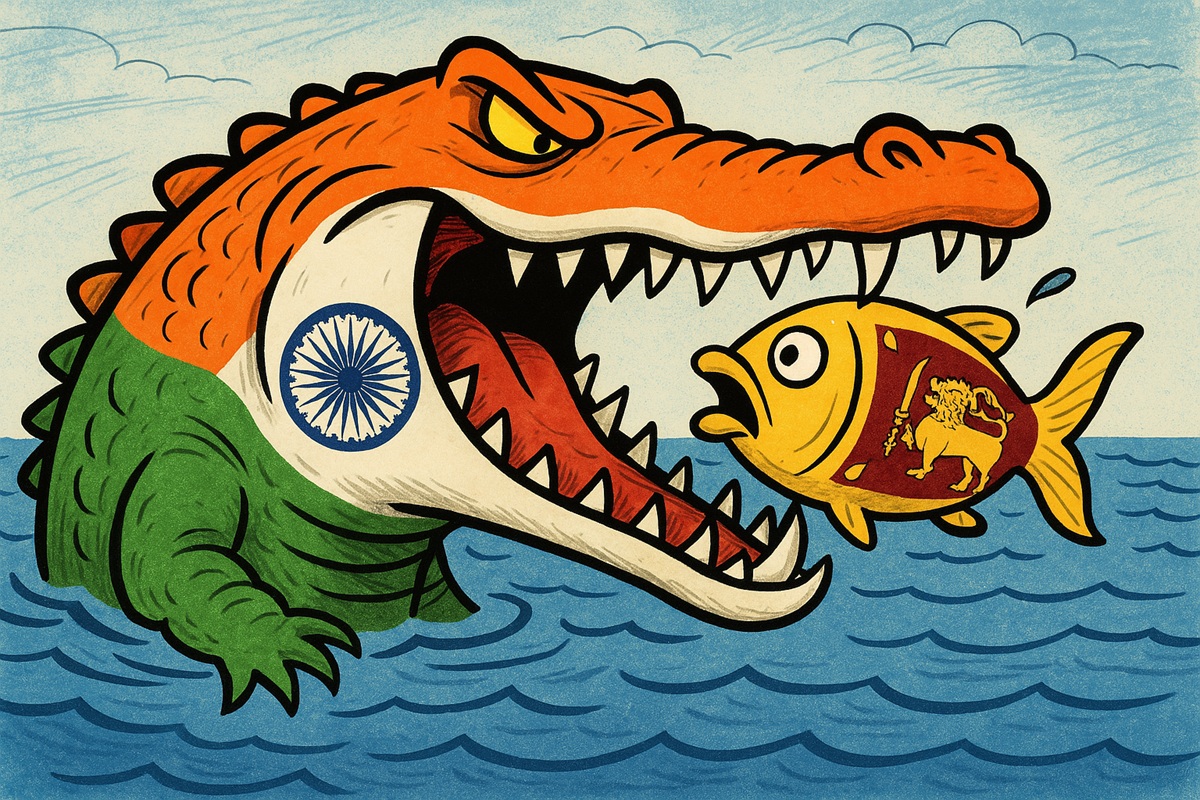
The cartoon speaks more loudly than any document. A crocodile, metaphorically draped in the Indian flag, devouring a small Sri Lankan fish painted with our identity. It is not satire—it is prophecy. The fish has no weapons, no voice, no strategy. Only hope. And as the crocodile’s jaws close, even hope evaporates.
This government, morally vacant, ideologically bankrupt, and intellectually hollow, has taken a battered country and turned it into a stage play of sovereignty—elaborate costumes, elaborate lies. We are governed by actors who believe themselves kings, who mistake applause for mandate, and who will sign anything, so long as the cameras are flashing.
There are moments in a nation’s life when silence amounts to treason. This is such a moment. The question is no longer whether the government is selling the country. The question is whether we, the people, are willing to stop buying their story.
This is no longer governance.
It is theatre.
And the curtain is falling.