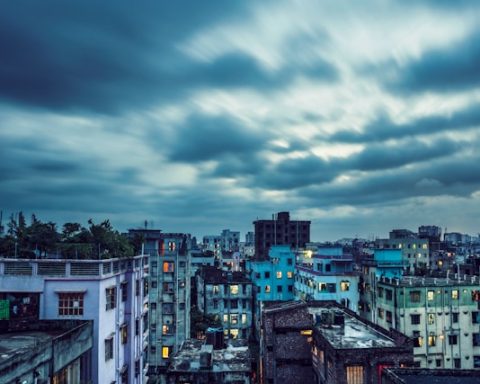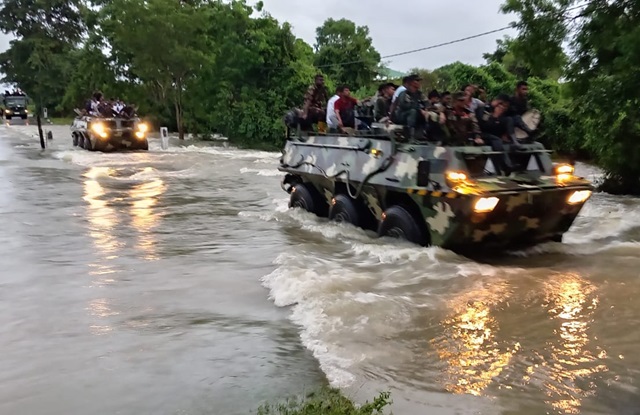
Sri Lanka teeters on the edge of disaster, and the government’s slow, ineffective response risks pushing the nation into chaos. A deep depression in the Bay of Bengal has already escalated into a severe weather crisis, with the Met Department issuing a ‘Red Alert’ for most of the country. Torrential rains exceeding 300mm, gale-force winds reaching 70 kmph, and coastal surges threatening life and infrastructure make this one of the most severe weather events in recent history. So far, over 77,670 individuals across 15 districts are already impacted, with 2,770 people displaced, and tragically, lives have been lost.
The horrifying incident in Karaitivu, where seven people, including five children, were swept away in floodwaters, epitomises the cost of inaction. How many more must perish before the government acknowledges that this is not just a weather event—it is a crisis of national governance?
The government’s response so far has been pathetically reactive. The decision to postpone the Advanced Level examinations scheduled for the coming days is necessary but embarrassingly overdue. Flights have been diverted, roads are submerged, and countless citizens face imminent danger. Yet, leadership remains paralysed. Decisions, when made, arrive late, piecemeal, and without the decisive coordination necessary to prevent further loss. This is not governance; it is abdication of responsibility.
What is required now is not incremental action but a National Emergency declaration to mobilise all resources at the government’s disposal. The island faces an impending cyclone, and yet we see non-essential services operating, individuals travelling unnecessarily, and authorities failing to enforce disaster preparedness measures. This is not merely negligence—it is a gross dereliction of duty.
Non-essential services must immediately cease. People should not be travelling or risking their lives unnecessarily during this catastrophic weather. The government must issue a directive requiring all non-essential workers to work from home and enforce compliance with this measure. Essential services such as healthcare, emergency response, and utilities must continue with full support from authorities, but all other operations must halt until the storm subsides. Every unnecessary journey and open office is a potential deathtrap during a crisis of this magnitude.
The statistics alone are damning. Six houses have been completely destroyed, 265 partially damaged, and infrastructure across districts is collapsing under the strain of nature’s fury. Emergency shelters, accommodating thousands, are overwhelmed, and the Disaster Management Centre has proven woefully ill-equipped to handle the scale of this crisis. If this is the government’s idea of a “prepared” response, the people of Sri Lanka deserve to be outraged.
Consider the tragic fate of the children swept away in Karaitivu—this was no unavoidable act of God but a preventable disaster borne of human failure. Why were schoolchildren allowed to travel in flood-prone areas despite warnings? Where were the local authorities? This incident highlights a systemic failure of communication, enforcement, and care for human lives. The Met Department’s warnings are only as good as the government’s ability to act on them. Right now, that ability is nowhere to be seen.
Delaying exams, diverting flights, and issuing advisories are important, but they do not constitute a comprehensive response. What is needed is an immediate, coordinated effort to safeguard lives, enforce strict safety measures, and prioritise essential services for the public. Non-essential activities must cease immediately, and a robust framework must be put in place to protect vulnerable communities, especially those in coastal and flood-prone areas. Lives depend on it.
A National Emergency declaration would not only enable better coordination but also send an unambiguous message to the people: their government is finally ready to take this crisis seriously. It would allow for the mobilisation of the military, the prioritisation of resources to disaster-stricken areas, and the strict enforcement of safety directives. Most importantly, it would ensure that every available tool—communication networks, logistical infrastructure, and emergency relief systems—is fully engaged to minimise the loss of life and property.
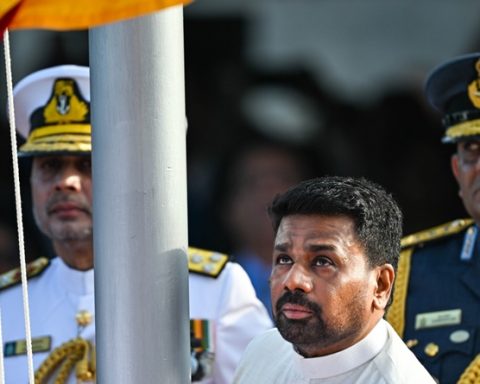
This storm is not merely a test of Sri Lanka’s infrastructure but a reflection of the state of its leadership. President Dissanayake must act decisively and act now. To delay any further is to court more deaths, more displacement, and more destruction. The time for excuses has passed. Sri Lanka cannot afford to stumble from one poorly managed crisis to the next, always reacting too late, always failing those most in need.
The people of this nation deserve leadership that is proactive, decisive, and compassionate. They deserve leaders who place their safety above bureaucratic delays and political hesitation. They deserve a government that does more than issue statements—it must take action.
Mr President, declare a National Emergency. Mobilise resources. Save lives. Shut down all non-essential services. Enforce work-from-home measures. Let this not be another chapter of avoidable tragedy in Sri Lanka’s history. Let this be the moment when decisive action prevented disaster. The clock is ticking, and every second counts.