by Our Correspondent in Colombo
In a visit to Kandy on February 23, 2025, President Anura Kumara Dissanayake focused on a cultural matter, announcing plans to hold an exhibition of the Tooth Relic after the Sinhala-Tamil New Year. However, his comments regarding the nation’s security have raised alarm, as he downplayed the significant threat posed by organized crime groups that are currently wreaking havoc across Sri Lanka.
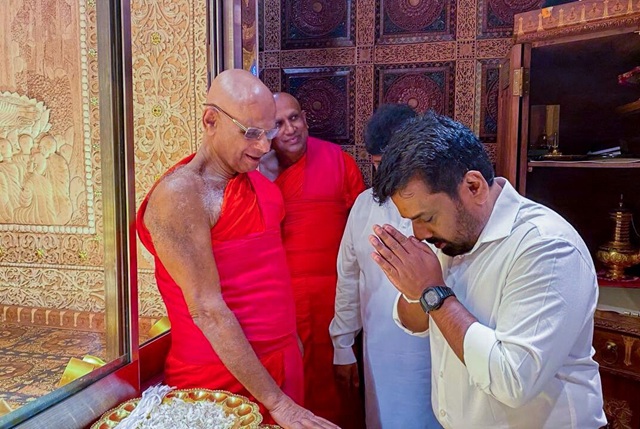
During his visit, the President paid homage at the Sri Dalada Maligawa, where he addressed the media and made statements on national security. While discussing the recent increase in clashes between underworld factions, he claimed there was no imminent threat to the country’s security, suggesting that these incidents had not yet posed a serious risk to the general public.
However, Dissanayake’s reassurances have been met with concern from security experts and law enforcement officials. The Acting Inspector General of Police, Priyantha Weerasuriya, highlighted the growing scale of organized crime in the country, with 58 active crime groups and around 1,400 of their followers identified. Weerasuriya, speaking at a recent security briefing, stated that these groups, once shielded by political protection, have become increasingly emboldened following the loss of such backing. This has led to a rise in violent incidents, including shootings and abductions, with 75 shootings and 18 abductions recorded in 2024 alone. So far in 2025, there have already been 22 incidents, including 17 shootings and five abductions, sparking concern over the level of violence.
The President’s dismissal of these growing threats stands in stark contrast to the warnings issued by law enforcement, who are engaged in a battle to dismantle these criminal networks. The police have made significant strides in cracking down on narcotics trafficking and other crimes, seizing large quantities of heroin, cannabis, and illegal liquor. Yet, despite these efforts, the influence of organized crime continues to spread, both domestically and internationally, with several criminals operating from abroad after fleeing Sri Lanka.
Weerasuriya revealed that many of the key figures behind these crime syndicates are now operating from overseas, making it harder for local authorities to apprehend them. The police have cooperated with international law enforcement agencies to bring some of these criminals back to Sri Lanka. In total, 19 criminals have been extradited to the country, while 199 red notices and several other international alerts have been issued for additional suspects. Additionally, criminal activities from prisons have continued, with reports of criminals running operations from behind bars, further complicating efforts to control the situation.
Despite these ongoing challenges, President Dissanayake’s focus on a cultural event, rather than a firm stance on tackling organized crime, has left many questioning his priorities. His statement that there is no significant threat to national security appears disconnected from the reality on the ground, where ordinary citizens are facing the brunt of the violence and lawlessness. The President’s remarks seem to ignore the urgent need for stronger measures to combat crime, particularly as the criminal underworld becomes more entrenched and sophisticated.
The Sri Lankan public, already on edge due to the escalating violence, may find little comfort in the President’s reassurances. While cultural events like the Tooth Relic exhibition are important, many believe that the government must address the immediate and growing threat posed by organized crime. With more violent incidents being reported and no signs of the situation improving, critics are urging the President to shift focus from ceremonial matters to concrete actions aimed at ensuring the safety and security of the citizens.