The CIVICUS Monitor announced in a new report Wednesday that the main civic space violations across the Asia-Pacific were the crackdown on protests and the criminalisation of human rights defenders.
The report, People Power Under Attack 2024, assesses civic space conditions in 198 countries and territories, looking at citizens’ ability to exercise their freedoms of assembly, association and expression. In the Asia-Pacific region, CIVICUS Monitor researchers found the majority of countries seriously restricted civic space.
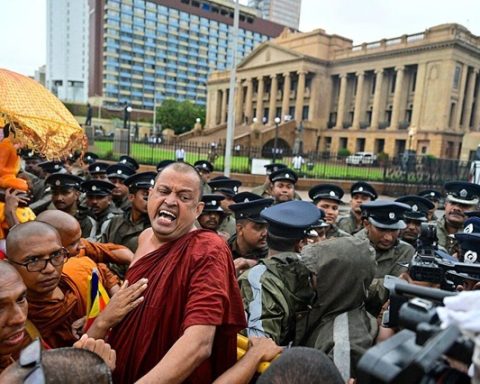
In Sri Lanka, where the state of civic space is rated by the CIVICUS Monitor as ‘repressed’, there was a systematic crackdown on protests. Police used tear gas and water cannons in January 2024 to disperse an opposition protest. in the capital, Colombo, against increasing taxes, as well as hiking prices for electricity and fuel. In February 2024, security forces shot tear gas and fired water cannon at Tamil students as they marched on Sri Lanka’s 76th Independence Day, with Tamils across the North-East launching demonstrations to mark it as a ‘Black Day’. In the same month, police used water cannon and tear gas to disperse a protest organised by the Inter-University Students’ Federation (IUSF) aimed at highlighting and seeking solutions to the challenges confronting the state university system.
In May 2024, human rights groups documented arrests and threats around commemorations marking the 15th anniversary of the end of Sri Lanka’s internal armed conflict. The authorities also obtained court orders to prevent some relatives of forcibly disappeared people and others from attending events. In June 2024, police attacked a protest involving around 10,000 teachers outside the Fort Railway Station and adjacent roads in Colombo. Three teachers were hospitalised and others were injured in an assault involving water cannon and tear gas.
Human rights defenders also faced reprisals. Asanka Abeyrathna, a human rights activist and a member of the Movement For People’s Council, was arrested in February 2024 during a protest and awareness campaign calling for justice for enforced disappearances, organised by the “Families of the Disappeared.” The trial of the human rights lawyer continued in 2024. Hizbullah is a lawyer and human rights defender known for advocating for the members of the minority Muslim Community in Sri Lanka.
Journalists were also targeted. Three Tamil journalists, Prabhakaran Dilaksan, Sundarampillai Rajeskaran, and Chinnaiya Yogeswaran, were threatened in February 2024 by the Sri Lankan army as they attempted to cover a gathering of civilians visiting a temple within the ‘High-Security Zone’ in Palali Vasavilan, Jaffna.
Freedom of expression remains at risk. Sri Lanka’s lawmakers passed the Online Safety Act in January 2024 regulating internet use among its citizens. The Online Safety Act provides broad powers to an ‘Online Safety Commission’ including deciding on what constitutes “prohibited statements” and making recommendations to internet service providers to remove such content and disabling access for those deemed offenders.
There are concerns that a proposed Non-Governmental Organisations (NGOs) (Registration and Supervision) Act of 2024 (which currently remains a Bill) to replace the Voluntary Social Service Organisations Act of 1980 (VSSO), could curtail freedoms available and pave the way for the governmental authorities to unjustifiably interfere with their work.
In Asia, seven countries and territories – Afghanistan, China, Hong Kong, Laos, Vietnam, Myanmar and North Korea are rated as ‘Closed’. Nine countries are rated ‘repressed’ while six countries are now in the ‘Obstructed category’. Civic space in South Korea and Timor-Leste are rated ‘narrowed’ while Japan and Taiwan are the only two countries rated ‘Open’ in the Asia region.
In the Pacific, the civic space situation is more positive with seven countries rated ‘Open’. Five rated ‘Narrowed’ while Papua New Guinea and Nauru remain in the ‘Obstructed’ category.
There were changes in ratings to four countries. Bangladesh was upgraded to ‘Repressed’ due to steps taken by the interim government to address civic space concerns following the mass protests in Bangladesh that led to the fall of the former Prime Minister Sheikh Hasina’s government. Japan has also been upgraded to ‘Open’ as civil society groups were able to undertake their work across the country without barriers and the rights to peaceful assembly were generally respected and protected. Fiji was upgraded too due to improvements since the change of government in December 2022, including the repeal of a restrictive media law used to silence the press since 2010.
Mongolia on the other hand has been downgraded to ‘Obstructed’ as human rights defenders face reprisals, journalists were targeted on baseless charges for their work while peaceful protesters have been criminalised.
“The overall picture for civic space in the Asia-Pacific region this year remained dismal, despite some improvements in countries like Bangladesh, Japan and Fiji. Most people in the region are living in countries with ‘closed’ or ‘repressed’ civic space where their freedoms to speak up, organise or mobilise are under attack on a daily basis. Authoritarian states are seeking to entrench their rule and there is a critical need to support activists and civil society from these countries who are pushing back against these repressive regimes,” said Josef Benedict, CIVICUS Monitor’s Asia-Pacific researcher.
The CIVICUS Monitor rates each country’s civic space conditions based on data collected throughout the year from country-focused civil society activists, regionally-based research teams, international human rights indices and the Monitor’s own in-house experts. The data from these four separate sources are then combined to assign each country a rating as either ‘Open,’ ‘Narrowed,’ ‘Obstructed,’ ‘Repressed’ or ‘Closed.’
The most widespread violation to civic freedoms in the Asia Pacific documented over the past year was the detention of protesters. Activists took to the streets for a wide range of issue, including demands for democratic reforms, labour rights, environmental justice, and calling for an end to the human rights violations in the Occupied Palestinian Territories. In many cases, the security forces resorted to excessive force leading to injuries and even unlawful killings.
Among the countries where this was documented include Pakistan where the government crackdown on the opposition around the elections. In Bangladesh, hundreds were detained as part of a brutal crackdown on the mass student-led protests in July 2024, that eventually brought down the Sheikh Hasina regime. In Sri Lanka police cracked down on protests by the opposition, students and ethnic Tamils while in India farmers mobilising protests faced excessive force. While in Indonesia, the security forces repressed multiple protests in the region of Papua, where there has been a high level of violations. Protesters across Australia mobilising for environmental issues and to end the war in Gaza were detained.
“These actions are a flagrant violation of the rights to peaceful assembly guaranteed under international human rights law and standards,” added Benedict.
Another top violation that was documented across the region was the detention and prosecution of human rights defenders. The main perpetrators were China, Hong Kong, Myanmar, Vietnam, Cambodia, Thailand and India. Many were criminalised for defamation and on fabricated charges linked to national security, anti-terrorism or public order laws. In addition, transnational repression, where countries collaborate to target human rights defenders beyond their borders, is on the rise.
Censorship is also a key concern in the region, most noticeably in China, where the government employs one of the most sophisticated censorship regimes in the world. Other countries where censorship was documented include North Korea, Myanmar, Pakistan and India. Over the year, the authorities used their power to restrict access to information critical of the state by blocking television broadcasts and news portals, restricting access to social media apps, suspending mobile internet services and targeting journalists and news outlets. There was an increase of censorship ahead of elections in Pakistan and Bangladesh. In the Pacific, there were censorship concerns in Nauru and the Solomon Islands.
“Governments across the region sought to detain and prosecute human rights defenders across the year on trumped-up charges using a range of repressive laws. Censorship was also pervasive in a number of countries to stifle critical voices and block the critical flow of information. The international community must do more to protect fundamental freedoms and support activists in detention,” added Benedict.