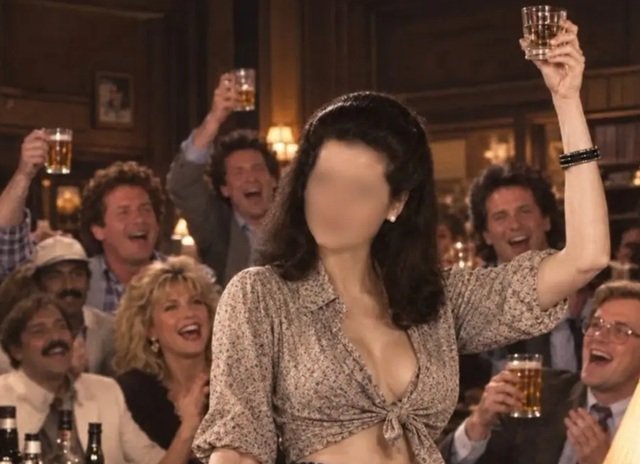
This week in India, a decades-old smear against Sonia Gandhi was given a new technological life. Crude AI-generated images portrayed the 79-year-old Gandhi, former Congress president and sitting Rajya Sabha MP, as a “bar dancer”. Several of the images were circulated on social media by official State handles of India’s ruling BJP. As Frontline India reported, the episode demonstrated not the invention of a new political insult, but the transformation of an old one into something that can now be manufactured and reproduced with unprecedented ease.
The political significance of the images lies partly in the particular form of the attack. Being seen has never been a neutral matter for women in politics. Public visibility can become a political test in which appearance, sexuality, family, age and behaviour are repeatedly assessed against expectations of femininity. Hillary Clinton, wearing pantsuits during the 2016 US presidential campaign, was portrayed through accusations that she was ambitious, emasculating and untrustworthy. In Germany, Chancellor Angela Merkel attracted political scrutiny after wearing a low-cut gown at the opening of the Oslo opera house in 2008, after which she carefully developed a public image centred on restrained suits. When New Zealand Prime Minister Jacinda Ardern gave birth in 2018, photographs of her with her newborn visibly connected motherhood with political leadership.
The pattern continued elsewhere. In August 2022, leaked videos showing Finland’s Prime Minister Sanna Marin dancing and drinking with friends generated international controversy. Kamala Harris faced sustained scrutiny of her appearance and personal life during the 2020 US election and the early months of her 2021 vice-presidency. Harris was the subject of about 17,000 news stories between August 2020 and April 2021, with attention focused on her pearls, wardrobe and relationships within sexist and racialised narratives. Across these different political and cultural settings, women leaders have repeatedly been expected to reconcile political authority with culturally acceptable forms of femininity.
The Sonia Gandhi episode acquires another layer because of the political language surrounding women’s empowerment in India. The BJP has made Nari Shakti, or “women power”, women’s representation and women’s empowerment central to its public vocabulary. Against that backdrop, the circulation through institutionalised social-media machinery of sexualised images designed to denigrate one of India’s most senior women politicians presents a striking contradiction in the political use of gender.
Yet the technology itself is not the origin of the smear. The “bar dancer” trope associated with Gandhi predates generative AI by many years. For more than a decade, social-media users have circulated photographs of Marilyn Monroe, Ursula Andress and other unrelated women while falsely presenting them as images of Gandhi. Existing photographs have also been altered to construct the same invented biography, portraying her as a bar dancer or waitress. Fact-checkers have repeatedly debunked the claims. What generative AI changes is not necessarily the content of the fantasy, but the ease with which that fantasy can be converted into new visual material.
It would therefore be tempting to describe the episode simply as another example of deepfake politics. But the central change is broader. The misogynistic visual itself is not entirely new. What is new is the ease and scale with which such images can be generated and multiplied. Political propagandists no longer necessarily need to locate an existing photograph that appears to support a fabricated narrative. The technology can produce the photograph required by the narrative itself.
That distinction matters because political images have always influenced how audiences understand leadership. This is particularly consequential for women, whose bodies often acquire political meanings in ways that men’s bodies do not. Clothing can be interpreted as a sign of seriousness or frivolity. Motherhood can suggest care while simultaneously provoking questions about professional commitment. A smile can communicate warmth or be interpreted as insufficient authority. Sexuality, marriage, age and appearance can all become material through which political competence is judged.
Women politicians consequently face an additional dimension of political visibility. They are not judged solely by their policies, speeches or political work. They must also navigate the expectations attached to how a woman in public life is supposed to look and behave.
The “bar dancer” imagery directed at Gandhi exploits precisely these codes. It does not merely attempt to make an existing photograph look unflattering. It constructs an alternative version of the woman herself. The bar, the dancing, the clothes, alcohol, youth and suggestion of sexual availability combine to place Gandhi outside an imagined sphere of respectable womanhood. Her Italian origin introduces another layer, allowing foreignness, sexuality and cultural belonging to be fused into a single political judgement. The attack therefore works by constructing what the source describes as the “wrong” kind of woman before using that construction to attack the politician.
Generative AI becomes powerful in this context because it enters a political culture in which these visual meanings already exist. AI does not have to invent what a woman drinking in a bar, dancing at a party or wearing particular clothes means to an audience. Those meanings have already been produced by society. The technology simply makes them easier to reproduce. A user can generate an image of a woman in a nightclub, alter her age, change her clothes and introduce an existing photograph to create facial similarity. Video generation can then make an invented body dance.
The consequence is a potentially profound change in the politics of visual propaganda. The propagandist no longer needs to search the visual archive for an image that fits the story. The story can produce its own archive. Repetition then becomes central. Each new fabricated image can place the same woman within a familiar moral frame, making the invented biography increasingly recognisable through sheer recurrence.
The experience of Sanna Marin offers a useful comparison. The controversy surrounding images of Marin dancing was not simply about what she had done. Audiences were encouraged to interpret her body behaving in ways considered inconsistent with expectations of a prime minister. Political opponents even demanded that she undertake a drug test. Scholars described the episode as a crisis of political visibility as much as one of conduct.
Generative AI potentially takes this form of politics further. It can make an invented body perform an invented act and then circulate that performance as political evidence. This means debates about political AI cannot stop with the question of whether an image is authentic. Detection and labelling remain necessary, but they answer only one question: Did this event happen?
Visual politics raises another question: why does an invented image make this particular body dance? And how does that image make the body politically vulnerable? For women politicians, the questions are particularly significant because representations of their embodied political presence can increasingly be reproduced, manipulated and detached from their actual conduct.
Generative AI did not create the double standards surrounding women in public life. It did not invent sexualisation, moral judgement or demands for feminine respectability. What it changes is who can produce such material, how quickly it can be made and the scale at which it can proliferate. Women politicians may spend years negotiating their public identities within a political culture shaped by gendered expectations. Generative AI introduces a mechanism capable of rewriting those identities almost instantly.
The central problem, therefore, is not simply that political images can now be fake. It is that technology can make old prejudices infinitely easier to reproduce. The fabricated image does not need to prove that a woman behaved in a particular way. It only needs to make the invented behaviour familiar enough to become part of the political imagination. In that sense, synthetic misogyny is not a wholly new prejudice. It is an old one equipped with a new production system.