The incident is laden with irony. The United States — a nation built on the fundamental tenets of free trade, well-entrenched with a fairly level playing field — now appears to be sowing thorns in that very system. This is causing concern across the world, especially for its northern neighbor, Canada. Canada’s economy is deeply integrated with that of the U.S. across multiple fronts.
It is profoundly tied to the American economy, impacting sectors ranging from trade and investment to infrastructure and labor. The proximity of the two nations and a series of trade agreements — most recently the Canada–United States–Mexico Agreement (CUSMA) — have fostered deep and multilayered economic ties.
For centuries, favorable trade activity has prevailed and thrived across this landscape. Yet now, it seems a corrosive spanner has been thrown quite irresponsibly into a well-lubricated and functioning machine. To be precise, it’s the handiwork of an ill-informed and immature president. A concerned neighbor has tried valiantly to inject some degree of sanity, but to no avail.
Effective communication — advertising — lies at the heart of all commercial activity. Proper conception and execution of such communication are key to success in any domain. Here, we have a case where an advertising campaign, designed by the government of Ontario in Canada, exposed the potential ill effects of Trump’s tariffs. Everything went according to plan, culminating in a eureka moment for the campaign’s sponsors. The message itself, however, angered the very person entangled in it — President Trump.
The Ontario government hit the nail on the head. It’s a classic example of mastering the finer points of the craft, from Madison Avenue itself, to strike hard at the U.S. administration. It was a job well done — a game changer, and the first irony. In other words, Canada successfully sharpened and fine-tuned an indigenous American craft to push back against sheer madness — a feat that both Americans and Canadians could applaud.
Madison Avenue has long been synonymous with advertising, having become the epicenter of the American advertising industry during its boom in the 1920s and again in the post–World War II era. This robust American tradition of persuasive communication turned into a metonym for the industry itself, thanks to the concentration of major agencies along that iconic New York street.
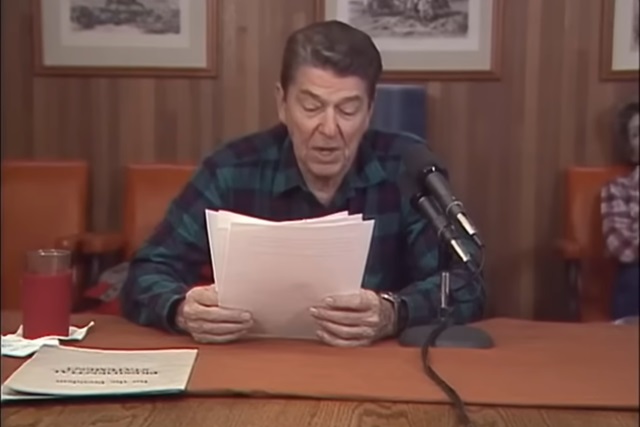
The president, palpably perturbed by the ad, demonstrated the second irony. True to form, he responded with childish and immature behavior — slapping further tariffs on Canada. People began freely discussing the Ontario government’s ad that had attracted the wrath of President Donald Trump. The ad, aired in the U.S., featured audio clips from a 1987 speech by President Ronald Reagan criticizing tariffs. It seemed to have incensed Trump, who denounced it as “fake,” abruptly cut off trade talks, and accused Canada of interfering with an upcoming U.S. Supreme Court decision.
President Ronald Reagan frequently spoke in favor of free and open markets. He often cited the economic and geopolitical benefits of free trade, arguing that it led to prosperity and peace. His administration pursued and signed significant free-trade agreements, including the 1988 Canada–United States Free Trade Agreement, which laid the groundwork for NAFTA. He also launched the Uruguay Round of multilateral trade talks, which eventually led to the creation of the World Trade Organization (WTO). Reagan’s overall economic philosophy, known as “Reaganomics,” favored free-market principles like lower taxes and reduced regulation. He viewed protectionist policies as a drag on economic growth and job creation.
“That ad worked. It was a good ad,” said Alex Marland, a professor at Acadia University and author of a book on political messaging. He noted that the challenge for political advertising is to cut through the clutter, resonate with people, and capture their attention. “In this particular case, the ad was so successful that the president was upset.”
It is injudicious, if not downright foolish, for politicians — wherever they may live — to seek legacy or immortality by harming their own people. In this case, it is virtually the entire world that has been exposed to the ill-conceived rationale of a single man.
Would you like me to make it more journalistic (e.g., suitable for publication in an op-ed or news magazine) or keep it as a more reflective essay style?