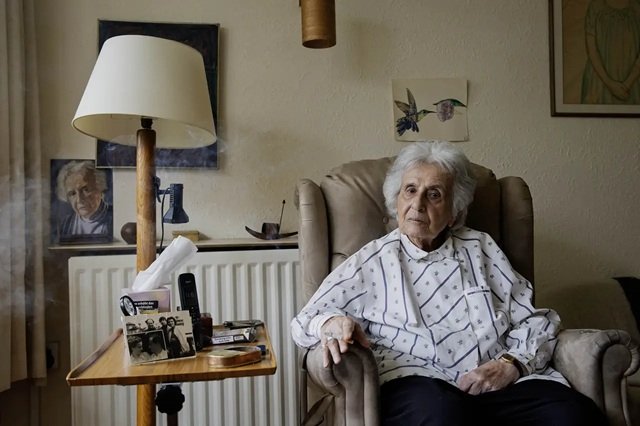
Anita Lasker-Wallfisch speaks with a clarity that resists time. Her voice, described in Observer UK accounts of her life and testimony, is forthright, steady, and entirely free of self-pity. It is not the voice of someone seeking sympathy, but of someone determined to ensure that what happened is neither softened nor forgotten. She survived Auschwitz and Bergen-Belsen, two of the most infamous Nazi concentration camps, yet her presence is defined not only by survival but by her insistence on bearing witness with precision and discipline.
When she was first encountered by observers in post-war Europe, what struck them most was not simply her history but her manner of speaking about it. Even decades later, she would recount events with a structural clarity that resembled documentation more than recollection. Her testimony, later published and widely studied, reflects a life shaped by destruction, displacement, and the ongoing responsibility of memory. It is a narrative that refuses emotional distortion while remaining deeply human in its detail.
Born into a cultured German-Jewish family, Lasker-Wallfisch grew up surrounded by music, education, and professional stability. Her father was a lawyer, her mother a musician. This environment was dismantled systematically under Nazi rule, as laws were constructed to exclude, isolate, and ultimately deport Jewish citizens. Her family was torn apart by these policies, leading to her imprisonment and eventual deportation to Auschwitz in 1943.
At Auschwitz, she became part of the women’s orchestra, forced to play music under the direction of Alma Rosé, a violinist of extraordinary discipline and authority. The role of the orchestra within the camp was deeply paradoxical. Music, traditionally associated with expression and humanity, was transformed into an instrument of control. Prisoners were made to perform during arrivals, departures, and even executions. The presence of music did not soften the brutality of the camp; instead, it became part of its structure.
Lasker-Wallfisch’s testimony repeatedly returns to this contradiction. She described how music accompanied the most horrific moments, creating a psychological dissonance that is difficult to comprehend outside lived experience. The orchestra was not a refuge but a survival mechanism embedded within a system of violence. It provided temporary protection from death but also placed its members in direct proximity to the machinery of extermination.
After Auschwitz, she was transferred to Bergen-Belsen. If Auschwitz represented industrialised mass murder, Bergen-Belsen represented collapse through neglect. There were no gas chambers, but there was starvation, disease, and complete breakdown of sanitation and medical care. Prisoners died in vast numbers from typhus and malnutrition. When liberation finally came in April 1945, it arrived not as a moment of triumph but as an encounter with devastation beyond comprehension.
British forces entering the camp, as later recalled in historical accounts cited by Observer UK, encountered scenes that defied expectation. Soldiers had not been prepared for the scale of death and suffering they found. Bodies lay unburied, survivors were emaciated, and disease was widespread. For Lasker-Wallfisch and others, liberation was not an immediate transition to safety but the beginning of a complex and uncertain recovery.
In the days following liberation, she spoke to a BBC broadcaster, delivering one of her earliest public testimonies. In that broadcast, she identified herself clearly and without hesitation, describing her experiences in Auschwitz and Bergen-Belsen in direct terms. She explained selection processes at the camps, the separation of families, and the systematic killing that occurred upon arrival. Her words were not abstract. They were grounded in observation and memory, delivered with urgency because she feared the world might not believe her.
She described the presence of doctors and commandants selecting prisoners upon arrival, sending some immediately to forced labour and others to death. She spoke of the crematoria, of smoke, of hunger, disease, and exhaustion. Her account was detailed, structured, and unembellished. It was not an attempt to dramatise events but to ensure their accuracy.
One of the most haunting elements of her testimony is the role of music within the camps. She explained that orchestras were required to play during operations that led directly to mass murder. The coexistence of music and death created a moral and psychological contradiction that remains difficult to fully articulate. It is this contradiction that continues to define much of her legacy.
After liberation, she remained in displaced persons camps, working as an interpreter and waiting for permission to relocate. The post-war period was not immediate resolution but prolonged uncertainty. Survivors were often without homes, families, or clear legal status. During this time, she also witnessed early trials of Nazi officials, including proceedings held in Lüneburg. Her participation as a witness brought her face to face with the legal system attempting to process crimes of unprecedented scale.
Her reaction to these trials was complex. While she acknowledged the importance of accountability, she also expressed deep scepticism about the adequacy of conventional legal frameworks. The trials, in her view, often felt insufficient when confronted with the magnitude of the crimes committed. The principle that individuals were “innocent until proven guilty,” while foundational to justice, appeared inadequate in the context of systematic mass murder. She questioned whether ordinary legal language could ever fully address such extreme violence.
This tension between justice and comprehension remains central to her reflections. The legal process required categorisation, evidence, and procedure. The Holocaust, by contrast, represented the collapse of moral and legal order itself. Reconciling these two realities was, for her, deeply problematic. Even when perpetrators were convicted, she remained aware of the limitations of the system.
Her eventual relocation to Britain marked the beginning of a new life, though not a departure from memory. Entry into the country required bureaucratic manipulation, including falsified age documentation arranged in exchange for cigarettes. These adjustments were practical necessities in a world still recovering from war, but they also underscore the arbitrary nature of survival in the post-war period.
In Britain, she rebuilt her life as a professional cellist. Music, once used as a mechanism of oppression, became again a form of artistic expression. She helped establish orchestras and performed internationally, contributing to the cultural life of her adopted country. Yet her past remained inseparable from her identity. She did not treat survival as closure, but as responsibility.
Over time, she became one of the most significant Holocaust witnesses in Europe. Her memoir, public appearances, and interviews contributed to historical understanding of the camps. What distinguishes her testimony is not only its content but its consistency. She has repeatedly returned to the same clarity of description, refusing to soften language or simplify events for comfort.
Even in advanced age, her reflections remain focused on truth rather than consolation. She continues to express concern about rising antisemitism, historical denial, and the fragility of collective memory. She questions whether the world has fully absorbed the lessons of the Holocaust, or whether memory is gradually being replaced by abstraction.
As Observer UK has noted in its coverage of her life, Lasker-Wallfisch represents a rare form of witness: one who does not merely recall history but actively resists its erosion. Her testimony is not static. It functions as an ongoing intervention in public understanding, insisting that remembrance must remain active rather than ceremonial.
Her life ultimately raises profound questions about the relationship between memory, justice, and survival. What does it mean to speak truthfully about events that defy comprehension? How does one translate extreme human experience into language without distortion? And what responsibility does the survivor carry in a world that moves further away from the events they endured?
Lasker-Wallfisch does not answer these questions directly. Instead, she embodies them. Her presence, her words, and her insistence on precision form a continuous reminder that history is not only something that happened, but something that must be actively preserved against forgetting.
In that sense, her testimony is not only about the past. It is about the present, and the ongoing struggle to ensure that what was witnessed is never lost to silence.