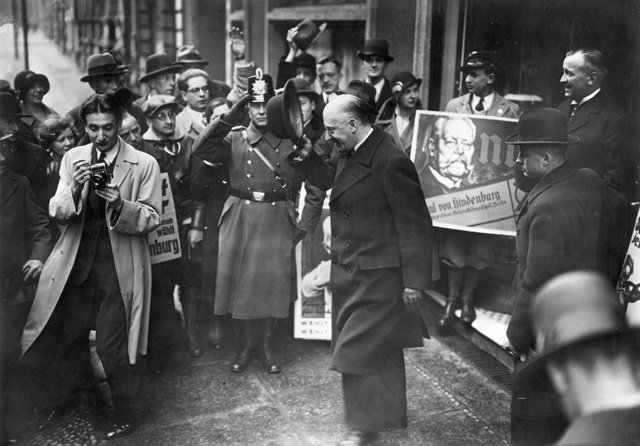
An August 1931 encounter in Rome left Heinrich Brüning, Germany’s chancellor, visibly dispirited. According to Erwin Planck, an Oberregierungsrat in the Reich Chancellery, the impression made on Brüning by Benito Mussolini was so strong that the chancellor increasingly spoke as though Mussolini possessed something like a “natural Caesar” quality, while political circumstances were turning Brüning himself into one.
That observation lies at the centre of a historical question explored by Die Zeit: what did Brüning do, or fail to do, during his term as Reichskanzler from March 1930 to May 1932 that made the emergence of Adolf Hitler more or less likely?
The answer presented in the article is uncomfortable. Brüning did not become Germany’s dictator, nor was he Mussolini. But his government helped advance an authoritarian transformation of the Weimar Republic, weakening parliamentary government and concentrating political power in an increasingly narrow circle surrounding Reich President Paul von Hindenburg.
Brüning’s decision to become chancellor was itself crucial. In 1929/30, the experienced parliamentary politician and leader of the Catholic Centre Party faction in the Reichstag accepted the proposal of the Reich President and Reichswehr leadership to become the first chancellor of a so-called presidential cabinet, governing without the normal parliamentary basis.
Parliamentary democracy, the account argues, meant relatively little to Brüning compared with his loyalty to Hindenburg. His experience during the final phase of the First World War, when he had commanded a company in a unit directly subordinate to the Oberste Heeresleitung, had left a lasting impression. His devotion to Hindenburg became a defining feature of his political conduct.
The institutional consequences were profound. In the presidential cabinets, the government became more dependent on the Reich President than on the Reichstag. Brüning’s restrained manner, modest personal style and introverted character could obscure the significance of that transformation.
The real power of government increasingly contracted into the hands of a small group. The political scientist Theodor Eschenburg later described the extraordinary concentration of authority under a democratic constitution: four men — Hindenburg, Brüning, Reichswehr Minister Wilhelm Groener and his close associate Kurt von Schleicher — had become the figures making consequential decisions.
And this happened without a revolution or formal overthrow of the constitution.
The group also sought to remove political parties from the formation and direction of government. Above all, the target was the SPD. For the Reichswehr leadership, the Social Democrats had become unacceptable after the experience of Hermann Müller’s Grand Coalition, when the party leadership had shown understanding towards military demands for accelerated rearmament but its wider membership had not.
The broader political conflict reflected the upheavals created by the First World War. Between 1914 and 1918, governments across the industrial powers had maintained their war efforts partly by making major concessions to organised labour. Trade unions were recognised, wages for skilled workers in war industries rose, and governments intervened deeply in economic and social affairs. Families of conscripted soldiers and survivors of those killed were supported; wages and salaries were regulated; food and raw materials were allocated; and large portions of national output were redistributed.
John Maynard Keynes argued in his post-war work The Economic Consequences of the Peace that these developments had unintentionally exposed the supposed naturalness of social inequality. The experience demonstrated that an interventionist state could reduce inequality — provided political parties existed that sought to pursue such policies.
Across interwar Europe, increasingly autocratic and dictatorial regimes sought to marginalise social democratic, socialist and communist parties. The account in Die Zeit places Brüning within that broader reaction against the political and social consequences of the war.
One of the decisive moments came in July 1930, when Hindenburg and Brüning dissolved the Reichstag after it rejected the first emergency decree. The timing was particularly consequential because the NSDAP was expected to gain support. The election of 14 September 1930 produced a political earthquake: the NSDAP increased its representation from 12 to 107 deputies and became the second-largest parliamentary faction after the SPD.
There was another possible path. Had the Reichstag not been dissolved, the next election would have taken place regularly in 1932. During the banking crisis of 1931, when mass unemployment was approaching its peak, the NSDAP would not yet have had the same opportunity to disrupt parliamentary politics.
Instead, Brüning pursued an increasingly authoritarian course. Thomas Mann, in his Deutsche Ansprache in October 1930, called for support for the Social Democrats as the only remaining major democratic party capable of defending the republic. Brüning chose another strategy. He attempted to persuade Hitler at a meeting to attack him politically and behave as an opposition leader, apparently seeking to make himself indispensable as the final barrier against National Socialism.
The economic crisis deepened the political consequences. Brüning drastically reduced public spending and prohibited municipalities from borrowing and investing. His deflationary policy intensified mass unemployment. But the Die Zeit account argues that the policy was not simply the result of economic theory or an attempt to eliminate reparations. Brüning also wanted to reduce the size of the state, alongside industrial associations and bourgeois parties.
The aim was a state that collected less tax and spent less money.
The reparations question became another source of tension. Hindenburg had told Brüning that he would never again sign a reparations settlement, as he had done in 1930 when he signed the Young Plan. Brüning sought the abolition of reparations, but his approach provoked anger in France, narrowed the French government’s room for negotiation and intensified resentment on both sides.
The eventual end of reparations was brought about not by Brüning but particularly by the British government at the Lausanne Conference in summer 1932. By then, the banking crisis of the previous year had brought Germany close to economic and financial collapse, making clear that reparations would end.
At the same time, Brüning’s austerity policies were helping to weaken the political forces that supported the republic. Falling wages and salaries weakened trade unions and parties, while reduced consumption was intended to encourage exports. Financial pressure was also used to bring Länder and municipalities under the authority of Berlin.
This was Brüning’s “Plan B”: a highly centralised German Reich with growing military power, weaker parliaments and parties, particularly the SPD, and a Reich President occupying a quasi-monarchical position.
The article describes this as a consistent political project — an “Abwrackplan für die Weimarer Republik”, or a plan to dismantle the Weimar Republic.
That did not make Brüning a Duce. Yet his two years governing through emergency decrees helped accustom Hindenburg to an increasingly quasi-monarchical role. The expansion of presidential authority made possible decisions that would previously have appeared far more difficult.
The comparison with Donald Trump, made in the Die Zeit article, is presented with important distinctions. Trump pursues comparable objectives to the Hindenburg-Brüning tandem, but his institutional constraints are greater. US courts can limit or annul presidential orders; Weimar Germany’s senior judiciary included some of the strongest opponents of democracy and the rule of law and did not provide the same restraint. The United States also possesses a strong democratic civil society, while Berlin in 1930/31 had far greater capacity to exert financial pressure on regional governments.
By the time Hindenburg dismissed Brüning at the end of May 1932, the presidential system had already been transformed. The concentration of power had normalised extraordinary executive authority.
The final consequence was devastating. The expansion of the Reich President’s powers gave the ageing Hindenburg greater freedom of action — including the power to appoint Adolf Hitler as Reichskanzler.
Brüning did not create Hitler. But the historical question raised by Die Zeit is more precise, and perhaps more consequential: how much did Brüning’s own political choices weaken the democratic system before Hitler entered the Reich Chancellery?
The answer offered is that the road to authoritarian rule was not built in a single act. It was constructed through decisions that narrowed parliamentary power, weakened political parties, concentrated executive authority and made emergency government increasingly normal.
By the time Hitler was appointed, much of the institutional ground had already been cleared.