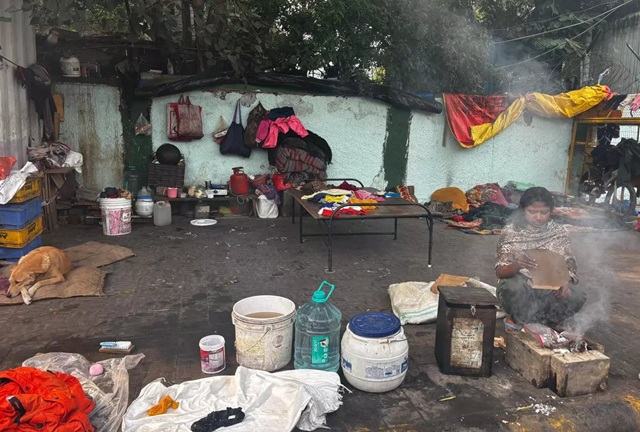
As Delhi approaches its assembly elections on February 5, a pressing crisis continues to grip the city’s most vulnerable population. Homelessness, exacerbated by the harsh winter, paints a bleak picture of the capital’s welfare initiatives. Despite government efforts and the release of the annual Winter Action Plan, shelters remain inadequate, leaving thousands of men, women, and children exposed to the bitter cold.
Ramkumari, a domestic worker, has lived on the footpath outside Delhi’s AIIMS hospital for five years. Her husband’s ongoing medical treatment and the lack of beds in nearby night shelters have forced the family to endure freezing temperatures. “It’s winter—we feel the cold intensely,” she tells Frontline, India. This story, unfortunately, mirrors the plight of thousands like her across Delhi, whose struggles remain hidden behind election rhetoric and inadequate infrastructure.
Night shelters are a crucial lifeline during the winter months. The Delhi Urban Shelter Improvement Board (DUSIB), tasked with their management, operates 197 permanent shelters and an additional 250 temporary tents during winter, increasing capacity to over 9,000 residents. However, with over three lakh homeless people in Delhi, according to a 2024 survey by Shahri Adhikar Manch: Begharon Ke Saath, the gap between demand and supply is glaring.
Rajvir Singh, director of night shelters at DUSIB, claims that rescue teams pick up an average of 150 people nightly, bringing them to shelters where three meals a day are provided. Yet, Singh admits there has been no increase in the number of shelters since the previous year. Data from a January 9 occupancy report highlights the strain: of 324 shelters in operation, 7,536 people were housed, with permanent buildings accommodating the most (2,813) but temporary tents falling far behind (1,201).
The structural issues underpinning Delhi’s homelessness problem are profound. Land ownership remains a contentious issue, with the Central government’s control over Delhi’s land restricting the state government’s ability to build affordable housing. Moreover, facilities in temporary shelters are woefully inadequate. Many lack electricity, water, and sufficient toilets, with one portable toilet often serving 50 to 80 people. Permanent shelters fare better, offering warm water, improved sanitation, and even skill development programs, but they are also overcrowded.
Caretakers at shelters, like Mohammad Irshad at a temporary facility near AIIMS, recount the overwhelming demand. “We often house more people than our capacity, especially when families or pregnant women come,” he says. Meanwhile, at the women’s shelter in Nizamuddin Basti, caretaker Tara laments the challenges of maintaining hygiene with just one cleaner for the entire facility.
Specialized shelters for vulnerable groups such as transgender individuals and persons with disabilities are nearly non-existent. According to Nitesh Kumar of the Society for Promotion of Youth and Masses (SPYM), which operates a fifth of Delhi’s shelters, “Transgender individuals are uncomfortable in general shelters, and no separate facilities exist for them.”
The issue of homelessness is compounded by a lack of long-term solutions. Rajesh Kumar, executive director of SPYM, emphasizes the need for low-cost housing and workers’ hostels, as many homeless individuals are employed as rickshaw drivers or daily wage laborers but lack a safe place to stay. “The Delhi Development Authority (DDA) has failed the city,” he says, citing demolitions of shelters in 2023 for “beautification” projects ahead of the G20 summit, which left 1,200 people homeless in areas like Yamuna Pushta.
Funding is another challenge. While the Delhi government doubled DUSIB’s budget to ₹185.17 crore in 2023-24, NGOs like SPYM report delays in receiving dues, hampering their ability to operate shelters. Jatin Sharma, formerly with the Centre for Equity Studies, argues that DUSIB lacks the expertise to address homelessness as a social justice issue, focusing instead on engineering tasks.
The Supreme Court’s 2010 mandate to establish adequate shelters—one per 1 lakh population—has been largely unmet. Official figures from the 2011 Census estimated Delhi’s homeless population at 47,000, a stark contrast to the three lakh figure cited by urban rights groups. This discrepancy leaves significant portions of the population unaccounted for in policy discussions.
As political parties make their final campaign pushes, homelessness has surfaced as a talking point. Yet, the reality remains unchanged for those like Ramkumari and Abhishek Kumar, a patient from Bihar who alternates between sleeping on the footpath and overcrowded shelters. For them, the promises of politicians and the machinery of government have failed to provide the basic dignity of shelter from the cold.