Arun was a man who had grown accustomed to cruelty. His face, with its rough edges and uneven proportions, invited ridicule wherever he went. The children in the village snickered behind their hands, the men jeered openly, and the women refused to meet his gaze. Yet, in his mother’s eyes, Arun was perfect. She loved him with unwavering devotion, even as she bore the sting of their neighbors’ scorn.
From an early age, Arun had resigned himself to solitude. He convinced himself that love was a luxury meant for others, not for a man like him. But everything changed the day Sundari arrived in the village.
She had come at twilight, her delicate hand resting lightly on the arm of a relative. Sundari’s blindness did nothing to diminish her grace, nor her undeniable beauty. Her voice carried a warmth that could soften even the hardest hearts, and her laughter, genuine and unguarded, drew people to her. For the first time in his life, Arun felt noticed—not for his face, but for his presence.
One afternoon, as they sat near the village well, Sundari asked him, “Why do the others mock you?”
Arun hesitated, his chest tightening. “Because I look different,” he answered softly.
She tilted her head, considering his words. “Well, I can’t see what they see, but I can hear your voice. And it doesn’t sound ugly to me.”
Her words wrapped around him like a shield, protecting him from a world that had always seemed intent on wounding him. Emboldened by her kindness, Arun began to court her. Slowly, tentatively, he allowed himself to hope. To his amazement, Sundari accepted his proposal, and they married in a quiet ceremony.
For Arun, life with Sundari felt like a dream he didn’t deserve. She filled their home with warmth, laughter, and an affection that seemed boundless. For the first time, Arun began to believe he was worthy of love.
But his mother, though overjoyed for her son, was troubled by an unspoken guilt. Sundari, she believed, deserved more than a life spent in darkness.
“She should be able to see the world,” Arun’s mother whispered one night, her voice heavy with conviction.
When she told Arun about the hermit, a healer who lived atop a distant mountain, Arun’s stomach churned with unease.
“She doesn’t need to be healed,” he argued. “She’s happy as she is.”
His mother shook her head. “She’s happy because she doesn’t know what she’s missing. How can we deny her the chance to see?”
Arun wanted to protest, but his guilt silenced him. He agreed to the journey, though his heart was heavy with dread.
The climb to the hermit’s mountain was long and grueling. Sundari, as always, held onto Arun’s arm, her trust in him unshakable. When they finally reached the hermit’s dwelling, they were met by a man whose presence was almost ethereal.
The hermit was young and strikingly handsome, his features as perfect as Arun’s were flawed. His movements were graceful, his voice soothing. Even Arun’s mother seemed momentarily entranced.
The hermit listened to their story with a calm, attentive expression and agreed to help. For several days, he worked with Sundari, using a combination of herbal remedies and meditative chants. Each session brought Sundari closer to regaining her sight, while Arun watched from a distance, his unease growing with every passing moment.
The morning Sundari’s vision returned, her joy was palpable. She marveled at the trees, the sky, and the colors she had only imagined. When her gaze fell upon the hermit, she gasped in awe, her gratitude pouring out in waves.
Then she turned to Arun. Her smile faltered.
“Arun?” she asked, her voice tinged with disbelief.
“It’s me,” he replied, his voice barely above a whisper.
She stared at him, her expression a mix of shock and something far colder. Then she laughed, a brittle, unfamiliar sound.
“You… I never imagined,” she said, her words trailing off. Her gaze shifted back to the hermit, whose serene smile had not wavered. “You’re the one who gave me sight,” she said, her voice filled with admiration.
The hermit inclined his head humbly, but Arun thought he detected a flicker of something behind the man’s calm exterior—triumph, perhaps, or pity.
That night, Sundari sat with the hermit, speaking animatedly about her new world. Arun sat outside their tent, his gaze fixed on the stars. His mother joined him, her face lined with regret.
“I thought I was helping her,” she said softly. “I didn’t mean to hurt you.”
Arun shook his head, his voice hollow. “You didn’t hurt me. The truth did.”
When it was time to leave, Sundari announced her decision.
“I can’t go back with you,” she said, avoiding Arun’s eyes. “I need to stay here. I need to find my place in this world.”
Arun understood. Without a word, he turned and began the descent, his mother following behind.
The hermit watched them go, his expression unreadable. Sundari stood at his side, torn between gratitude and a longing she couldn’t yet define.
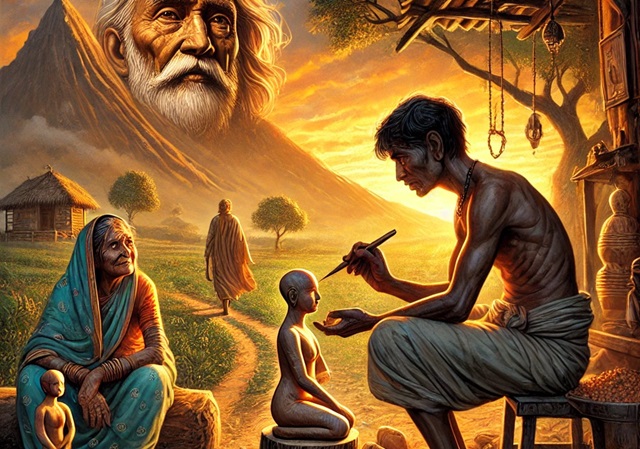
Months passed, and Arun returned to his quiet life. In his workshop, he carved figures from wood: a blind woman smiling, a crooked-faced man laughing, and a tall hermit standing apart.
His mother watched him in silence, guilt etched into her features. One day, she finally spoke. “You loved her truly.”
“Yes,” Arun replied, placing the figures on a shelf. “And I still do. But sometimes love means letting go.”
The evening sun cast its golden light across the room as Arun continued carving, transforming his pain into something beautiful.