by Durga Velautham in Chennai
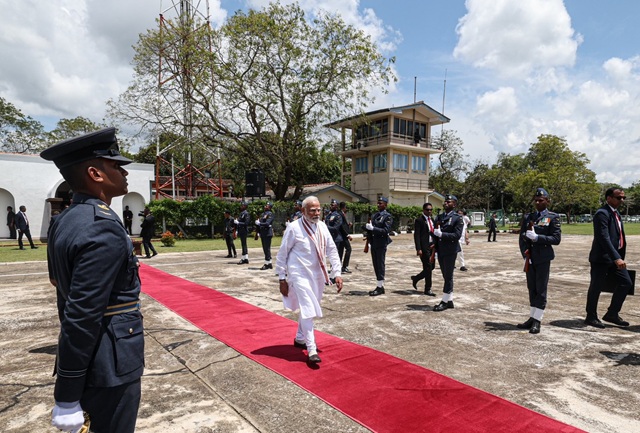
There comes a moment in the decline of a state when silence ceases to be neutrality and becomes acquiescence. Sri Lanka, once a proud island nation that held its ground against empires and ideologies, has now become a hollowed vessel of sovereignty—draped in ceremony but void of substance. The recent visit of Indian Prime Minister Narendra Modi brutally exposed this decay. It was not just the grandiose speeches or the MoUs, but the subtle details—the misspelled banners, the linguistic exclusions, the journalists locked out of their own space—that underscored the profound disintegration. The degradation lay not in the words spoken, but in the silences that followed.
Sri Lanka has not merely lost its diplomatic clout. It has lost the ability to say “No.”
There was once a time when diplomacy was an art—requiring subtlety, strategy, foresight, and strength. Today, Sri Lanka’s foreign policy has been reduced to a reactive ritual—composed of thank-you notes and borrowed postures. The essence of sovereignty is not merely to accept, but to assert. To say “No” to powerful allies is not an act of petulance—it is the litmus test of a nation’s independence. Yet, Sri Lanka has sacrificed that right not for survival, but for the illusion of partnership. The transactions have been stripped of reciprocity. Sri Lanka no longer negotiates; it complies. It does not reciprocate; it receives. What has resulted is a cautionary tale for the Global South—a state whose foreign ministry functions less like a strategic apparatus and more like a subservient desk.
The MoUs signed during Modi’s visit were not agreements born of equality—they reek of asymmetry. The HVDC interconnection for electricity, veiled as infrastructure development, is a long leash in the guise of progress. The Digital Identity initiative, paraded as a leap into the future, essentially places the biometric soul of Sri Lanka’s citizens within a foreign digital framework. The development of Trincomalee, now a collaborative project with Indian and Emirati partners, transforms one of the most strategically vital coastal areas into a playground for external interests, stripping it of its inherent significance.
What did Sri Lanka gain from these deals? Temporary relief from default? A few thousand solar panels? A handful of warehouse openings via video call? The nation has sold the keys to its sovereignty for a mere coat of paint.
Sir Harold Nicolson, in Diplomacy (1919), observed that “the real diplomatist is he who has the courage to say ‘No’ at the right moment, and to do so with grace.” One searches in vain for such grace in Sri Lanka’s current administration, where sycophancy is mistaken for pragmatism, and docility is falsely presented as diplomatic intelligence. President Disanayaka’s government—armed with a supermajority—has squandered its mandate not through ideology, but through sheer inertia. The state is no longer run by realists or idealists, but by opportunists whose only guiding principle is to avoid offending the powerful.
A nation that cannot offend cannot negotiate.
Niccolò Machiavelli famously wrote, “A prince is also esteemed when he is a true friend and a true enemy.” That dichotomy—friend or enemy—is the foundation of respect in global politics. Yet, Sri Lanka today occupies neither position. It is not a friend to India in any meaningful geopolitical sense; it is a dependency, a polite underling clapping at every announcement. Nor is it a sovereign rival with a spine. Sri Lanka is simply available—embodying the most humiliating condition to which a state can fall.
Foreign relations must be governed by national interest, not sentiment. Even alliances must be calculated, not worshipped. The lack of reciprocal dignity during Modi’s visit should have raised alarms. When local journalists were sidelined in favor of foreign media, when Sri Lanka’s cultural narratives were dictated by external forces, when electoral promises were conveniently forgotten in the name of regional harmony—these were not diplomatic triumphs. They were humiliations. And yet, the ruling regime not only tolerated them, but welcomed them with garlands and hollow speeches.
Diplomatic suicide does not occur in grand gestures—it unfolds through incremental surrenders, through the failure to object, through the routine trading of sovereignty for the sake of hollow symbolism.
Henry Kissinger, with all his moral ambiguities, understood the anatomy of power. “The task of the leader,” he said, “is to get his people from where they are to where they have not been.” The JVP-led government has instead led Sri Lanka in the opposite direction: from the struggle for freedom, back into a patron-client relationship with regional powers. The irony is cutting. A movement born from resistance against imperial structures now bends the knee—not from fear, but from calculated convenience.
India’s strategy has been executed with surgical precision. Modi’s regional ambitions are no secret. He has never pretended to seek equality—he plays the long game with unmatched discipline. From energy infrastructure to defense to digital systems, India has positioned itself as the indispensable partner in every crucial sector of Sri Lanka’s survival. This is not philanthropy. This is strategy.
What does this mean for Sri Lanka?
It means that every future negotiation will begin from a position of dependency. It means that Sri Lanka’s options are predetermined. It means that development will occur within the constraints of another state’s vision. In other words, Sri Lanka is not developing—it is being developed. That is the stark difference between partnership and patronage. A state with an identity would recognize it. A state with self-respect would feel it. But Sri Lanka, under its current leadership, is governed by technocrats in revolutionary garb—a ruling class that views politics as theatre and foreign policy as photo opportunities.
A nation’s foreign ministry must not serve as an accessory to power—it must be the bedrock of sovereignty. Where is the doctrine of Sri Lankan diplomacy? What is Sri Lanka’s long-term vision in the Indian Ocean? What red lines are maintained in energy, defense, and digital policy? Who are the alternatives when a superpower becomes too overbearing? These are questions that the current regime either refuses to ask or lacks the intellectual capacity to answer.
There is still time to remember the value of saying “No.” Not as a tantrum, but as a strategic posture. To say “No” is to assert one’s interests. It is to draw a line in the sand. It is to act as a nation with self-respect. The world does not respect puppets. Even India, whose diplomats are adept at reading weakness, does not respect the compliant. They respect the resilient.
The Island that forgot how to say “No” may one day find it has forgotten how to say “Yes”—on its own terms. And when that day arrives, Sri Lanka will not be negotiating its future—it will be begging for inclusion in it.