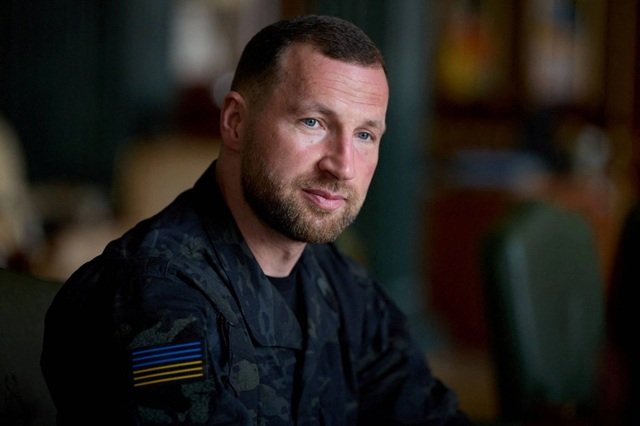
Ukrainian President Volodymyr Zelenskyy has appointed senior security official Yevhenii Khmara as acting defence minister in an effort to contain a political crisis triggered by the dismissal of reformist defence minister Mykhailo Fedorov, a move that prompted rare public protests and exposed divisions within Ukraine’s wartime leadership.
In a statement on Thursday, Zelenskyy said Khmara, who currently serves as acting head of Ukraine’s SBU domestic security service, would assume the role of acting defence minister while parliament is asked to approve his appointment permanently.
“Yevhenii Khmara has gained extensive and, in many respects, unprecedented experience with technological combat operations,” Zelenskyy wrote on X. “This is exactly where our defense efforts should be focused during this war.”
The leadership change comes after hundreds of demonstrators gathered in Kyiv and other Ukrainian cities to demand the reinstatement of Fedorov, whose unexpected dismissal formed part of the president’s second major government reshuffle within a year. The protests marked one of the rare public displays of dissent during Russia’s full-scale invasion of Ukraine.
The controversy also coincided with the resignation of a senior commander responsible for Ukraine’s air war, further highlighting tensions within the country’s military establishment.
Fedorov, 35, had earned recognition for promoting technological innovation within Ukraine’s armed forces, seeking to transform an outnumbered military into a more efficient fighting force through digital systems and drone warfare. Speaking to reporters in Kyiv after his dismissal, he said he had rejected an offer from Zelenskyy to serve as an adviser after the president declined to include him in the new government.
During the same appearance, Fedorov sharply criticised Ukraine’s commander-in-chief, General Oleksandr Syrskyi, accusing him of obstructing defence ministry initiatives and failing to resolve operational problems. He alleged that instead of focusing on defeating Russia, Syrskyi had contributed to divisions within the country.
Syrskyi, who has led Ukraine’s military since early 2024 and has faced criticism over his command style, responded by calling for attention to remain on the war effort. He also referenced his role in defending Kyiv during the opening weeks of Russia’s 2022 invasion, appearing to dismiss Fedorov’s public criticism.
Khmara’s appointment reflects Ukraine’s growing emphasis on advanced military technology. Before leading the SBU, he headed the agency’s Alpha special operations unit, which has played a central role in Ukraine’s long-range strikes against Russian oil infrastructure, defence facilities and other strategic targets. Those operations have become a key element of Kyiv’s military campaign in recent months.
Parliament had earlier approved a new government under Prime Minister Sergii Koretskyi, although it remains unclear when lawmakers will vote on confirming Khmara as defence minister. The next parliamentary session is scheduled for Aug. 18.
Earlier on Thursday, Zelenskyy acknowledged that discussions over Fedorov’s successor had continued, saying outgoing Interior Minister Ihor Klymenko had also been considered for the position. Speaking to reporters, the president said he had hoped for greater unity but admitted that agreement had not been reached.
The political tensions have emerged despite what the source described as Ukraine’s strongest battlefield position since late 2022. Ukrainian forces have continued conducting long-range drone and missile strikes targeting Russia’s oil sector and military logistics, while seeking to sustain momentum on the battlefield.
At the same time, Ukraine continues to face significant military challenges, including Russian advances in the eastern front, shortages of ground personnel and limited air defence capabilities as Moscow intensifies missile attacks.
The reshuffle also prompted further criticism from within Ukraine. Pavlo Yelizarov, a deputy commander of the country’s air force and a senior figure in drone operations, announced his resignation following Fedorov’s dismissal.
Outside the presidential office in Kyiv, more than 1,000 protesters gathered chanting “Shame!” while carrying signs questioning the government’s decision. Some demonstrators also called for Syrskyi’s removal instead of Fedorov’s.
The demonstrations drew comparisons with protests held last year, when public pressure led Zelenskyy to reverse measures affecting the independence of Ukraine’s anti-corruption agencies.
Fedorov, who previously served as Ukraine’s minister for digital transformation, has been credited with reducing bureaucracy, expanding drone warfare capabilities and introducing data-driven military planning. Supporters have argued that his efforts to reform defence procurement faced resistance within parts of the establishment, while critics have questioned the pace of recruitment reforms.
Zelenskyy announced the broader government reshuffle earlier this week, saying Ukraine’s government and law enforcement institutions required renewal. Newly appointed Prime Minister Sergii Koretskyi said his administration would prioritise fully equipping the armed forces with drones, expanding Ukraine’s defence industry and preparing the country for another winter of Russian attacks on its energy infrastructure.
If you’d like, I can also produce a more Reuters-style or AP-style version with an even sharper hard-news lead.