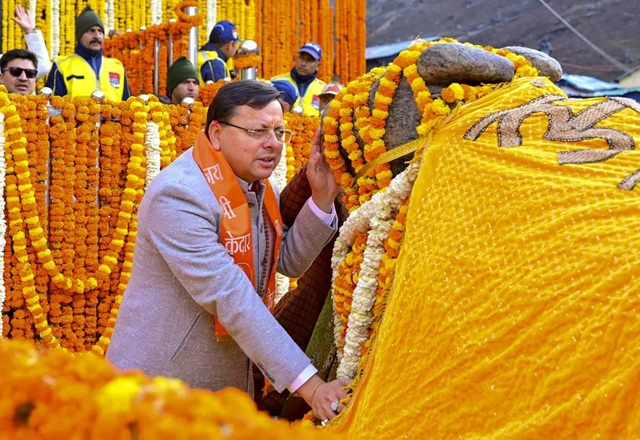
The monsoon session of the Uttarakhand Vidhan Sabha ended abruptly in chaos on August 20, after just two days, as the Assembly witnessed raucous protests and unprecedented disorder. According to Frontline India, the storm began when opposition Congress MLAs demanded a discussion on alleged rigging in the Nainital zila panchayat election. When their calls were ignored, the legislators rushed into the well of the House, shouted slogans, tore official papers, and hurled them into the air. In the midst of this bedlam, the BJP government led by Chief Minister Pushkar Singh Dhami took the opportunity to push through nine Bills in a matter of minutes, without debate or scrutiny, using a hurried voice vote. Among these were three highly contentious legislations that have since dominated public discourse—the Uniform Civil Code (UCC) Amendment Bill, 2025; the Freedom of Religion and Prohibition of Unlawful Conversion (Amendment) Bill, 2025; and the Minority Educational Institutions Bill, 2025.
The UCC amendment has attracted criticism for its intrusive clauses that criminalise unregistered live-in relationships with punishments of up to seven years in prison. The law not only penalises individuals but also grants the Registrar General the authority to annul registrations related to marriage, divorce, inheritance, and live-in arrangements, deepening fears of state overreach into private life. The amended anti-conversion legislation goes even further, enhancing punishments for so-called forced conversions from a maximum of 10 years to life imprisonment. It broadens the definition of “allurement” to include everything from gifts to employment, while also criminalising misrepresentation in marriage and online content deemed as religious propaganda. Critics say these provisions are deliberately designed to discourage interfaith relationships and bolster the BJP’s narrative against “love jihad,” a conspiracy theory propagated by right-wing groups that claims Muslim men are luring Hindu women into conversion.
Perhaps the most controversial measure is the Minority Educational Institutions Bill. On one side, it extends minority status to Sikh, Jain, Christian, Parsi, and Buddhist institutions, but on the other, it mandates that all madrasas seek state affiliation and approval. Those that fail to meet the criteria will face closure. This move has been widely interpreted as a direct attempt to target Muslim educational institutions under the guise of regulation. For many, this legislation, combined with ongoing crackdowns on so-called illegal madrasas and mazaars, reveals a systematic attempt to sideline Muslims in the state.
Observers argue that these laws are not isolated developments but part of a larger political project. As Frontline India notes, the Dhami government has consistently advanced an aggressive Hindutva agenda, with the UCC as its centrepiece. The state has already demolished hundreds of shrines and sealed over 200 madrasas, while government rhetoric routinely invokes “land jihad,” “love jihad,” and “thook jihad.” These terms, used to stigmatise Muslims as encroachers, conspirators, or even unhygienic food vendors, are increasingly shaping the political discourse in the hill state. For Dhami, critics say, the aggressive pursuit of this agenda has become both a survival strategy and a way to establish himself as one of the BJP’s strongest Hindutva champions.
The fallout on the ground has been deeply divisive. Communal violence has flared repeatedly since the passage of the UCC, with incidents in Haldwani, Nandprayag, and Uttarkashi leaving Muslim families alienated and fearful. In Haldwani, clashes following the demolition of a mosque and madrasa claimed six lives. In Purola, Muslim families were forced to flee after accusations of abduction sparked protests and an economic boycott. Analysts warn that such flashpoints are the direct outcome of the government’s political messaging, which frames Muslims as outsiders in what is promoted as “Dev Bhoomi,” the land of the gods. Cultural historian Pushpesh Pant has argued that this term, once used in a purely spiritual sense, has now been weaponised for political purposes, both to attract pilgrimage tourism and to justify exclusionary politics.
Experts believe that Uttarakhand is fast becoming a test case for what is being described as the “Uttarakhand model”—a mix of Hindutva politics, securitisation of the border state, and a narrative of cultural protection. Political analyst Jay Singh Rawat accused Dhami of betraying his constitutional oath, arguing that he has instead aligned himself with hardline elements. Others point out that Uttarakhand’s proximity to China and its heavy military presence are being used to merge nationalism with religious politics, making Hindutva inseparable from the state’s governance model. As Frontline India highlights, the increasing frequency of hate speeches, demolitions, and discriminatory legislation is sending a chilling message not just within the state but across the country.
For many critics, the danger is that the so-called Uttarakhand model mirrors the Gujarat experiment of the early 2000s but in an even starker form—less about development and more explicitly about dismantling the social fabric. As Prof. Mohammed Saleem Engineer of Jamaat-e-Islami-Hind told Frontline India, “Earlier we had the Gujarat model, which masked itself as development while suppressing Muslims. Now we have the Uttarakhand model, which is openly forcing Muslims out. This is not just about Uttarakhand—it is about the very idea of India.”