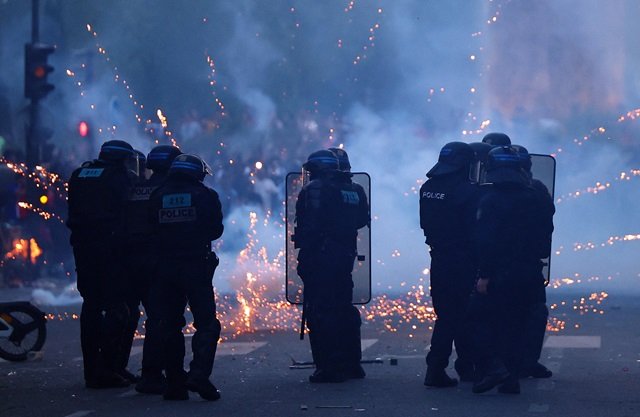
On May 30, 2026, the historic UEFA Champions League victory of Paris Saint-Germain (PSG) was overshadowed by widespread violence across France. What began as celebrations following PSG’s triumph quickly descended into riots in at least 15 cities, including Paris, Lyon, Strasbourg, and Rennes, leaving one person dead, more than 200 injured, and hundreds arrested.
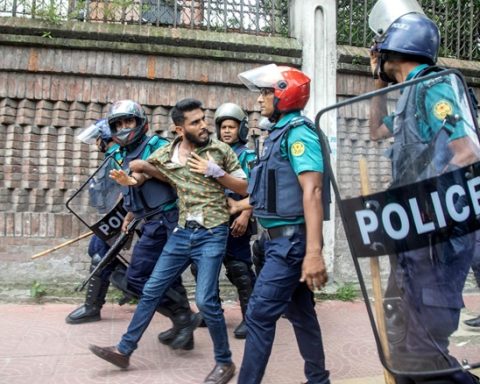
According to French Interior Minister Laurent Nuñez, the unrest resulted in 219 injuries, including 57 police officers, with eight victims reported in serious condition. A 24-year-old motorcyclist was killed after colliding with barriers placed on Paris’s ring road, which rioters had attempted to block. Authorities made at least 780 arrests nationwide, including 480 in Paris, where 277 individuals were placed in custody, among them 82 minors. Offences included attacks on police, vandalism, looting, arson, and illegal weapons possession.
Meanwhile, far-right National Rally President Jordan Bardella slamming “scenes reminiscent of civil war” caused by “predators” stated: “I tell the French: Wake up because soon they will [be] breaking into your apartments.” Bardella, who is currently leading in opinion polls ahead of presidential elections scheduled next years, laid the blame on France’s population of immigrant descent, which includes people who “are physically in France, but whose spirit and heart is elsewhere.”
The worst disturbances occurred on the Champs-Élysées and around Parc des Princes Stadium, where rioters torched vehicles, smashed shopfronts, and clashed with security forces. Despite the deployment of approximately 6,000 police officers in Paris and 22,000 personnel nationwide, authorities struggled to contain the scale and spread of the disorder.
The violence marked the second consecutive year that PSG’s Champions League success has been followed by deadly unrest. In May 2025, PSG’s maiden European title triggered riots that left two people dead, nearly 200 injured, and more than 500 arrested. Authorities recorded nearly 700 fires during those celebrations. The recurrence of such incidents despite enhanced security measures has intensified concerns about France’s capacity to manage large-scale public gatherings.
Football-related violence has long been a challenge in France. Rivalries involving PSG and Olympique de Marseille have frequently produced violent incidents. In 2002, a Marseille supporter was paralysed after being struck by a seat thrown by PSG hooligans, while in October 2023, an attack on the Lyon team bus by Marseille supporters injured then-coach Fabio Grosso. PSG has also faced sanctions for fan misconduct, including the partial closure of its stadium following homophobic chanting in May 2026.
However, the nature of football violence has evolved significantly. Traditional hooliganism, once largely confined to clashes between rival supporters, has increasingly transformed into broader urban unrest targeting public infrastructure, businesses, and law enforcement. Across Europe, highly organised “Ultra” groups have developed sophisticated networks, while in some regions football-related violence has become intertwined with organised crime, extremist movements, and political agendas.
France is not alone in confronting these challenges. During the Euro 2020 final at Wembley Stadium in London, thousands of ticketless fans attempted to force entry, resulting in violent confrontations with police and dozens of arrests. Germany also faced major security concerns during Euro 2024, including attacks targeting football supporters and public viewing events. Such incidents demonstrate the growing security risks associated with major sporting occasions across Europe.
A particularly troubling aspect of the 2026 riots was the apparent involvement of individuals with little connection to football. French authorities reported that many detainees were teenagers and young adults who were not genuine PSG supporters. Several reportedly admitted they had never watched a football match and had simply exploited the celebrations as an opportunity to engage in disorder. Interior Minister Nuñez acknowledged that many participants attended with the intention of causing trouble rather than celebrating the victory.
This reflects a broader trend in which large public gatherings are increasingly exploited by opportunistic actors, including criminal elements, radical groups, and marginalised youths. The combination of crowd psychology, alcohol consumption, anti-authority sentiment, and reduced fear of identification often creates conditions conducive to violence, looting, and vandalism.
The security implications are significant. Domestically, repeated episodes of urban violence strain law enforcement resources, undermine public confidence in state authority, and damage France’s reputation as a safe destination for tourism and international events. The need to deploy tens of thousands of security personnel for a single football match raises questions about the sustainability of current public-order strategies.
At the European level, the riots underscore the increasingly transnational nature of football-related disorder. Social media and encrypted communication platforms enable rapid mobilisation and coordination among hooligan networks and other disruptive actors. Recognising these threats, UEFA and Europol renewed their Memorandum of Understanding in November 2025 to strengthen cooperation against football-related crime, though recent events suggest that significant challenges remain.
Addressing this evolving threat requires a more comprehensive approach than traditional crowd-control measures alone. Enhanced intelligence gathering on hooligan groups, criminal networks, and extremist actors need to be combined with improved surveillance, stricter control of celebration zones, and stronger legal penalties for attacks on emergency personnel and public property. Long-term efforts also need to address the social and economic marginalisation that contributes to youth involvement in urban unrest.
The PSG riots of 2026 demonstrate that football-related violence has evolved beyond conventional hooliganism into a broader public security challenge involving criminal opportunism, social tensions, and weaknesses in crowd-management systems. The sharp political reactions that followed the unrest, including efforts to link the violence to broader debates over immigration and national identity, also underscore how such incidents can deepen existing social and political polarisation. Unless authorities adopt a coordinated, intelligence-led strategy capable of separating genuine supporters from opportunistic rioters, major sporting celebrations will continue to carry a significant risk of descending into large-scale urban disorder. Failure to address these challenges could further erode public confidence in state institutions and intensify divisions within French society.