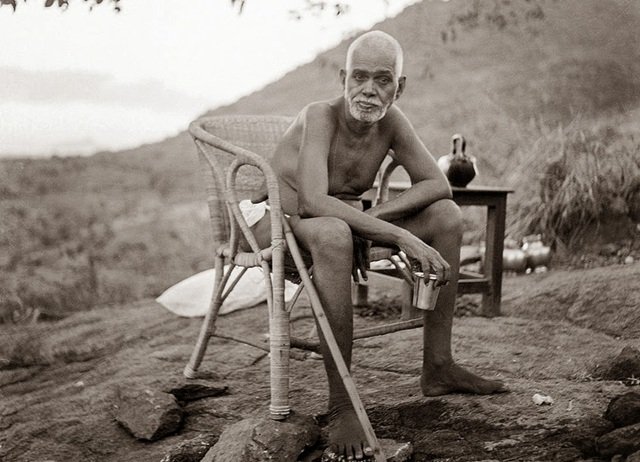
Bhagwan Ramana Maharshi is considered and respected as one of the greatest saints who lived in India in the 20th century. He was born on December 30, 1879, and he left his mortal body on April 14, 1950. There are millions of devotees of Bhagwan well spread all over India and in several other countries. He has shown the way to humanity for leading a life of bliss, which has stood the test of time and would remain appropriate for all time to come.
I never had the opportunity to visit Ramanashram in Thiruvannamalai in Tamil Nadu as it existed when Bhagwan Ramana Maharshi was in mortal frame, and I was not fortunate to listen to his words of wisdom nor interact with him in person. This is a lifelong regret for me. My age was only less than six years when Bhagwan left his mortal frame.
All I know about Bhagwan’s mortal frame is from his photographs, which I keep in my pooja (prayer) room.
I have been reading Mountain Path (a journal published by Ramanashram) for the last few years with a certain level of dedication and have also read other writings of Bhagwan. I think that I have somewhat, however little it may be, understood the approach and philosophy of Bhagwan towards worldly life and his thought process, which have also been very elegantly written by his ardent disciple and the spiritual poet of extraordinary standard, Muruganar, in addition to what Bhagwan himself has written.
As I read about Bhagwan leaving his home at a young age and reaching Tiruvannamalai all alone and involving himself in meditation for a long time, unconscious even of the insects biting him, I have been wondering all the time how this could have been possible for a young boy, which only highlights the fact that there are some aspects beyond human comprehension.
When Bhagwan’s mother approached him in Tiruvannamalai, pleading with him to return to his home, Bhagwan did not speak a word to her and wrote a note which made his mother realise that the content of this note was something extraordinary. Obviously, she must have understood that Bhagwan, more than being her son, was someone much more, and she left the place, almost reconciling herself to Bhagwan’s way of life.
Later on, his mother joined him in Thiruvannamalai, and Bhagwan viewed his mother with utmost respect like most humans, though with a certain level of detachment.
As I further read the story of Bhagwan, I felt that subsequent to his meditation for a considerable period, his life later on was like that of a normal human being, though he had very minimal clothing to cover himself and went around in the initial days pleading for food from different houses. Later on, when he moved to the Arunachala hill and stayed for a long time in extremely hazardous conditions, people realised that Bhagwan was a person far different and a philosopher par excellence and a saint.
Thereafter, people flocked to him over the years from one part of the world to the other, and he liberally rendered his guidance and advice about the object of human life and methodology of leading a peaceful life to whoever was wanting to listen to him. He patiently answered several intriguing questions with clarity.
Bhagwan made no distinction between humans and animals and other creatures, and his approach was the same in viewing humans and other creatures. This again shows Bhagwan’s highest level of thought process and detached outlook.
While Bhagwan brought out several notes and poems, as I see it, the central theme of his advocacy is Atma Vichar (self-introspection).
Obviously, Bhagwan never attempted to convince others or propagate his views but only asked everyone to introspect and conclude about the content of life and its objectives. Bhagwan may not be considered as the founder of any religion or religious concept. He only reiterated whatever has been said in the Hindu Vedic scriptures and in Adi Sankara’s writings. Bhagwan believed in Karma theory and rebirths, as said in the Hindu scriptures.
While Adi Sankara’s writings are well known, what is particularly significant is his Bhaja Govindam, where he had no hesitation in calling those running behind money and passion as fools. However, Bhagwan was not known to have decried anyone leading life with passion and greed. Adi Sankara travelled all over India to spread his views and concepts and established mutts (centres) to ensure that his concepts would remain permanently known for all time to come and remain beneficial to humanity, whereas Bhagwan never left Thiruvannamalai and has never focused on spreading his views. Obviously, this indicates that Bhagwan had his own way, even while banking on what has been said in Hindu scriptures and Adi Sankara’s teachings. Bhagwan left his mortal body like any other human, though there is a saying that lightning was seen when Bhagwan left his mortal body.
Looking into the entire teachings of Bhagwan in a holistic manner, I get a view that he was forthright with clarity and had answers for every question and suggested self-introspection as the only way to lead a life of self-realisation and peace and bliss. This is something extraordinary, since every religion and religious head insists on a certain way of life and actions to attain the feet of God wherever He is and whatever He is. On the other hand, Bhagwan left it to the individuals to introspect and derive the benefits and pleasure of introspection, which would enable everyone to see the futility of the life process and give up ego that would lead to a feeling of bliss (Ananda).
Bhagwan led his life like a normal human being and, at the same time, led a life with detachment and love or hate for no one, cracking jokes, occasionally working in the kitchen, taking meals together with his devotees and so on. When Bhagwan suffered from cancer with intense pain and doctors persuaded him to undergo surgery, Bhagwan accepted the suggestion but refused to take painkiller drugs. The surgery was conducted, with Bhagwan obviously suffering pain but remaining unconcerned. At one time, there was a litigation filed against Ramanashram by a disgruntled person, and when an enquiry was ordered, Bhagwan, without hesitation, met the officials and answered all questions with patience. And all these events highlight the human-like behaviour of Bhagwan. Thus, he also showed that anyone can lead a blissful life if only the person would attempt to discover himself by introspection.
Though I have been living in the world for around 81 years now and being a chemical engineer with the wherewithal to travel and visit different places in India and abroad in the past several years, I have visited Ramanashram only two times. Like several people in India and abroad who visit Ramanashram unnoticed and quietly, pray for some time and leave the place, I have also conducted myself in the same way. I have heard people stating that they experienced a feeling of ecstasy and a high level of mental peace while in Ramanashram. I confess that I did not undergo such an experience so far, even as I remain an ardent devotee of Bhagwan.
While I try to introspect and search within, as Bhagwan advocated, I have not experienced any extraordinary reaction in my mind. My mind runs here and there even as I try to sit and introspect. Obviously, it reflects the fact that I still have a long way to go in spiritual exercise, in spite of my advanced age. However, I am absolutely sure that Bhagwan has shown the way for me, like he has shown to several other millions of people. I remain an ardent devotee of Bhagwan and would remain so till I breathe my last.
Last but not least, I wonder whether Bhagwan would have approved the present practice of worshipping him as an incarnation of God, which is a million-dollar question.