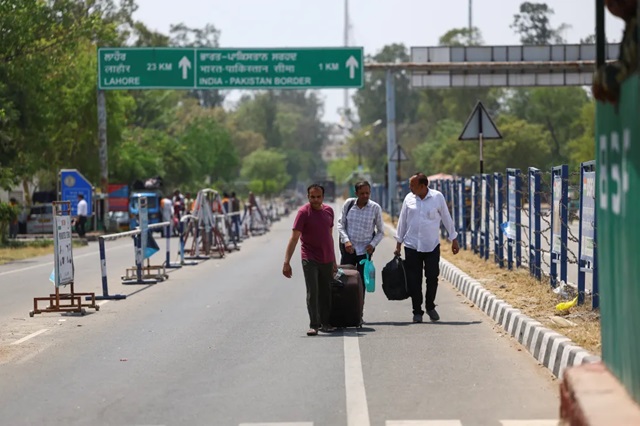
The terror attack in Pahalgam, Jammu & Kashmir, India, which killed 26 innocent tourists of the Hindu religion, sent shockwaves around the world. India has accused Pakistan of sending trained terrorists to carry out the attack, while Pakistan has denied any involvement. However, given Pakistan’s past record of harbouring terrorists — a fact recently acknowledged by Pakistani ministers — the global consensus largely leans towards the conclusion that this terrorist act may have been sponsored or supported by Pakistan. India’s subsequent Operation Sindhoor, targeting several terrorist bases in Pakistan, has created a scenario in which an all-out war between the two countries could become imminent.
Basic Factors for the Conflict:
Many people around the world fail to understand the fundamental factors contributing to the conflict between India and Pakistan. They appear to believe that the dispute over the Kashmir region is the root cause and sole reason for the conflict.
However, discerning observers with a deeper understanding of the ground realities and historical factors assert that the basic cause of the conflict is not a territorial dispute, such as in Kashmir, or political ideologies, but religious factors. These observers argue that even if the Kashmir dispute were to be settled, it would not bring about peace between India and Pakistan by itself. According to them, while the Kashmir issue appears to be the immediate cause of conflict, it is not the underlying cause, which is far more deep-rooted.
Creation of Pakistan:
The conflict between India and Pakistan has existed ever since Pakistan was created as a nation, following the partition of the Indian subcontinent by the British government when they withdrew from the region after ruling it for three centuries.
Pakistan was created with the intention of being a one-hundred-percent Islamic country. In other words, the founder of Pakistan, Muhammad Ali Jinnah, demanded a separate Muslim country for Muslims, implying that Muslims would not want to live with Hindus in India.
When the bitter partition occurred, horrific violence ensued, and many Muslims from various parts of the region migrated to Pakistan. However, a substantial population of Muslims chose to remain in India. Today, Muslims make up around 15% of India’s population, and India is one of the largest Muslim-populated countries in the world. It is possible that many Muslims chose to stay in India expecting not to face discrimination.
On the other hand, most Hindus from the newly created Pakistan migrated to India, preferring not to live there. Today, the Hindu population in Pakistan constitutes a microscopic minority.
Today, Pakistan remains an Islamic country in both letter and spirit, while India remains a multi-religious country. Despite the fact that Hindus constitute around 75% of India’s total population, India has not declared itself a Hindu state.
This clearly highlights that Pakistan was created based on the dislike for the Hindu community, and the overwhelming feeling among Muslims that Islam is a superior religion, thus necessitating a separate country.
While Muslims are certainly entitled to take pride in their religion, the feelings of dislike or hatred for Hindus among certain sections of Pakistan’s population have persisted for decades. Islamic religious leaders have had a dominant role in Pakistan’s political and social spheres, and the overwhelming majority of Pakistan’s population is Muslim. Young and old are constantly indoctrinated about the reasons for Pakistan’s creation. In such an environment, a section of the Pakistani population has been “brainwashed” into developing a deep-seated hatred for Hindus and Hinduism.
Present State of Pakistan:
Pakistan has a strong agricultural base and several mineral resources, along with natural wealth that could be utilised for achieving sustained growth across various sectors. The country also has an educated intelligentsia capable of contributing to its progress.
Unfortunately, over the past several decades, Pakistan has been plagued by unstable governments alternating with military rule. As a result, the country has been unable to progress to the extent of its potential in economic and industrial development. To cut a long story short, Pakistan’s finances are in a dire state, the country is heavily indebted, and it faces serious issues in Balochistan, with the Taliban and other insurgent groups further complicating the situation.
Some believe that, due to these economic and other issues, Pakistan seeks to divert the focus of its people towards the Kashmir issue and cultivate animosity towards India in order to prevent internal unrest. While this may be considered an uncharitable view, it is a perspective that exists.
Prospects for Peace:
While it is true that there are feelings of dislike towards Pakistan in India, these sentiments do not run as deep as those in Pakistan, given India’s status as a multi-religious country. Voices in India occasionally call for peace, advocating for harmonious coexistence between the two nations, and such voices are also sometimes heard in Pakistan.
However, these voices of wisdom in both India and Pakistan have not yet led to tangible prospects for peace.
Rajaji, India’s first Governor-General after independence and an intellectual of exceptional calibre, strongly advocated for people-to-people cooperation between India and Pakistan. He believed that, irrespective of political or other issues, communication channels should remain open, especially through activities in arts, culture, literature, sports, and other fields.
In today’s context, Rajaji’s advocacy might seem like an idealistic thought. However, with strong public opinion fostered by peace-loving individuals in both countries, peace may one day become a reality.
After all, during the Second World War, no one could have imagined that Germany and Britain would cooperate in any way in the future.