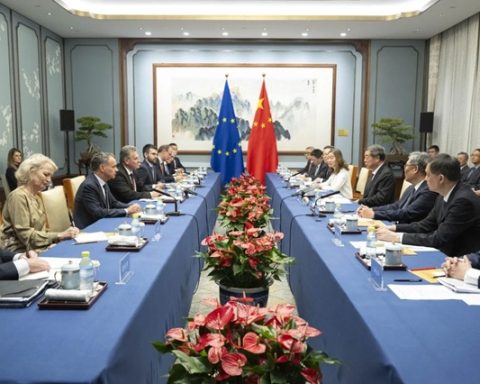
China’s President Xi Jinping and Japan’s newly appointed Prime Minister Sanae Takaichi met on the sidelines of the APEC summit in Gyeongju on Friday, holding their first formal discussions as leaders amid ongoing tensions over trade, security, and regional stability.
The meeting, scheduled for Friday afternoon according to the Japanese government, follows a brief exchange earlier in the day, as reported on Takaichi’s official X account. China is Japan’s largest trading partner, while Japan relies on the United States for critical security guarantees, creating a delicate balancing act as relations between Beijing and Washington grow increasingly strained.
Bilateral issues remain contentious, including China’s military activity around the disputed Senkaku/Diaoyu islands, trade restrictions on rare earth exports, and concerns over peace in the Taiwan Strait. Takaichi’s ties with Taiwan politicians and her previous visits to Tokyo’s Yasukuni Shrine, associated with Japan’s militaristic past, add an additional layer of diplomatic sensitivity.
Despite her reputation as a hawkish politician, Takaichi has signaled a more pragmatic approach since taking office, skipping the customary Yasukuni visit and emphasizing the need for a “constructive and stable relationship” with China in her first parliamentary address. Xi, however, has yet to publicly congratulate her on her premiership, a break from protocol observed with her predecessors.
During the talks, both leaders reaffirmed their commitment to “mutually beneficial strategic ties,” a phrase first popularized in a 2006 joint statement between former Japanese Prime Minister Shinzo Abe and former Chinese President Hu Jintao. Takaichi highlighted the shared responsibility of Japan and China for regional peace and prosperity, stating: “I want to continue a frank dialogue with you and deepen my personal relationship with you.” Xi echoed the sentiment, emphasizing the importance of stable and constructive ties amid global uncertainties.
Trade issues, particularly China’s restrictions on rare earth exports, were a key topic for Takaichi, whose previous role as Japan’s economic security minister gives her insight into their strategic importance for manufacturing cars, chips, and other high-tech products. Although China temporarily eased restrictions following Xi’s meeting with US President Donald Trump, Tokyo’s top ministers expressed continued concern about the curbs.
China is also likely monitoring Takaichi’s close ties to Taiwan. Her April visit to the island, which included discussions with Taiwanese President Lai Ching-te on supply chains and economic cooperation, remains a potential source of tension. Beijing’s response to her premiership has been cautious, deferring personal congratulations through Premier Li Qiang rather than Xi himself.
Takaichi’s new leadership marks continuity with previous Japanese diplomatic and security policies while also introducing a firm stance on economic independence and national defense. She has pledged to accelerate military spending, ease restrictions on the export of defense equipment, and revise Japan’s core security documents sooner than anticipated.
Friday’s discussions at APEC represent a strategic effort by both sides to stabilize bilateral relations amid ongoing geopolitical frictions. As Takaichi and Xi continue their dialogue, the international community will be watching closely to see whether Japan-China relations can maintain constructive engagement despite deep-rooted tensions.