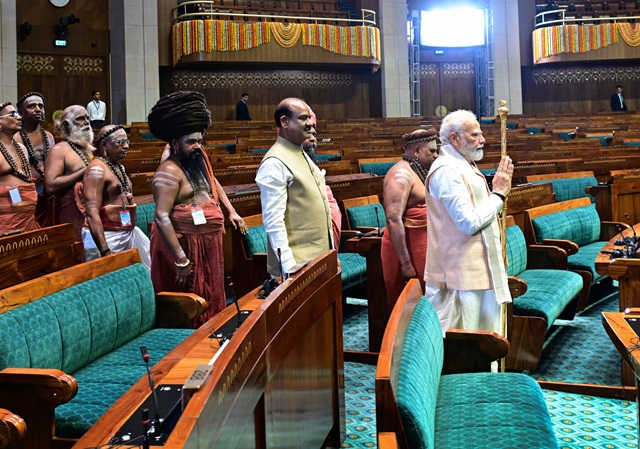
After the recent parliamentary election in India, Mr. Modi was elected as the Prime Minister for the third time with a reduced majority of his coalition government and with more members in the opposition parties than the previous parliament. It was thought that there would be balanced and healthy discussions and debates and divergent views would be heard from members in parliament. Many observers thought that the government not having an overwhelming majority could be a healthy sign in a democratic setup. However, the recent proceedings in the parliament have belied all such expectations.
In the first session of the parliament when the President of India delivered her address, the discussions that followed were marked by insulting and making derogatory remarks by the opposition parties against Prime Minister Modi. Ruling party members, and particularly Mr. Modi, listened to the vituperative comments with near patience. However, when Mr. Modi started his reply, almost all the opposition party members started shouting at the top of their voices, making it difficult for Modi’s speech to be heard clearly. In spite of this, Mr. Modi spoke for more than two hours, raising his voice to the best of his ability as the shouting continued throughout his talk.
The PM’s speech was telecast all over India by most TV channels, and it was a disgusting sight for the viewers in general.
While this was the scenario in the Lok Sabha, the opposition members repeated their behaviour in the Rajya Sabha also when Mr. Modi spoke. However, in the Rajya Sabha, they shouted for some time and then walked out, giving some relief to the viewers of the television channels.
In the ongoing budget session, the budget was presented by the Finance Minister, which was applauded by some sections and criticized by others. After the completion of the budget presentation, the opposition members raised several objections and queries, which is their right and privilege. However, when the Finance Minister started clarifying the government’s stand point by point and refuted some of the allegations, the opposition members started shouting at the top of their voices in unison, to prevent the Finance Minister from being heard.
The Finance Minister too had to raise her voice, and it was a tortuous exercise for her to outshout the opposition members, who were more than one hundred in number at that time and all of them shouting together against the Finance Minister.
Now, the shouting in parliament is continuing.
When people started looking at the behaviour of the members of parliament, many of them have started wondering whether these members are the representative gathering of the people of India.
India boasts of a great civilization in the past and cultural and traditional standards, where mutual respect and healthy discussions have been highlighted. In the earlier years after India’s independence, there were many members of parliament like Jawaharlal Nehru, H.V. Kamath, Nath Pai, Dwivedi, and others who exhibited very high standards in debates. Now, the conditions seem to have changed.
In any country, there would be some people who exhibit civilised behaviour and some people who do not do so. However, when the elected members of parliament exhibit such behaviour, people would wonder as to what is in store for the country with such members of parliament, who sometimes behave more like street urchins.
While India has been achieving impressive economic and industrial growth and healthy change in social life in the last several years, India has still a long way to go to claim to be an egalitarian society. The precondition to march towards such a state is that the politicians, particularly members of parliament, should set standards for healthy conduct and principled approach in matters governing the country.
The proceedings of the recent parliamentary session create doubts as to whether the members of parliament are capable of setting up such standards. By their behaviour as seen currently, they are setting a very bad example for the younger generation and are doing great harm to the fibre and fabric of resurgent India.
Seeing the present turmoil in the parliament with more shouting and abuses than scholarly discussions and debates, a mood of despondency seems to be developing in the country. There are millions of people in India who are working hard in their pursuits and contributing to national growth. They fear that all their positive contributions and the consequent good image that the country could get would be nullified by the unruly and shouting brigade in parliament.
There is a widespread feeling amongst the countrymen, including those living in India and in other parts of the world, that India deserves better. They confess that they are embarrassed.