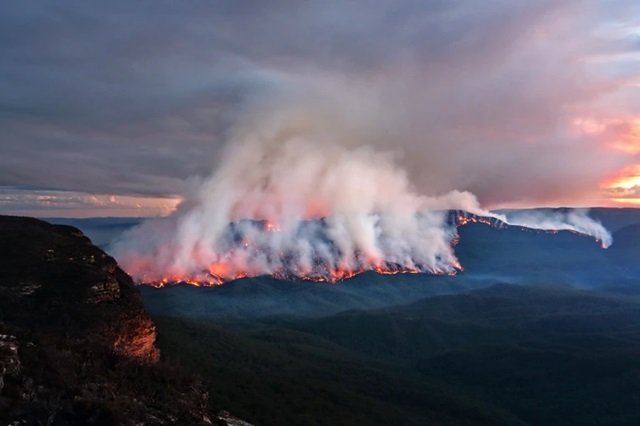
The suppression of Indigenous fire management after British colonisation probably transformed large areas of southeastern Australia into dense forests containing more combustible vegetation, contributing to the larger and more intense bushfires experienced today, according to a study published in Nature.
Researchers reconstructed vegetation and fire patterns over the past 1,000 years and found that forests in the region remained relatively open for centuries before changing markedly after British colonisation. The findings suggest that restoring Indigenous approaches to land management could provide another way to reduce wildfire risks as temperatures rise.
“It gives us another variable when we’re trying to tackle this problem, rather than just focusing on climate change,” said Michael-Shawn Fletcher, a Wiradjuri scholar and palaeoecologist at the University of Melbourne.
The study was prompted by the increasing scale and destructiveness of fires in southeastern Australia, including the Black Summer fires of 2019–20, which burned more than 8 million hectares of forest in the region.
Earlier research by a team that included Fletcher used pollen records to show that forests in southeastern Australia were generally more open and grassy before British colonisation at the end of the eighteenth century. Following colonisation, the vegetation changed, with an increase in woody fuels.
To examine the pattern over a longer period, Fletcher and his colleagues extracted a sediment core from a lake in Croajingolong National Park at the southeastern tip of Australia, within the traditional lands of the Gunaikurnai people. Historical evidence and landscape reconstructions indicate that the Gunaikurnai regularly used fire to manage the land before their violent removal by the British in the mid-nineteenth century.
The researchers analysed pollen preserved in the sediment to reconstruct vegetation over 1,000 years. For roughly 800 years, the record showed an open woodland dominated by grasses and containing relatively few trees. Around 1840, however, eucalyptus coverage doubled and woody shrubs spread through the area.
The team also analysed charcoal preserved in the sediment to estimate changes in fire intensity. By identifying molecules produced when plants burn at different temperatures and comparing them with compounds in the sediment, the researchers found that the proportion of high-temperature charcoal increased from the mid-nineteenth century onwards. The change indicates that fires became more intense.
The researchers argue that the vegetation and fire changes reinforced one another, creating what they describe as a “catastrophic wildfire loop”. More intense fires can favour the rapid growth of highly flammable vegetation, increasing fuel loads and producing a denser forest canopy. Eucalyptus trees, Fletcher said, can rapidly regenerate after fire clears competing plants.
The researchers link the transformation to the suppression of the small, regular fires traditionally lit by Indigenous Australians. Those fires were used to protect particular areas from burning and to encourage the growth of vegetation that provided food for animals.
Christy Briles, a palaeoecologist at the University of Colorado Denver, described the proposed feedback loop as “compelling”, while cautioning that more sites would need to be examined to determine how widespread the pattern is across southeastern Australia.
Clay Trauernicht, an ecologist at the University of Hawaii at Manoa, said the findings were convincing and reflected changes observed in other regions where Indigenous land management was replaced by systems focused on private property, including Hawaii and the western United States.
Some efforts are already being made to restore cultural burning and other Indigenous management practices in southeastern Australia, but Fletcher said they remained too limited and infrequent to produce a substantial effect.
As temperatures continue to rise, Fletcher said more frequent, lower-temperature burns could reduce the likelihood of later, uncontrolled fires. “We need landscape-scale experiments to test these things before it’s too late,” he said.