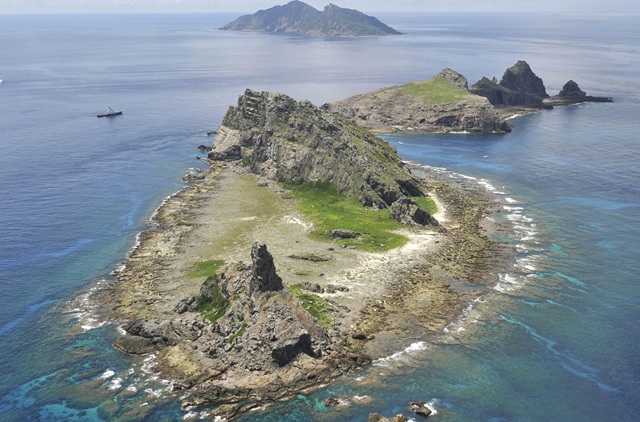
The East China Sea has become a flashpoint for rising tensions between two of Asia’s most powerful nations—China and Japan. At the heart of this dispute lies a small cluster of uninhabited islands known as the Senkaku Islands in Japan and the Diaoyu Islands in China. This seemingly insignificant stretch of land, located in the East China Sea, has sparked fierce debate over its ownership for decades, with each country presenting a long history of territorial claims and national pride.
As the dispute continues to intensify, the involvement of the United States, particularly in light of the Japan-US Security Treaty, has further complicated the situation, leading to a potential geopolitical powder keg. The situation has become so contentious that the islands’ status now plays a pivotal role in shaping the region’s security dynamics, with both nations staking their territorial claim on historical narratives and geopolitical interests that stretch back over a century.
The Historical Context of the Senkaku/Diaoyu Dispute
The origins of the Senkaku/Diaoyu Islands dispute are deeply embedded in the region’s tumultuous history, dating back to the late 19th century. Japan incorporated the islands into its territory in 1895, asserting that they were terra nullius, or unclaimed land. This assertion came amidst Japan’s imperial expansion, and the islands were considered part of Japan’s Okinawa Prefecture.
However, the end of World War II led to dramatic shifts in control over the region. Under the post-war agreements, the United States occupied Okinawa Prefecture, including the Senkaku Islands, from 1945 until 1972. At that time, the U.S. returned control of the islands to Japan as part of the Okinawa Reversion Agreement, solidifying Japan’s administrative control over the islands. For Japan, the islands are regarded as an integral part of Okinawa, with the Japanese government considering the matter closed in terms of territorial disputes.
From China’s perspective, however, the story is entirely different. Beijing claims that the islands have been part of Chinese territory for centuries, appearing on maps dating as far back as the 14th century. China argues that the islands were unlawfully seized by Japan in 1895 during the First Sino-Japanese War and that Japan’s claims to the islands are thus illegitimate. For Beijing, the Diaoyu Islands represent an essential element of China’s territorial integrity, and they maintain that the islands must be returned to China.
The Involvement of the United States: A Geopolitical Dilemma
One of the most significant factors in this dispute is the involvement of the United States. As part of the Japan-US Security Treaty, Washington is committed to defending Japan in the event of an attack, which, in theory, extends to the Senkaku Islands. In recent years, this agreement has been a source of increasing tension, as China has ramped up its military presence in the region.
In 2019, U.S. President Donald Trump and Japanese Prime Minister Shigeru Ishiba publicly affirmed that Article 5 of the Japan-US Security Treaty applies to the Senkaku Islands, reiterating the U.S. commitment to defending Japan’s control over the islands. This announcement was seen as a clear signal to Beijing that any attempt to challenge Japan’s sovereignty over the islands would risk triggering a military response from the U.S. Given the region’s strategic importance, this pact significantly complicates an already fraught geopolitical situation.
While the U.S. maintains a strong military presence in the region, its stance on the ownership of the islands is more neutral. Washington recognizes Japan’s administration of the Senkaku Islands but refrains from taking a side in the actual territorial dispute. This approach has served to maintain stability and avoid directly antagonizing Beijing, yet it has left Tokyo in a precarious position, as the U.S. can be seen as the balancing force between Japan’s territorial ambitions and China’s claims.
China’s Growing Military Presence
China’s increasingly assertive approach to the Senkaku/Diaoyu Islands has raised alarms in Tokyo and beyond. In recent years, Beijing has conducted numerous military exercises and sent warships and aircraft near the disputed islands, challenging Japan’s control and underscoring China’s determination to assert its territorial claims. These provocations have drawn sharp rebukes from Japan, which views China’s actions as a direct threat to its sovereignty.
For China, the Senkaku Islands represent more than just a territorial dispute. They are a symbol of national pride and the country’s broader ambitions to assert itself as the dominant power in East Asia. Beijing’s position is clear: the Diaoyu Islands belong to China, and its territorial integrity is non-negotiable. As China continues to expand its military capabilities and push for greater influence in the region, the Senkaku Islands have become a critical point of contention that could have far-reaching implications for the broader regional security landscape.
The Global Perspective
The international community remains divided on the Senkaku/Diaoyu dispute. The United States, along with the European Union and G7 nations, generally recognizes Japan’s administration of the islands and supports its sovereignty over them. However, the United Nations has taken a more cautious approach, refraining from officially recognizing the islands as belonging to any specific country. This neutrality is a reflection of the broader challenge the UN faces in addressing territorial disputes in a region characterized by complex historical claims and shifting geopolitical dynamics.
The involvement of global powers, particularly the U.S. and China, has turned the Senkaku Islands into a microcosm of the larger geopolitical struggle playing out in the Asia-Pacific region. For Japan, the islands are seen as an essential part of its national security and territorial integrity. For China, they are a vital piece of its territorial claims and a crucial part of its strategic ambitions. As these two nations continue to jostle for dominance in the region, the Senkaku/Diaoyu dispute will undoubtedly remain a central issue in the broader U.S.-China rivalry.
The Future of the Dispute: Escalation or Resolution?
Looking ahead, the future of the Senkaku/Diaoyu Islands dispute remains uncertain. The continued military presence of both Japan and China, along with the U.S.’s strategic interests in the region, has created a volatile environment where even small provocations could escalate into full-blown conflict. The U.S. military presence in Japan, bolstered by the Japan-US Security Treaty, is likely to serve as a deterrent to any Chinese military intervention. However, Beijing’s increasingly bold actions suggest that China is willing to push the boundaries of this delicate balance.
In this complex geopolitical landscape, one thing is certain: the Senkaku/Diaoyu Islands dispute will continue to be a point of contention, not only between Japan and China but also within the broader regional and global order. As both nations cling to their historical claims and assert their military dominance, the role of international actors, particularly the United States, will remain crucial in shaping the outcome of this high-stakes standoff.