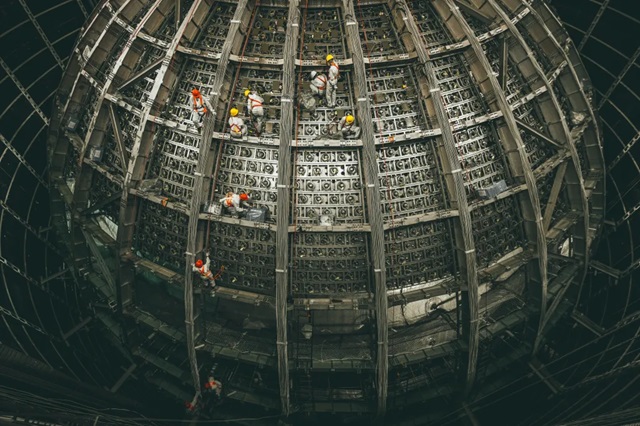
Deep beneath a hillside in Guangdong, China, a new underground observatory is at the forefront of particle physics research, aiming to reveal the secrets of neutrinos — elusive subatomic particles often called “ghost particles” for their near-imperceptible interactions with matter. Reporting for The Times UK, Wang Yifang of the Chinese Academy of Sciences and his team of 700 international physicists hope the Jiangmen Underground Neutrino Observatory (JUNO) will provide answers to some of the universe’s biggest questions.
At the heart of the observatory lies a massive acrylic sphere containing 20,000 tonnes of a liquid scintillator, itself surrounded by 45,000 tonnes of pure water. Neutrinos from two nearby nuclear power stations — Yangjiang and Taishan, each 53 kilometres away — pass through the sphere almost unnoticed, occasionally colliding with protons to produce tiny flashes of light. These events, which occur at a rate of around 50 per day, are being carefully monitored by physicists worldwide. The data will allow researchers to study the three “flavours” of neutrinos — electron, muon, and tau — and determine their mass hierarchy, a crucial piece in the puzzle of particle physics and cosmology.
“The hierarchy of the neutrino mass is key,” Wang told The Times UK. “By knowing this, we can build up the model for particle physics, for neutrinos, for cosmology.” JUNO is expected to generate the statistically significant 100,000 neutrino interactions needed for conclusive results over the next six years.
Neutrinos, first postulated in 1930 by Austrian physicist Wolfgang Pauli, have long challenged scientists due to their nearly undetectable nature and initially assumed zero mass. Their discovery and the realization that they oscillate between forms have opened questions about the relationship between matter and anti-matter, and why the universe contains more matter than its opposite. JUNO’s controlled measurements aim to shed light on these enduring mysteries.
The observatory, which cost $300 million to construct, is part of China’s growing investment in fundamental research. Collaborators include scientists from Europe, Russia, Taiwan, and the UK, including Warwick University. While the US is not involved with JUNO, it has developed its own neutrino experiments alongside Japan. According to Wang, the project benefits from China’s lower construction costs and proximity to nuclear power stations, making it more economical than similar ventures in the US and Japan, where projects have cost $1 billion and $3.5 billion respectively.
After its initial phase, JUNO will be upgraded to search for neutrinoless double beta decay — a theoretical phenomenon in which neutrinos are their own anti-neutrinos — and may also detect neutrinos from supernovae within the Milky Way, an event that has not occurred visibly in over 300 years. “In our Milky Way there should be one per 100 years; we haven’t had one for 300 years,” Wang said. “Given that 99 percent of a supernova’s energy is transmitted as neutrinos, JUNO will have a lot to play with.”
The project exemplifies China’s growing prominence in experimental physics, combining advanced technology, international collaboration, and cost efficiency. As The Times UK reports, JUNO could redefine our understanding of the subatomic world and, by extension, the universe itself.