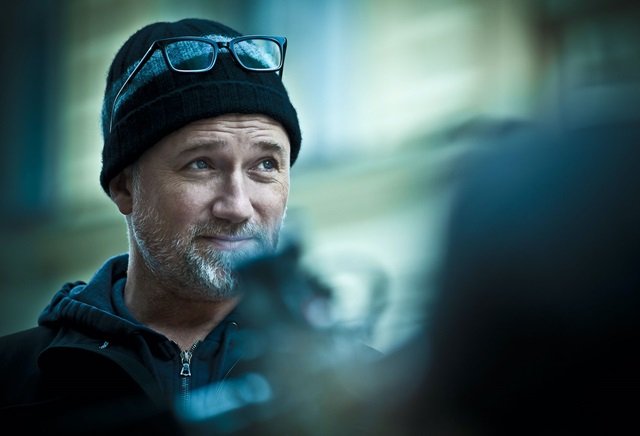
David Fincher has spent much of his career examining violence, obsession and the darker instincts of human behaviour. His latest film takes him back to 1977 Los Angeles, but his most pointed observations concern the future of cinema. In an interview published by El País, the director argues that the increasingly heated debate over artificial intelligence in filmmaking is being driven less by questions about artistic practice than by a broader cultural conflict. For an industry confronting technological change, economic uncertainty and shifting creative power, his message is straightforward: the argument should be about what cinema can become, not simply what it used to be.
Fincher’s latest project, The Further Adventures of Cliff Booth, continues the story of the character played by Brad Pitt in Quentin Tarantino’s Once Upon a Time in Hollywood. Set eight years after the events of the earlier film, it follows Booth, a former stuntman who remains in Los Angeles, living with his father and taking on work far removed from the glamour of his former association with a major Hollywood star. Some of his assignments are criminally unsavoury, but all are connected in some way to the film industry.
The story unfolds in a deteriorating Los Angeles in 1977, around the time of the release of Star Wars. Fincher approaches the period with the darkness and bitterness associated with his filmmaking, while shifting attention away from the glamour traditionally attached to Hollywood’s golden mythology. The film, released in cinemas before becoming available on Netflix, also marks a distinctive collaboration between two filmmakers with markedly different cinematic identities.
The project originated with Pitt, who contacted Fincher while the director was developing other work and asked him to read Tarantino’s screenplay. Fincher agreed after receiving confirmation that Tarantino was comfortable with him directing it. The opportunity to follow Booth beyond the earlier film was what attracted him, rather than an attempt to reproduce Tarantino’s original approach.
The screenplay reportedly ran to 230 pages, of which Fincher removed around 60 pages of dialogue. He insists that he did not eliminate any sequences, describing the process as an adjustment of the material rather than a restructuring of its narrative. Tarantino, he says, had one overriding objective: to see the film made. That arrangement allowed Fincher to shape the screenplay while retaining its central story and characters.
The director also sought to give the women in the film a presence that extended beyond supporting the male protagonist. He cites the influence of screenwriter Robert Towne, whose female characters he admired for their strength and independence. Elizabeth Debicki’s character, Crosby, was never intended to function as a romantic accessory to Booth, Fincher explains. Although the film contains a romantic element, her character is defined by her own thoughts and sophistication. The director says Pitt welcomed that approach.
The film’s setting also reflects Fincher’s interest in a period when Hollywood was undergoing a significant transition. He recalls the popularity of large-scale studio productions such as The Towering Inferno, while observing that these films often overshadowed the work of directors such as Hal Ashby. The latter’s cinema offered a different perspective on American life, one that Fincher believes deserves renewed attention. His own film, he suggests, draws on that tradition while incorporating a much greater degree of on-screen violence.
Yet the most revealing part of the interview concerns the controversy over artificial intelligence. Recent debate surrounding the film has focused on the use of AI to reconstruct aspects of 1970s Los Angeles and images appearing on television screens. Fincher rejects the idea that this controversy is primarily about the films themselves. “The debate about AI hides a culture war,” he argues, suggesting that the dispute is driven by competing attitudes towards technology and cultural change.
For Fincher, filmmaking remains a practical exercise in turning an idea into something tangible. Directors work with limited budgets, a defined number of sequences and technical resources that must be used to bring a story to life. The tools are part of that process, not its ultimate purpose. His position is not that technological questions are irrelevant, but that an exclusive focus on the instruments risks obscuring the creative objective.
His comments also extend to the changing economics of Hollywood. Asked about the emergence of young horror filmmakers from YouTube and the growing interest in projects such as Obsession and Backrooms, Fincher admits that he has not yet watched them. Nevertheless, he is interested in the phenomenon, particularly because it represents new intellectual properties and alternative approaches to filmmaking.
He offers horror as an example of a genre that demands continual reinvention. Filmmakers must repeatedly discover new ways to create fear, construct suspense and develop the identities and motivations of their antagonists. That pressure, he suggests, encourages experimentation. Horror is also unusually personal: different audiences respond to different fears, allowing relatively inexpensive films to find distinct markets.
There is another reason these productions can operate at lower costs. Fincher points out that they do not necessarily carry the same executive structures and layers of supervision associated with major studio productions. They still have to pay for equipment, vehicles, lighting and unionised performers, but can avoid some of the institutional expenses that weigh on larger projects. The implication is that creative independence may be connected not simply to smaller budgets but also to fewer corporate intermediaries.
Fincher describes the political atmosphere in the United States as having been difficult for approximately 12 years, characterising the country as experiencing a cultural war. He also reflects on what he sees as a national tendency towards strong personal loyalties and intense disagreements. His remarks suggest that the conflict surrounding AI in cinema cannot be separated entirely from the wider divisions shaping American public life.
The director is equally sceptical of the industry’s tendency to romanticise earlier periods. He acknowledges that a film rarely matches the ideal version that exists in a filmmaker’s imagination, estimating that achieving 60 or 65 per cent of what he originally envisioned can constitute success. But he is more interested in discussing where cinema should go than in repeatedly revisiting the difficulties of the past.
He rejects the assumption that older formats or production methods were inherently superior, pointing to the tendency to treat technologies such as VistaVision, introduced in 1954, as benchmarks that contemporary filmmaking should preserve. For Fincher, the history of visual storytelling is one of continual experimentation, from painting on walls thousands of years ago to the development of cinema over the past century.
His current collaboration with Spanish animator Alberto Mielgo, whom he describes as a remarkable talent, reinforces that outlook. Fincher says the work they are producing has surprised even people familiar with his filmmaking.
The wider message emerging from the El País interview is that cinema’s future may depend less on defending established methods than on recognising where new creative possibilities are emerging. For Fincher, technological change is not necessarily a threat to filmmaking. The greater danger may be an industry so preoccupied with cultural disputes and nostalgia that it loses sight of the possibilities still waiting to be explored.