Europe’s capacity to defend itself without the United States has become a pressing concern as the geopolitical landscape shifts and Washington increasingly focuses on countering China. In a detailed report by the Financial Times, questions about NATO’s ability to operate without the critical support of its largest member are becoming more urgent, especially as European leaders grapple with the possibility of Donald Trump returning to the White House. Trump’s previously stated skepticism of NATO and his calls for Europe to take on a greater share of defense responsibilities have amplified anxieties about the future of transatlantic security cooperation.
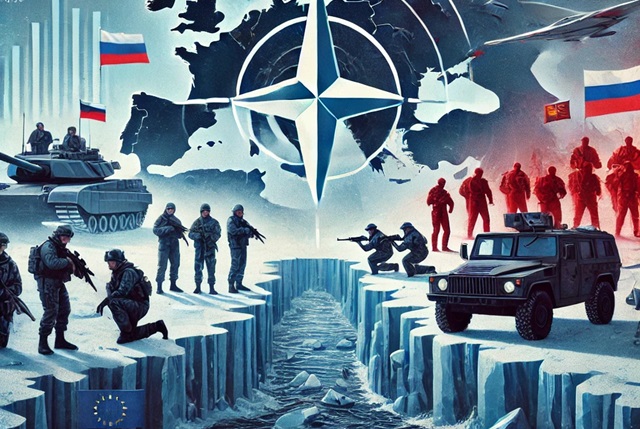
The report outlines a scenario envisioned in the book The Retreat From Strategy by General Lord David Richards, former head of Britain’s armed forces, and Julian Lindley-French. By 2030, the hypothetical scenario imagines Russia and China conducting joint military exercises in the Arctic and asserting territorial claims over Norway’s Svalbard archipelago. In this situation, NATO’s European members would face a critical choice: respond with military force without US support, risking nuclear escalation, or cede strategic ground. While the scenario is speculative, it underscores vulnerabilities in Europe’s defense posture and the challenges of filling the void left by a diminished US presence.
For decades, the United States has provided the backbone of NATO, offering advanced military hardware, logistical capabilities, and leadership. General Christopher Cavoli, NATO’s supreme commander, recently warned that despite significant losses in Ukraine, the Russian military could reemerge stronger and more focused on European borders. As a result, Europe faces a daunting challenge: how to respond to a resurgent Russia without the comprehensive support of the US military.
While European NATO allies have pledged to do more, including adopting NATO’s “New Force Model” to deploy 100,000 troops in less than 10 days, many remain unprepared for a post-US scenario. Key NATO members such as Germany, France, and the UK face major hurdles. Germany’s defense modernization has been hampered by constitutional spending limits. France, despite having NATO’s second most capable military force in Europe, suffers from inadequate stockpiles. Meanwhile, the UK’s traditionally strong military has been described as “hollowed out” by its own defense secretary, John Healey.
Another challenge is the fragmentation of Europe’s defense industry, which the Financial Times highlights as a significant barrier to interoperability and efficiency. The United States operates 32 types of major weapons systems, while Europe has 172, leading to logistical complexities and inflated costs. This inefficiency is starkly visible in Ukraine, where NATO allies have supplied Kyiv with a variety of artillery shells that require constant recalibration for different guns. European defense companies like Rheinmetall and MBDA have made strides in consolidating and increasing production, but these efforts are not yet sufficient to replace the scale of US contributions.
Leadership is another critical issue. NATO has traditionally relied on US commanders to provide strategic direction and unity. European leaders such as Emmanuel Macron and Olaf Scholz have acknowledged the difficulties of replacing this role, given historical rivalries and differing national priorities. According to Edward Stringer, a former British RAF air marshal, removing US leadership from NATO would likely lead to internal discord, as no European nation is positioned to assume the “team captain” role.
Financial constraints also loom large. While NATO members have increased defense spending to $476 billion—a 30% increase since 2022—meeting the alliance’s goals for readiness and modernization will require even greater investment. NATO Secretary-General Mark Rutte has emphasized that Europe’s current target of spending 2% of GDP on defense may not be enough, suggesting that 3-4% may be necessary to effectively deter Russia. However, tight national budgets, public debt, and competing priorities like healthcare make this a politically challenging prospect.
The Financial Times notes that even with increased spending, Europe faces practical challenges in replacing critical US capabilities. For example, the US fleet of C-17 transport aircraft, F-35 fighter jets, and advanced intelligence systems are currently unmatched within Europe. Despite proposals for joint procurement and industrial collaboration among European nations, progress has been slow due to bureaucratic hurdles and political disagreements.
The urgency of these issues is further highlighted by the war in Ukraine, which has revealed both the strengths and weaknesses of European defense efforts. While some countries, particularly in the Baltic and Nordic regions, have demonstrated impressive resolve and capabilities, the conflict has also exposed glaring gaps in Europe’s readiness to sustain long-term military operations.