As cross-strait tensions continue to mount, a former senior Taiwanese defense official has cautioned that the risk of a military mishap between China and Taiwan is growing—fueled by heightened military activity and a lack of direct communication. In a recent interview with the South China Morning Post at the Shangri-La Dialogue in Singapore, Andrew Yang Nien-dzu, former Taiwan defense minister and deputy minister, urged both sides to “break the ice” and re-establish dialogue channels to prevent dangerous miscalculations.
Yang highlighted the intensification of China’s so-called “grey zone operations”—tactics that blur the line between military and civilian actions. These include increasingly frequent patrols by China’s coastguard near Taiwanese waters, activities Yang described as “not actually military operations but [that] carry a military message.” Such pressure, he said, creates a precarious environment prone to accidents.
“There have not been accidental conflicts yet, but this kind of activity has placed immense pressure on us,” Yang said, warning that without mechanisms for dialogue, the potential for misunderstanding and misjudgment is dangerously high.
Since 2016, official communication between Taipei and Beijing has been frozen, following the election of Tsai Ing-wen from the independence-leaning Democratic Progressive Party (DPP), who rejected Beijing’s “one-China principle.” Her successor, current President William Lai Ching-te—whom Beijing has labeled a “dangerous separatist”—has maintained a firm stance, including remarks that Taiwan and China “are not subordinate to each other” and branding Beijing a “hostile foreign force.”
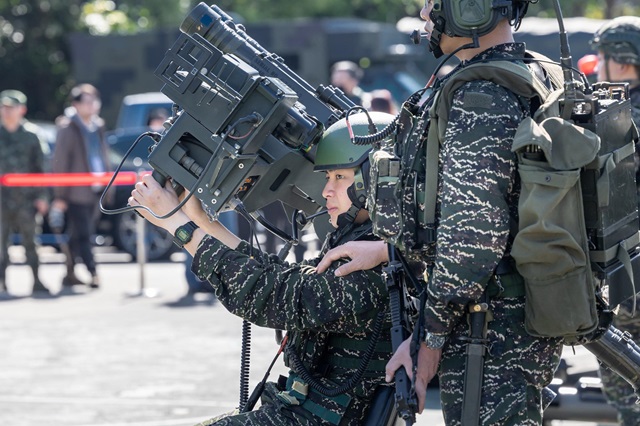
In response, China’s People’s Liberation Army (PLA) has ramped up military drills around Taiwan and intensified its air and naval presence near the island. According to Yang, this approach amounts to “salami slicing,” where the PLA gradually escalates its activity—often crossing the median line of the Taiwan Strait—forcing Taiwan to constantly adjust its defenses.
“This is indeed a depletion,” Yang said. “Our intense defence preparation is a kind of depletion, while the intense military drills of the other side also depletes them.”
The risk of an unintended clash looms large, he added, especially in the absence of lower-level or informal communication channels. Yang, who now serves as secretary general of the Chinese Council of Advanced Policy Studies in Taipei, suggested that academics and policy advisers from both sides could begin exchanges to “share interpretations of the situation” and reduce the risk of escalation.
“If there is such a channel for lower-level [policy advisers] to convey information, higher-level officials on both sides could prevent errors when making policy judgments,” he said.
Yang also supported the Lai administration’s increase in defense spending, calling it a “necessary move” to build deterrence and delay any potential military action from Beijing.
The Shangri-La Dialogue, organized by the International Institute for Strategic Studies (IISS), has emerged as a key platform for regional security dialogue. Yang has attended the forum regularly since its inception in 2002 and participated this year as an IISS guest—a designation designed to navigate the sensitive issue of Taiwan’s international status.
US Secretary of Defense Pete Hegseth also used the forum to issue a stark warning, claiming that China could be ready to invade Taiwan by 2027. He reassured regional partners that “Communist China will not invade Taiwan on [President Donald] Trump’s watch.” In response, China’s delegation—led this year by Hu Gangfeng, vice-president of the PLA National Defence University—dismissed Hegseth’s statements as “groundless accusations.”
Beijing continues to view Taiwan as part of its territory, to be reunited by force if necessary. While most countries, including the United States, do not recognize Taiwan as an independent state, they oppose any change to the status quo through military means.
Yang’s call for pragmatic engagement stands out amid an increasingly combative environment. His proposal—beginning with academic and expert-level exchanges—seeks to inject reason and dialogue into a standoff marked by military brinkmanship and diplomatic silence.
Also present at the dialogue was Lai I-chung, president of the Taipei-based Prospect Foundation and a veteran of the DPP’s cross-strait and international affairs teams, who attended in a private capacity.
As the cross-strait situation teeters on a knife edge, Yang’s warning—reported by the South China Morning Post—serves as a sobering reminder that without meaningful dialogue, the path forward could be marked by costly missteps.