Government of India has set the target of achieving a major leap forward in industrial, economic and social growth by the year 2047 under the title “Viksit Bharat 47”. While this move by the government to set such an ambitious target has caught the imagination of the people, the biggest challenge in achieving it appears to be the surging population of India.
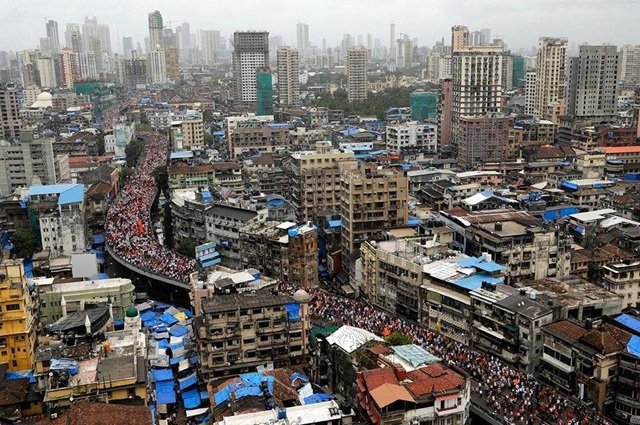
In 1947, when India attained independence, the national population was around 340 million. In the last 75 years, India’s population has soared to 1,440 million, and it is still increasing. India has now achieved the “distinction” of emerging as the most populous country in the world, with one of the highest population densities among major countries. India’s present population density is 497 people per square kilometre. By comparison, population density in China is 150 people per square kilometre, in the USA 38 people per square kilometre, and in Russia 9 people per square kilometre. Such a high population density in India is a matter of concern.
Talking about population management, some people hold the view that India’s population level need not be a matter of concern for the future, as in some states the growth rate is below the replacement level. However, this is not the case in several other states, and it is estimated that India’s population could reach an alarming level of 1,600 million by 2050 or before.
While India has achieved considerable progress in multiple directions in the past, particularly during the last 12 years, this may not be adequate to tackle the unmanageable population density likely to emerge in the coming years. With millions of additional mouths to feed and continuing demand for products and services that may be difficult to meet adequately, it is inevitable that social and political stress could become much more intense than it is today. This would particularly be the case because of the unemployment issue that is likely to challenge the country.
While the working-age population is increasing, economic and industrial growth activities cannot necessarily lead to a proportional level of job creation. This is partly because of modern technological tools, through which human activities are increasingly being replaced by machines.
In such a scenario, it is strange that the Chief Minister of Andhra Pradesh has announced an incentive programme for women to have more children, instead of restricting family size to two children. The Chief Minister of Tamil Nadu has also provided some form of incentive to mothers by increasing maternity leave from the present three months to twelve months in government departments for women giving birth to a third child. Certainly, several people are highly critical of these questionable decisions by the Chief Ministers of Tamil Nadu and Andhra Pradesh.
There is a view that a high population reflects demographic strength, which should be utilised optimally to reap the benefits. However, a holistic view of the entire scenario in the country could lead one to conclude that such a high population density cannot necessarily be considered demographic strength, but should instead be viewed as a demographic burden, considering India’s present population and its likely increase in the future.
It is said that a substantial percentage of India’s population consists of young people, aged around 25 or below.
It is a daunting task for any government to provide suitable employment for such a large youth population, commensurate with their qualifications and skill levels. With the developing science and technology scenario, automation, artificial intelligence and robots are steadily becoming tools for getting work done. There is also a widespread belief that the use of such technological tools can be far more productive and provide higher-quality output than employing humans for certain tasks. Governments and employers all over the world are therefore increasingly focusing on using these technological tools. In the process, employment opportunities could steadily decline. India cannot be an exception to this global trend.
It is correctly said that an idle brain is the devil’s workshop. In other words, a scenario of increasing joblessness could generate the seeds of conflict, restlessness, social tension and even violence.
In such a scenario, it is also seen in several overpopulated developing and underdeveloped countries that young people seek to migrate to developed countries in search of job opportunities. This is creating problems for several developed countries, particularly the USA, Canada and countries in Europe.
In these countries, there is increasing evidence of anti-migrant attitudes developing among local people who are concerned about changing demographic balances and consequent religious and social issues. These concerns can create law-and-order problems and other negative developments. Governments are increasingly becoming concerned about these developments. Consequently, several developed countries are seeking to adopt more restrictive practices towards migrants.
In India, it can be seen that an increasing number of people are seeking ways and means to find jobs abroad and even attempting to obtain permanent residency in several developed countries. This trend obviously reflects the increasing level of unemployment and underemployment among India’s working-age population. In the process, India is losing the services of several highly qualified and talented people.
What India needs today is not population growth but population stabilisation at a much lower level than the population India has today.
It is pointed out that, apart from an increasing birth rate, a falling death rate and the consequent ageing of the population are also factors contributing to population growth. The target should be to reduce both the death rate and the birth rate. However, it should be kept in view that, with modern technological tools, many older people remain productive and therefore this so-called ageing-population issue need not be exaggerated beyond a reasonable level.
Perhaps, the ideal population for India is 1,000 million people, and it should be stabilised at this level. This could be achieved over time by families voluntarily reducing and restricting family size because of the cost of raising children and the limited job opportunities available to them.
What is needed in India today is not an incentive for population growth but a disincentive for population growth.