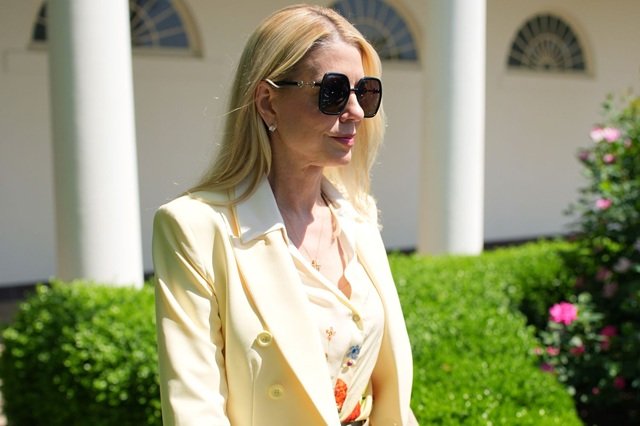
On a bright Wednesday morning in Washington, Attorney General Pam Bondi walked alongside President Donald Trump down the sunlit steps of the White House, appearing relaxed and composed as the two prepared for a short but significant journey. Their destination was the United States Supreme Court, just two miles away, where a hearing on birthright citizenship awaited. But it was not the courtroom that would define the day. Instead, it was a quiet conversation inside the presidential limousine, known as “The Beast,” that would abruptly end Bondi’s tenure as the nation’s top law enforcement official.
According to accounts later shared with associates, it was during that brief ride that Trump informed Bondi of his decision. “I think it’s time,” he told her, signaling the end of a tenure that had been marked by tension, controversy, and persistent dissatisfaction from the president himself. The moment was as stark as it was unexpected, unfolding in the confined and heavily secured space of one of the most powerful vehicles in the world.
The hours that followed reflected the strained dynamic that had come to define their working relationship. Although the two appeared together at the Supreme Court shortly afterward, they kept their distance. Trump soon moved seats during the hearing, a subtle but telling gesture. Later, Bondi made a final appeal, asking if she could remain in her role until the summer. Trump declined, underscoring that the decision had already been made.
Behind the scenes, the president had been weighing her removal for days. His frustration had been building steadily, fueled by a series of grievances that ranged from policy disagreements to political optics. Chief among them was the Justice Department’s handling of the Jeffrey Epstein investigative files, an issue that had become a persistent source of controversy. Trump was also angered by what he saw as Bondi’s failure to aggressively pursue legal action against his political adversaries, a priority he had repeatedly emphasized.
As reported by the Wall Street Journal, the tensions between Trump and Bondi had been simmering for months, with the president frequently expressing dissatisfaction over the pace and effectiveness of her work. He had even floated the idea of appointing special counsels to take over responsibilities he believed she had not fulfilled. At times, he reportedly showed visitors social media criticism of Bondi, using it as evidence of her shortcomings.
Bondi’s departure did not come entirely without warning. Discussions about her potential exit had been ongoing since early in the year, according to individuals familiar with the matter. Still, the speed and manner of her dismissal sent shockwaves through Washington, particularly as it followed closely on the heels of another high-profile firing: that of Homeland Security Secretary Kristi Noem just a month earlier.
The abrupt shift marked a departure from Trump’s earlier efforts to project stability within his administration. During his first year back in office, he had sought to avoid the kind of personnel upheaval that characterized his initial presidency. Now, facing declining approval ratings, rising fuel prices, and mounting uncertainty over the war in Iran, the president appeared increasingly willing to make bold and disruptive changes.
Bondi, for her part, had made repeated efforts to align herself with Trump’s priorities. On several occasions, she initiated investigations targeting individuals and entities the president had publicly criticized. However, many of these efforts were viewed within the Justice Department as lacking substance, and some were ultimately blocked by judges or grand juries. These setbacks only deepened Trump’s frustration, reinforcing his perception that she was not delivering results.
The pressure on Bondi was relentless. She reportedly confided to allies that the expectations placed on her often exceeded what was legally or practically possible. At the same time, external voices within Trump’s orbit continued to question her effectiveness. Advisers and allies, including figures such as Boris Epshteyn and Bill Pulte, frequently urged the president to push for more aggressive legal action against his opponents.
Trump had initially envisioned a far more combative figure in the role of attorney general. His first choice, former congressman Matt Gaetz, ultimately proved untenable due to legal and political challenges. Bondi, a former Florida attorney general with a reputation for loyalty and a measured demeanor, became the fallback option. While she brought experience and familiarity to the role, she struggled to meet the president’s expectations for a more confrontational approach.
One of the most damaging episodes of her tenure centered on the Epstein case. Early in her time as attorney general, Bondi made a remark during a television interview suggesting that she possessed a list of Epstein’s clients. The comment ignited intense speculation among Trump’s supporters, many of whom believed such a list would implicate prominent political figures. Although Bondi later clarified that she was referring to broader case files, the damage had been done.
The issue continued to haunt her. Efforts to manage the release of information related to Epstein only fueled further controversy, culminating in congressional action that forced the Justice Department to disclose additional records. The resulting wave of revelations generated sustained media attention and political fallout, affecting figures across the political spectrum. Trump, despite denying any wrongdoing, blamed Bondi for allowing the issue to remain in the spotlight.
The Epstein controversy also exposed fractures within Trump’s political base. Some Republican lawmakers openly defied the administration, demanding full transparency and criticizing attempts to control the narrative. The episode highlighted the challenges Bondi faced in balancing legal considerations with political pressures, a tension that ultimately proved unsustainable.
At the same time, Bondi found herself navigating demands to pursue investigations into a wide array of Trump’s perceived enemies, including prominent political and institutional figures. While some cases led to indictments, others collapsed under judicial scrutiny, raising questions about the independence and credibility of the Justice Department. Critics argued that the agency was being used as a tool for political retribution, a charge that Bondi had explicitly rejected upon taking office.
Despite the mounting challenges, Bondi retained some support within the administration. Figures such as White House Chief of Staff Susie Wiles maintained close ties with her, and there were efforts to publicly defend her performance. These interventions may have extended her tenure, but they were ultimately insufficient to overcome the president’s growing dissatisfaction.
By the time her dismissal became public, Bondi had already left Washington, traveling to Florida for a previously scheduled event with local law enforcement. There, she promoted a child identification initiative, emphasizing the importance of protecting vulnerable communities. Even as news of her departure spread, she struck an optimistic tone, hinting at future opportunities in the private sector.
In a social media post, Trump offered a notably restrained assessment of her service, describing her as a “Great American Patriot” and a loyal ally. The measured language stood in contrast to the harsher rhetoric he has used in past dismissals, reflecting the personal dimension of their relationship.
Bondi, meanwhile, has received a wave of support and job offers, ranging from legal roles to media opportunities. One possibility under consideration is a move into the field of artificial intelligence, signaling a potential shift in her career trajectory. Yet her immediate future remains intertwined with ongoing political developments, including a scheduled congressional testimony on the Epstein case that could bring her back into the spotlight.
The search for her successor is already underway, with several names under consideration. Among them are Environmental Protection Agency Administrator Lee Zeldin and interim Attorney General Todd Blanche, as well as other prominent figures within Trump’s political network. The choice will carry significant implications, not only for the direction of the Justice Department but also for the broader trajectory of the administration.
Bondi’s rise and fall encapsulate the volatile nature of power in Trump’s Washington, where loyalty, performance, and perception intersect in unpredictable ways. Her tenure, though relatively brief, leaves behind a complex legacy shaped by high-stakes decisions, political controversies, and the relentless demands of serving at the highest levels of government.
As the administration moves forward, the circumstances surrounding her dismissal serve as a reminder of the precarious balance within the inner circle of power. In a presidency defined by rapid shifts and bold moves, even the most trusted allies can find themselves abruptly on the outside, their fate decided in moments that unfold far from public view but carry consequences that reverberate across the nation and beyond.