



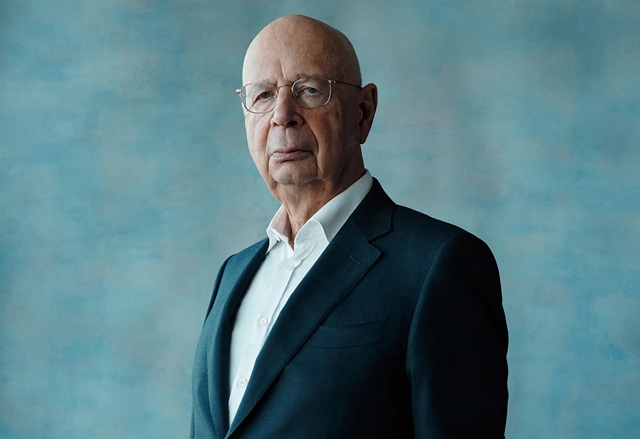
Each year, the anointed elite flew to Davos to witness Klaus Schwab’s pageantry—where lofty proclamations drowned out the unresolved crises of poverty, health emergencies, and food insecurity. They gathered in alpine luxury, more suited to honeymoons than humanitarian reckoning, to moralise about catastrophes unfolding continents away. The spectacle revealed not merely paradox, but a deliberate choreography of geopolitical theatre—where privilege cloaked itself in altruism and global suffering was repurposed as elite currency.
Klaus Schwab, the architect of this icy Olympus, the World Economic Forum’s omnipresent paterfamilias, has long styled himself as the cerebral messiah of stakeholder capitalism. With almost oracular cadence, he declared: “The pandemic represents a rare but narrow window of opportunity to reflect, reimagine, and reset our world.” It was the kind of proclamation that sounded benevolent to some and Machiavellian to others. To his admirers, he was a prophet of multilateralism and sustainable development; to his critics, a grandiose technocrat cloaked in the language of humanism, who sought not to dismantle the system of inequity but to rebrand it.
Schwab’s legacy, now embroiled in scandal and precipitous retreat, was always a palimpsest: the elegant prose of visionary change obscuring darker subtexts of elitism, opacity, and manipulation. The recent whistleblower allegations—detailing misuse of institutional funds, methodological tampering in flagship reports, and attempts to solicit a Nobel Peace Prize—have only validated the long-held suspicions of those who viewed Davos as a vaudeville of virtue signalling. The Financial Times called it a “downfall in Davos,” yet it is not merely the toppling of a man, but the implosion of a grand narrative that spanned five decades.
One cannot ignore the irony that the very man who exhorted the world to “build back better” is accused of bending institutional mechanisms to bolster personal prestige. That Schwab allegedly altered the methodology of the Global Competitiveness Report to curry favour with petulant governments speaks volumes—not only about his imperium within the WEF, but about the pliability of ‘truth’ within elite consensus. “Over the years I continued to engage with the methodology to improve and maintain the credibility of the report,” Schwab protested. But in the realm of epistemic governance, “engagement” too often becomes a euphemism for expedient distortion.
That Schwab’s decline coincides with his octogenarian twilight lends the entire episode a tragic Shakespearean air—Lear exiled from his castle not by storm or sword, but by memo. A figure who once dined with monarchs and ministers now pens rebuttals to anonymous emails and threatens defamation lawsuits. His supporters insist he is the target of “character assassination”; others call it karmic revelation. In his 1 April email to the trustees, Schwab remarked with characteristically self-assured solemnity, “It is evident that I do not have to strive any more to create a legacy.” And yet now, with his departure expedited and ignominy encroaching, that legacy appears less a monument and more a mausoleum.
Few remember that Schwab’s intellectual lineage was forged not merely in the groves of academia but in the grey spaces between policy, industry, and ideological hegemony. His 1971 book Modern Enterprise Management in Mechanical Engineering proposed the then-novel idea that corporations ought to serve all stakeholders, not just shareholders. On the surface, this was prescient. But the WEF he built around that idea became a quasi-aristocracy of corporate nobles, where virtue was worn as adornment and seldom as burden.
He mastered the theatre of global benevolence, wrapping laissez-faire capitalism in the warm hues of inclusivity and green ambition. In Davos, climate activists mingled with oil executives, AI ethicists with surveillance capitalists. To attend was to be consecrated among the responsible elite—a spectacle of noblesse oblige, where the powerful confessed the sins of others while affirming their own salvific role.
Behind the curtains of this alpine symposium, Schwab reportedly centralised control, maintaining a grip so unrelenting that one senior WEF member remarked: “He should have left years ago, but he obviously couldn’t. I am sure he’ll fight tooth and nail.” That insight now reads as prophecy, as Schwab’s once-invulnerable façade disintegrates under the weight of new probes, internal dissent, and boardroom tremors.
To speak of Schwab without addressing the WEF’s governance is to narrate Hamlet without Denmark. The 2015 Swiss designation of WEF as an “international organisation for public-private cooperation”—complete with tax privileges and special legal status—revealed not neutrality, but institutional sanctification of elite opacity. The requirement that a Schwab family member remain on the board perpetuates not merely nepotism, but a dynastic arrogance that belies the Forum’s democratic posturing. What began as an initiative for transnational dialogue became, over time, an ecclesiastic council for technocratic orthodoxy.
And still, despite these revelations, Schwab clings to the mythos of personal sacrifice: he waived bonuses, accepted below-market salaries, and saw his spouse offer unpaid labour. One is reminded of Talleyrand’s dictum: “They have learned nothing and forgotten nothing.” That Schwab, at the end, saw his predicament through the lens of personal martyrdom rather than institutional accountability is less surprising than it is depressingly emblematic.
Uncommonly recounted is Schwab’s fierce control over the Forum’s narrative architecture. Staff have long whispered of ghostwritten books produced under WEF auspices, generating royalties attributed to Schwab, marketing funded by the Forum, arguments constructed by its analysts. While commonplace in think tanks, the scale and lack of disclosure here were part of a broader pattern: an empire of ideas with a singular sovereign. Even his aspirational bid for a Nobel Peace Prize—allegedly encouraged by staff at his behest—reveals a man intoxicated not only by influence, but by immortality.
What remains of Klaus Schwab’s WEF is uncertain. Børge Brende and Peter Brabeck-Letmathe may attempt to re-legitimise its mission, to dust off its public trust and reaffirm its relevance. But among the Forum’s financiers and acolytes, there is growing apprehension: does Davos remain magnetic without its high priest? One insider put it plainly: “That is the biggest worry at the moment. Does it die with him or stick to WEF?”
As Klaus Schwab recedes into the footnotes of history, his final chapter remains unwritten—perhaps he will pen memoirs to catalogue his intentions and proclaim his innocence. Yet, even if he evades formal censure, the myth he so carefully constructed is unravelling. He may be remembered less for the ideals he championed than for the grand illusion he perpetuated: that Davos was a fortress of solutions rather than a gilded stage of detached spectacle.
Men like Schwab are often seen as the disease itself, but in truth, they are the symptoms—the parasites—deeply versed in the art of manipulation, thriving within societies long afflicted by such endemic corruption. Like all ideologues who outlive their eras, Schwab is not merely fading; he is being unmasked, his carefully woven illusions stripped away by the very crises he sought to orchestrate. The page turns, the Forum endures, but the man who made it immortal now stands conspicuously mortal, and the mountain echoes differently when its oracle falls silent.
Source: Daily Pioneer, India





he needs prison .
Agreed!!!
Very well written!
Who is Klaus Shwab? Never heard of him. ..
Schwab needs to be hung from the gallows
Never mind Schwab what about all those stooges he has peppered our governments with? How are we supposed to deal with them? Look at whatTrudeau, a devout follower of Schwab, has just inflicted on Canada.