For Vivian Jenna Wilson, rebellion has become both personal and public. The 22-year-old transgender model and one of Elon Musk’s 14 children has emerged as a prominent critic of her father, and her latest statement takes the form of an anti-AI fashion campaign for Spanish brand Desigual.
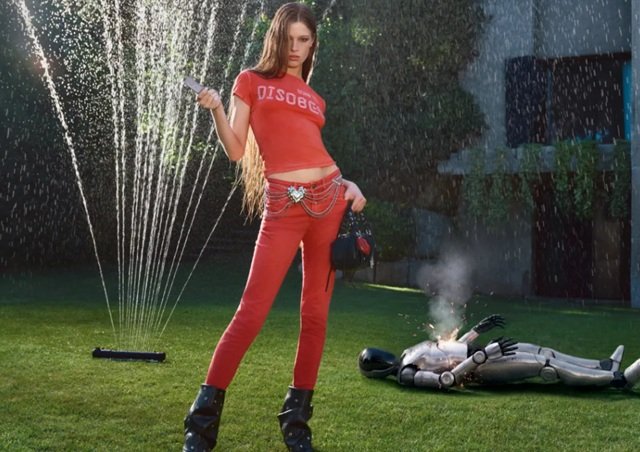
Titled “Born to Disobey”, the campaign places Wilson opposite a humanoid device markedly similar to Tesla’s Optimus model, created by Musk. Rather than presenting the machine as a symbol of technological progress, Wilson subjects it to a series of deliberately irreverent indignities. She uses the humanoid as a golf tee, orders it to mow the lawn before turning on the sprinklers, leashes it like a pet and takes it to bed. Eventually, she heaves the lifeless device across the carpet before declaring: “Some things aren’t meant to be fixed.”
The campaign gives a commercial setting to a dispute that has become deeply personal. Wilson’s relationship with Musk became increasingly strained after she began her gender transition in 2020, at the age of 16. Musk publicly rejected her transition in language that intensified the rupture between father and daughter.
“My son, Xavier, died,” Musk wrote in a transphobic remark posted to X at the time. “He was killed by the woke mind virus. Now, the woke mind virus will die.”
Two years later, the model legally changed her name and stated that she no longer wished to be related to Musk “in any way, shape, or form”. The decision placed the family dispute into the public record and established a sharp distinction between Wilson’s identity and her father’s increasingly prominent political and technological persona.
The disagreement has also extended into politics. In Musk’s 2023 biography by Walter Isaacson, the estrangement is attributed to Wilson’s “neo-Marxist influences”, although she rejected that characterisation in an interview with Teen Vogue in March last year. Her stated political positions instead centred on social welfare and economic inequality.
“I believe in free health care. I believe food, shelter, and water are human rights,” she said. “I feel like workers should be fairly compensated for the work that they do, and I don’t feel like the wealth should be hoarded by these mega-billionaires who are the top one per cent, who have their own interests at heart. I’ve met some of these billionaires – they’re not good people. I don’t think any of them are,” Wilson concluded.
Her latest campaign therefore carries an additional resonance. Wilson’s criticism of AI is not simply presented as a rejection of a particular technology but as an argument about individuality and independent thought. In an interview accompanying the Desigual campaign, she said: “Stop using AI for everything – you’re going to give yourself a lobotomy. Outsourcing all of your critical thinking to AI is the easiest way to lose your individuality and perspective.”
The comments arrive as Musk’s family relationships receive renewed attention through Alex Gibney’s four-hour documentary, Musk, which examines the billionaire’s estrangement from Wilson alongside his relationships with former partners and the mothers of his children. The film is released this October, after premiering at Venice Film Festival.
Among those interviewed is Ashley St Clair, a 28-year-old former conservative influencer who is currently embroiled in a custody battle with Musk for their son, Romulus. St Clair revealed at the film’s Venice premiere that she had rejected a $40m (£29.5m) offer from Musk’s team not to appear in the documentary.
The offer, she said, forced her to consider the relationship between financial security and freedom of speech.
“Why do they want to offer me this amount of money not to speak?” she asked. “I want to set the example for my kids that you should never take being materially comfortable over speaking the truth.”
St Clair also recounted a text message in which she said Musk told her that he wanted to have a child with her because he needed to have “a legion of children before the civil war”. She criticised Musk’s activity on X, saying: “Whatever it is, what he’s doing with this platform on X cannot be ignored, because he is stoking flames that don’t exist in the real world”. She added: “I do believe that he is causing deliberate division that may be catastrophic if it’s not regulated or tamed, or if we don’t do our part in putting it down.”
St Clair, who previously held right-wing political views, also acknowledged her own earlier position. “That ignorance does not excuse any role in that,” she said. “And I hope the risk that I’m taking now and speaking out and trying to fight back, that that at least helps a little bit.”
Musk declined to participate in Gibney’s documentary, describing the filmmaker as a “douchebag” who was “obviously going to make the most convincingly terrible hit piece on me that he can possibly think of”. Gibney, an Oscar winning documentary maker who has spent decades making investigative films about powerful individuals, has said he was prepared to have his assumptions challenged.
He said he had initially approached the project as an “admirer” of the billionaire. “Then you start digging into the facts and you follow them where they lead,” he said of the process that produced the finished film.
Gibney’s interviews extend beyond Wilson and St Clair. Musk’s first wife, Justine, Wilson’s mother and the co-parent of four other children with the tycoon, is also interviewed. In a 2010 essay for Marie Claire, the fantasy author described herself as a “starter wife” and wrote that she and Musk had no direct contact, with arrangements concerning their children handled through Musk’s assistant.
Singer Grimes, who co-parents three children — X Æ A-,Xii, 5, Exa Dark Sideræl, and Techno Mechanicus — with Musk, also made their custody dispute public in 2023. She sent a now-deleted message to Isaacson on X asking him to tell Musk to let her see her son. The following year, she stated that she had not seen her children for five months, before the custody battle was resolved in court.
With 14 children whose ages range from 22 to infancy, the family conflicts surrounding Musk extend across several relationships and generations. The disputes have increasingly become part of the public understanding of a figure whose influence reaches far beyond his businesses and technological ambitions.
Wilson, however, has made clear that she does not regard her father’s wealth or status as a reason for intimidation. Asked about Musk being described as the richest man in the world, she responded: “He’s a pathetic man-child. Why would I feel scared of him?”
Her Desigual campaign turns that defiance into a visual statement. The humanoid resembling Musk’s Optimus is reduced from a symbol of technological ambition to an object of ridicule, while Wilson positions individuality and critical thought against an increasingly automated world.
For a daughter who has publicly separated herself from her father, the message is unusually direct. The campaign is ostensibly about AI, but its most striking line — “Some things aren’t meant to be fixed” — inevitably echoes a much more personal history.