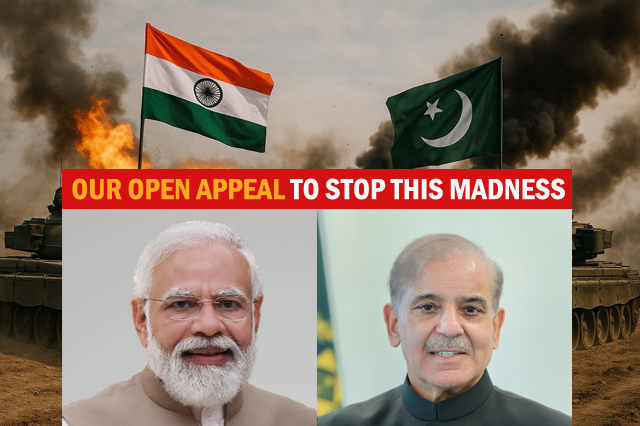
We, Sri Lanka Guardian, a small yet independent media entity with a publishing history spanning nearly two decades, vehemently oppose wars and violence that have shaped the destinies of South Asia for far too long. As a publication that has consistently stood for peace and justice, we are compelled by conscience—not by the selfish whims of power—to address you both.
We stand apart from the vast conglomerates that masquerade as media organisations, drenched in wealth and propaganda, for we know that war and violence only serve the interests of the elite, not the common people. Our role, as we see it, is to speak truth to power, expose failed policies, and demand that leaders recognise their unshakable responsibility to prevent further devastation. This is our moral duty: to defend the innocent whose lives are threatened by the reckless actions of those in power.
And yet, despite all the evidence of suffering and destruction that has plagued South Asia, you—the Prime Ministers of two of the most powerful nations in the region—continue to steer your countries into the abyss of conflict, trapped in a ceaseless, self-perpetuating cycle of vengeance.
It is with a profound sense of urgency and moral clarity that we address you both. Our words are not intended to appease or praise but to challenge, provoke, and, above all, demand accountability for the fate of millions who continue to pay the price for political decisions made in the comfort of your palaces, far removed from the realities of the lives you are entrusted to protect. The actions of both India and Pakistan have, time and again, exacerbated the suffering of their own people and the wider region, while perpetuating a violent history of antagonism. This conflict, driven by misguided nationalisms, geopolitical calculations, and personal vendettas, has infected the soul of South Asia, stalling progress, stunting development, and ensuring that peace remains an elusive dream.
Let us recall the first, glaring error that both India and Pakistan made at the very dawn of independence—the fateful decision to embrace violence as a political tool. The Partition of 1947, imposed upon the people by British colonial masters, was not simply an arbitrary separation of land but a deliberate act of divide and rule, executed by a colonial power seeking to consolidate its own fading dominance by sowing seeds of hatred among the subcontinent’s disparate communities. The bloodshed that followed, the forced migrations, the abductions, and the countless atrocities committed during this period cannot be erased from history.
The British rulers left behind a curse that continues to plague the subcontinent for generations. It transcended borders, not confined to the physical partition of territory but cutting deep into the hearts and minds of the people. The “divide and rule” strategy did not merely create territorial divisions; it sowed the poison of sectarianism, mistrust, and division.
For decades, South Asia has seen its people sacrificed at the altar of political machinations and military one-upmanship, with no regard for their hopes, dreams, or basic human rights.
Instead of confronting this curse with reconciliation, the leaders of both India and Pakistan chose to entrench themselves in the rhetoric of nationalism. While India, under Prime Minister Jawaharlal Nehru, embraced secularism and unity, Pakistan’s foundation was based on religious identity, which quickly spiralled into its own form of nationalism. The consequences of these choices, both ideologically flawed and politically motivated, have led to decades of bloody conflict, with Kashmir as the central battleground—but not the only one. Rather than healing the wounds of Partition, both governments chose to fuel them further, maintaining animosity for political gain.
Over the years, both India and Pakistan have cultivated a narrative of perpetual victimhood, leading to a violent and unhealthy competition for the title of “most aggrieved.” This toxic contest disregards the profound suffering of innocent civilians on both sides—those who have borne the brunt of war, terrorism, and militarisation. As a result, each new government has inherited a broken state, a fractured society, and a populace held hostage to the ideological battles of their forefathers. For decades, South Asia has seen its people sacrificed at the altar of political machinations and military one-upmanship, with no regard for their hopes, dreams, or basic human rights.
In this tragic history, we cannot ignore the role of political elites—the so-called “engineers of emancipation”—who have failed to transcend the prejudices and divisive ideologies they inherited. Whether they are monarchs, colonisers, or modern-day “democrats,” these figures have designed themselves as liberators, yet in reality, they have perpetuated systems of oppression and violence. The political elites in both India and Pakistan have, time and again, embraced the narrative of “us versus them,” inflaming passions for their own self-interest. They have created a culture of militarisation, where national pride is inseparably linked to the deaths of soldiers and civilians alike. And the tragedy is compounded by the fact that these elites, despite all the destruction, have failed to deliver on the promises of true emancipation—the promise of peace, stability, and prosperity for the masses.
It is the height of tragic irony that this land, once rich in its civilisational history, has become the battlefield for power-hungry leaders, with the very souls of its people sacrificed upon the altar of political expediency. Yet, beyond the corpses, the numbers, and the ever-increasing casualties, lies an uncomfortable truth: these wars were not only fought with bullets and bombs, but with the deliberate manipulation of the human spirit, dividing our people along artificial lines of religion, ethnicity, and nationalism. These lines were drawn by those who never truly had a stake in the land or the lives of its people. Whether it was the colonial masters who devised the divide-and-rule strategy or the political elites who took up their mantle, we have been subjected to their cold, heartless calculus. These architects of division—whether monarchs, colonialists, or later, the so-called democratic leaders—did not merely massacre bodies but sought to massacre our souls. The poison they injected into the veins of our politics has festered for decades, leaving a region crippled by perpetual mistrust, hatred, and violence.
Prime Ministers Narendra Modi and Shehbaz Sharif, you stand as the inheritors of this grim legacy. The decisions of your predecessors, laced with fear, ambition, and arrogance, have placed this region on a path where peace seems but an illusion. They have constructed empires of division, built upon a foundation of historical wrongs and politically charged memories. And yet, you too, like your predecessors, have perpetuated these cycles of violence, unable or unwilling to break free from the shackles of old grudges and outdated ideologies. The tragic reality is that you have allowed South Asia to remain a pawn in the hands of external powers, forces that seek to control, divide, and conquer for their own gains. While the lives of millions hang in the balance, the powers that profit from conflict—whether they be economic, military, or geopolitical—remain untouched, with their interests fully served.
The innocent people of South Asia, shackled by the mistakes of their leaders, continue to pay the price for decisions made by those who view war not as a tragic necessity, but as a tool for political manoeuvring.
Look no further than the record of your own actions. The tit-for-tat retaliatory strikes, the belligerent rhetoric, and the constant posture of hostility have only served to deepen the wounds that have plagued this region for generations. These actions are not only morally indefensible, but politically short-sighted. What is gained in these confrontations? Does either of your nations gain anything more than fleeting nationalistic pride, at the cost of human suffering and the stability of an entire region? The answer is clear: the cost is far too great, and the rewards, if any, are hollow.
The question must therefore be asked: when will this madness cease? The innocent people of South Asia, shackled by the mistakes of their leaders, continue to pay the price for decisions made by those who view war not as a tragic necessity, but as a tool for political manoeuvring. The tragic history of Partition remains a testament to this callous disregard for human life. Millions displaced, murdered, and silenced—this is the legacy you inherit. The blood of those innocents stains your hands, as it stains the hands of all those who have perpetuated this violence in the name of some greater political cause. And yet, the pain of Partition is not a distant memory; it is a living reality for those who continue to suffer in the form of communal strife, poverty, and instability.
Your nations, Mr. Modi and Mr. Sharif, possess the most destructive weapons known to humanity. Nuclear arsenals that could obliterate entire populations are in your grasp. And yet, this power has not brought peace; it has brought an even greater danger—the threat of escalation, the threat of annihilation. The balance of terror that has kept the peace between India and Pakistan is a fragile and hollow one, built not upon mutual understanding, but upon fear and mistrust. It is the very definition of the nuclear curse—an unholy pact that binds your nations to the perpetual risk of mutual destruction.
And in this context, the role of smaller nations like Sri Lanka becomes even more crucial. We, too, suffer the consequences of your failed leadership. Our people, who seek only peace and prosperity, are caught in the crossfire of your conflicts. The peace and stability of the region are constantly threatened by the machinations of those who care little for the lives of ordinary citizens. The Organisation of South Asian Association for Regional Cooperation (SAARC) lies impotent, a hollow shell that consumes the resources of its people without delivering any tangible results. The situation in South Asia is dire, and the clock is ticking. This region is on the verge of yet another calamity, one that could undo any hope for progress or development.
This is a moment for both of you, the leaders of South Asia’s most powerful nations, to rise above the petty squabbles of the past and come together in the name of peace. If there is any chance for the future of this region, it lies in your hands. You must stop this endless cycle of retaliation, where the innocent are the first to suffer and the guilty walk free. The failure to do so will ensure that the blood of future generations is on your hands.
Those who refuse to confront the truth, who continue to parrot lies over facts, are complicit in perpetuating cycles of violence.
If Pakistan is linked to any terror attack, as is often alleged by India, it must be the responsibility of the international community to ensure that justice is served. The legal and judicial processes that govern the global order must be upheld, not only to protect the rights of those affected but to ensure that the truth is sought in a fair and transparent manner. No longer should the lives of innocent civilians be held hostage to political games and military aggression. The international community must stand united in ensuring that those responsible for such heinous acts are held accountable.
But mere allegations without any substantive evidence, dressed up as national security imperatives, and fuelled by political vengeance, will not bring us closer to justice—they will only inflame existing hostilities. The warmongering media, gleefully serving as the mouthpiece of state propaganda, has unleashed a toxic narrative that silences dissent and vilifies entire populations. This will not awaken the slumber of deep denial—it only deepens it. Those who refuse to confront the truth, who continue to parrot lies over facts, are complicit in perpetuating cycles of violence. There can be no genuine peace if political convenience is allowed to trample over the demand for truth and accountability.
The time has come for South Asia to break free from the chains of external manipulation. The West, for too long, has used your conflicts to its own advantage. But now it is time for South Asia to stand on its own. The true path to freedom and prosperity lies in peace and cooperation—not in endless war. The future of this region will depend on your ability to set aside old grievances and work together for the betterment of your people.
Prime Ministers Modi and Sharif, upon you both, as the most powerful leaders in the region, with immense power and responsibility, rests the future of South Asia. The time for division, hatred, and blame is past. The Quran reminds us, ‘And hold firmly to the rope of Allah all together and do not become divided.’ (Quran 3:103), while the Bhagavad Gita calls for harmony: ‘In the selfless work of peace, there is no division or conflict.’ (Bhagavad Gita 5:2). The question now lies before you: will you follow the path of your forefathers, bound by their bitter divisions, or will you rise above their enmity, transcending the cycle of endless violence that has held South Asia captive for so long? As leaders of nuclear-armed nations, the weight of your decisions cannot be overstated. The Quran teaches us, ‘Whoever saves one life, it is as if he has saved all of humanity.’ (Quran 5:32). Will you heed this divine wisdom, recognising the sanctity of every life, or will you allow the blood of the innocent to flow yet again? The cycle of violence is not a destiny; it is a choice.
The choice is yours. Yes, the choice is yours. But, life belongs to us—and to the generations yet to come. Choose wisely , for the echoes of your decisions will resonate across generations, shaping the future of South Asia for centuries to come. The time for peace is now.
With hope for peace and a brighter future for South Asia,
Sri Lanka Guardian Editorial Team
Eric, Nil, Durga, Victor, and Luxman