A dramatic shift in Mongolia’s leadership is raising concerns about the country’s democratic future, as President Ukhnaagiin Khurelsukh, a former military officer and noted ally of Russian President Vladimir Putin, appears to have successfully ousted Prime Minister Luvsannamsrain Oyun-Erdene following weeks of political turmoil.
According to an exclusive report from The Times UK, Oyun-Erdene — a Harvard-educated former charity worker — lost a parliamentary vote of confidence last week, capping off a turbulent period of protests and internal party strife. He now serves as caretaker prime minister as parliament prepares to vote on a new appointee, Gombojav Zandanshatar, a close ally of the president.
The conflict, described by The Times as an “invisible struggle for authority,” has brought to light deep divisions between Mongolia’s two most powerful leaders. Oyun-Erdene, who took office in 2021, had pursued reforms including the creation of a sovereign wealth fund to reclaim partial government ownership of key mineral resources. While widely seen as a step toward economic independence, the move angered entrenched business interests and, reportedly, elements of the political elite.
“It is important that the next steps are properly carried out so that parliamentary democracy is strong and stable,” Oyun-Erdene told The Times in a candid interview following his ousting. He expressed concern that “those with no agenda, vision, [who] are only fighting over positions” could reverse the country’s democratic progress.
The prime minister’s downfall came amid public outrage over perceived corruption linked to his family, after social media posts by his son’s fiancée showcased signs of wealth including luxury goods and a Mercedes-Benz. While Oyun-Erdene has denied any wrongdoing and insists all family assets are accounted for through official means and personal business, the images helped galvanize a protest movement that culminated in mass gatherings in Ulaanbaatar’s Sukhbaatar Square.
Oyun-Erdene alleges the protests were not entirely spontaneous. “Some of the youth protest may have come out organically,” he told The Times, “but they were also deliberately organised as well.” He claims the campaign against him was politically motivated and intended to pave the way for Khurelsukh’s consolidation of power.
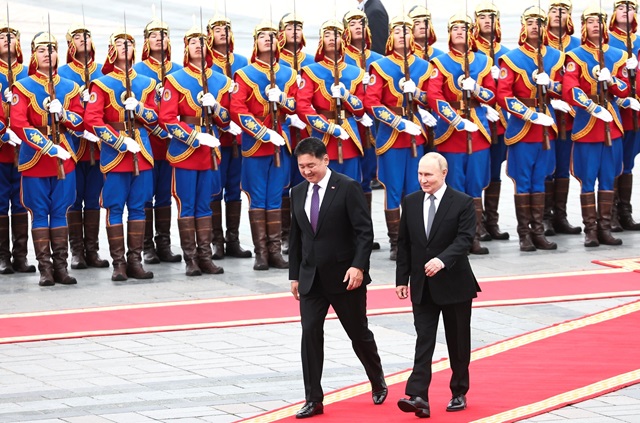
Mongolia, strategically situated between authoritarian giants Russia and China, remains heavily dependent on its neighbors for energy and trade. Khurelsukh, a former prime minister himself and now president since 2021, has strengthened ties with Moscow in recent years. His attendance at Russia’s Victory Day celebrations this May and his earlier hosting of Putin in Ulaanbaatar — despite an International Criminal Court warrant against the Russian leader — drew international criticism, particularly from Ukraine.
Sources close to Oyun-Erdene suggest that Khurelsukh’s long-term ambition may be to amend the constitution and remove the current single-term limit on the presidency. They describe the installation of Zandanshatar as a “puppet prime minister” as a potential step toward that goal. Parliament is expected to vote on Zandanshatar’s appointment this Thursday.
Under Mongolia’s constitution, executive power is divided between the directly elected president, who commands the armed forces and has influence over the judiciary, and the prime minister, selected by parliament to lead the cabinet. The delicate balance is now under strain as Khurelsukh appears to move toward consolidating authority in both spheres.
Mongolia, once a Soviet satellite, has made significant strides since transitioning to democracy in 1990. But with its small population, vast territory, and geopolitical vulnerability, the recent developments could signal a return to more centralized, authoritarian rule if current trends continue.
The office of President Khurelsukh has not responded to requests for comment.