


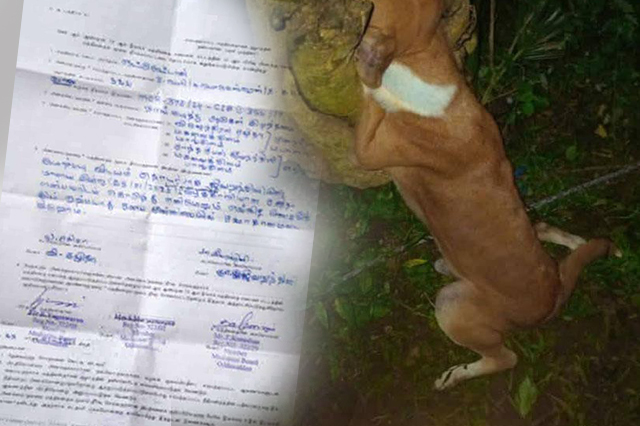
The gruesome spectacle of a dog being hanged in Oddusuddan, Mullaitivu, is not merely an isolated incident—it is a grotesque symptom of a society mired in the psychosis of cruelty, retribution, and medieval justice. In what could only be described as an affront to both humanity and animal rights, a dog, a helpless creature, was executed as a punitive measure for biting a goat. This grotesque act, ordered by a Mediation Board in a bid to settle a dispute between two families, is not just an indictment of a flawed legal system but a direct confrontation with Sri Lanka’s collective identity. It raises an urgent question: Is this truly the Sri Lankan identity we are prepared to defend, one steeped in barbarism and a perverse reversion to cruelty?
The order to hang the dog—and the subsequent execution of that order—carries with it a chilling resonance of dark ages long past. It is the language of vengeance, not justice; of punishment, not resolution. This is a collective failure to evolve from a primordial state of retribution into a civilised society where empathy, reason, and reconciliation would govern. For a nation that purports to be modern, this barbaric act reveals an uncomfortable truth: Sri Lanka, despite its claims of progress, has allowed its psyche to remain shackled to the chains of its medieval past.
Psychologically, this incident reveals a deep-seated malaise within the social fabric of the nation. It is not merely the act of hanging the dog that appals, but the inherent mindset that allowed it to happen. This is not an isolated aberration of individual cruelty, but rather a reflection of a collective consciousness that has internalised violence as a legitimate method of dispute resolution. To punish an innocent animal—who has no voice, no means of defending itself—as a proxy for human conflict, exposes a level of moral regression that is both horrifying and deeply revealing. It is a manifestation of an underlying psychopathy that thrives in the shadows of unchallenged authority, ignorance, and a society too willing to look the other way.
The psychoanalytic dimension of this tragedy cannot be overstated. Sigmund Freud’s theory of the “return of the repressed” seems painfully apt in explaining this savage act. What was repressed in Sri Lanka’s cultural unconscious—the progressive ideals of justice, empathy, and moral responsibility—has been violently resurrected in the form of this medieval spectacle. In a society that has yet to come to terms with its own post-colonial identity crisis, the trauma of centuries of oppression, conflict, and division finds expression in these inhumane acts. The decision to hang the dog is not merely a form of retribution against an animal but an eerie manifestation of the psychological scars of a society still marred by violence, unable to break free from its primitive impulses.
The fact that such an act was not only condoned but carried out with apparent indifference speaks volumes about the rot that lies at the heart of Sri Lanka’s legal and cultural systems. How, in 2025, does a society that presents itself as progressive still engage in such grotesque practices? How can we claim to be a modern nation when the language of justice we employ is so deeply entrenched in violence and barbarism? This tragic episode is a mirror—one that reflects the unhealed wounds of Sri Lanka’s psyche. It is not merely an isolated legal miscarriage, but a national reflection of a moral failure.
The arrest of the woman who posted the photograph of the hanging dog is, in itself, a cynical gesture. It is not the woman’s actions that should be under scrutiny, but the systemic and institutionalised cruelty that permits such acts to occur in the first place. To focus the conversation on a single individual while neglecting the deeper, more insidious societal forces that made this possible is a grotesque misdirection. The crime here is not the act of posting a picture—it is the act of hanging the dog, and the systemic indifference that allowed it to transpire. What does it say about the state of Sri Lanka’s law enforcement when the true culprits—the individuals who handed down this barbaric verdict—remain unpunished, while a woman is jailed for merely sharing an image of the carnage?
The reality we must confront is this: the hanging of a dog, in its raw savagery, is not just a symptom of one broken legal decision—it is a clear reflection of Sri Lanka’s collective psychosis. It exposes the deep fractures within a society that continues to cling to primitive, archaic notions of justice. It demonstrates that the legal system—at least in this instance—has not evolved; it has merely learned to mask its cruelty with the façade of formality. The system of mediation, which should have been a forum for resolution, instead became a conduit for state-sanctioned violence.
This is not just about a dog. It is about the cruelty embedded in the very fibre of Sri Lanka’s social and legal systems. It is about a nation that continues to define itself by violence—whether in the guise of political conflict, social injustice, or, as we now see, in the execution of a helpless animal. In this deeply unsettling episode, the true cost is not just the life of a dog, but the life of Sri Lanka’s collective conscience. Every individual complicit in this grotesque charade—whether by action or inaction—is responsible for the moral decay that has consumed our society.
The collective responsibility is one of profound guilt—a guilt that, until confronted, will continue to fester in the dark recesses of our social psyche. This is a nation that has failed to heal, a nation that still revels in bloodlust as a means of resolving conflict. We cannot afford to look away from the implications of this incident. To do so would be to condone the deep, disturbing regression of our collective morality.









This act of utter cruelty and barbarism is an act of lack of humanity but basically an utter lack of education on the part of the mediation board on a helpless animal.